









The proliferation of websites across various domains of everyday life has led to a significant rise in cybersecurity threats. The complexity and frequency of cyber-attacks have escalated dramatically, posing substantial risks to network infrastructure and digital systems. Unauthorized access attempts and intrusive actions have become increasingly prevalent, compromising the integrity and security of network environments. Network Intrusion Detection Systems (NIDS) have emerged as a critical mechanism to address these challenges. Particularly concerning are Distributed Denial of Service (DDoS) attacks, which can instantaneously overwhelm network resources by flooding systems with massive traffic volumes from multiple bot locations. These sophisticated attacks can render virtual networks inaccessible to legitimate users within seconds, underscoring the urgent need for robust and adaptive cybersecurity methodologies.
Researchers have proposed numerous techniques to address intrusion detection challenges, like the BAT method, combining attention mechanisms with Bidirectional Long Short-term Memory (BLSTM) to extract key traffic data characteristics. Some researchers have introduced multi-architectural modular deep neural networks to reduce false positives in anomaly detection. Others have proposed a hybrid network intrusion detection system integrating convolutional neural networks (CNN), fuzzy C-means clustering, genetic algorithm, and a bagging classifier. The Semantic Re-encoding Deep Learning Model (SRDLM) can also be used to improve traffic distinguishability and algorithmic generalization, as presented by the prior researchers. Despite these advancements, handling imbalanced datasets remains a significant challenge, often leading to biased classification results and necessitating sophisticated feature extraction and classification techniques.
Researchers from Amrita Vishwa Vidyapeetham, Center of Excellence, AI and Robotics, VIT-AP University, and Department of Mathematics, Faculty of Science, University of Lagos present a hybrid optimization-based deep belief network for DDoS attack detection, addressing critical challenges in intrusion detection systems. The proposed approach utilizes( a Stacked Sparse Denoising Autoencoder (SSDAE) capable of learning complex features through a layer-by-layer learning strategy, which enables better extraction of structural information from input data. By hybridizing optimization techniques with deep belief networks, the method aims to enhance DDoS attack detection accuracy, speed, and scalability. The research utilizes a hybrid firefly-black widow optimization algorithm, combining the randomness of firefly algorithm with the faster convergence of black widow optimization. This innovative approach seeks to overcome the limitations of existing techniques by improving global optimality and providing more effective real-time network protection against evolving cyber threats.
The proposed DDoS attack detection model comprises three primary modules: preprocessing data, imbalance processing, and classification decision. In the preprocessing stage, socket features undergo data cleaning and normalization operations to prepare the dataset. The imbalance processing module addresses data bias through a robust conditional Generative Adversarial Network (cGAN) approach, generating a fully balanced sampling dataset. The classification decision module employs a Stacked SSDAE to extract deep attributes from training data and perform classification. To mitigate challenges associated with random weight initialization, which typically increases training time and risks local optimum convergence, the researchers implement a firefly-Blackwidow optimization-based weight selection process. The framework targets binary class classifications using the CICDDoS2019 dataset, demonstrating its effectiveness in contemporary network environments through a comprehensive methodological approach.
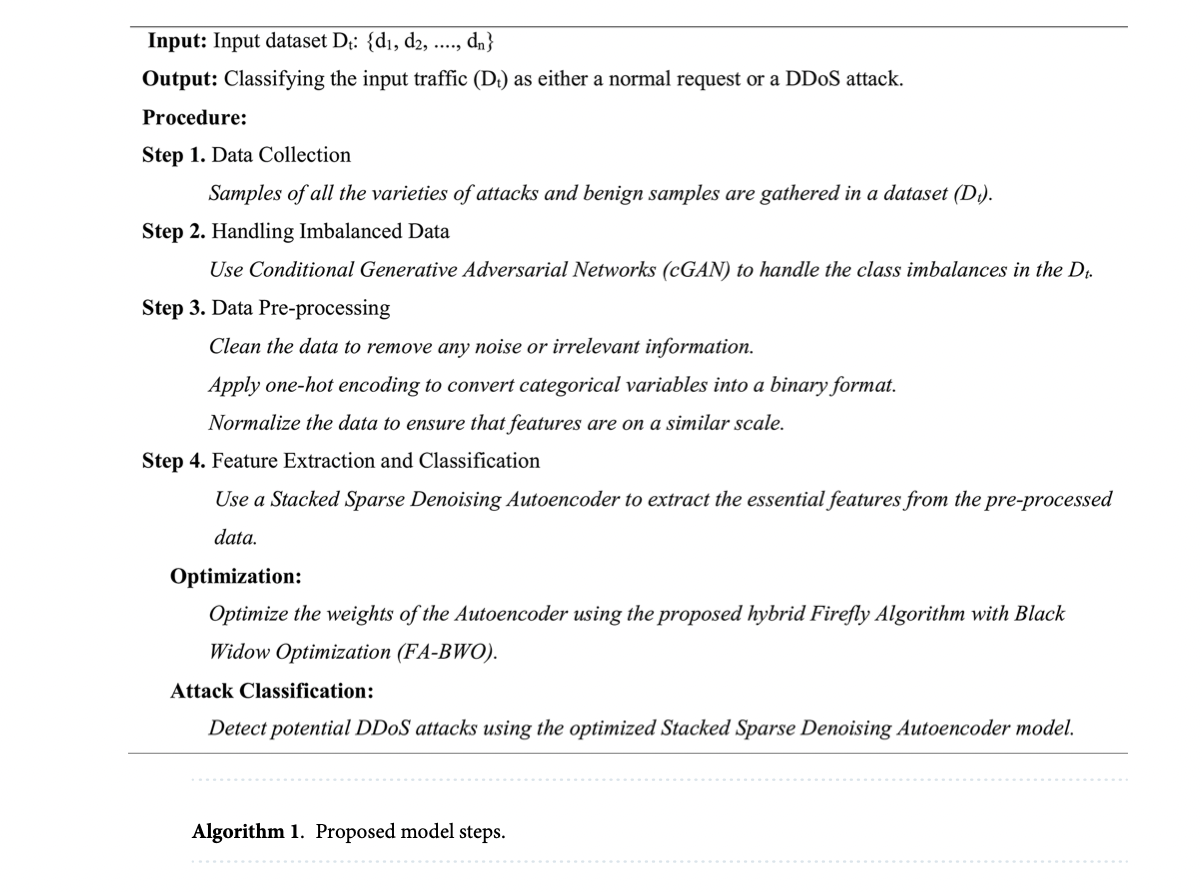
The proposed technique demonstrated exceptional performance across multiple experimental trials. In the initial experiment with imbalanced data, the model achieved remarkable metrics: 99.89% accuracy, 99.24% precision, 99.02% recall, and 99.39% F1-score. The Stacked Sparse Denoising Autoencoder (SSDAE) combined with black widow optimization produced superior precision and Area Under Curve (AUC) results. Following balanced data processing using cGAN, the performance further improved, reaching 99.99% accuracy, 99.81% precision, 99.26% recall, and 99.63% F-score. The significant performance enhancement is attributed to deeper learning models with larger batch sizes, fewer layers, and the effective cGAN approach, which reduced processing complexity and minimized local optimum challenges through the Firefly-Black Widow Optimization (FA-BWO) algorithm.


This research demonstrates the powerful potential of deep learning in enhancing intrusion detection systems against DDoS attacks. By integrating data pre-processing, CGAN-based balancing, and an SSDAE classification approach optimized through FA-BW hybrid algorithms, the method achieved exceptional accuracy rates of 99.89% for imbalanced and 99.99% for balanced datasets. Future research could explore multi-attack classification and incorporate explainability techniques to further advance cybersecurity strategies.
Check out the Paper. All credit for this research goes to the researchers of this project. Also, don’t forget to follow us on Twitter and join our Telegram Channel and LinkedIn Group. If you like our work, you will love our newsletter.. Don’t Forget to join our 55k+ ML SubReddit.
[FREE AI VIRTUAL CONFERENCE] SmallCon: Free Virtual GenAI Conference ft. Meta, Mistral, Salesforce, Harvey AI & more. Join us on Dec 11th for this free virtual event to learn what it takes to build big with small models from AI trailblazers like Meta, Mistral AI, Salesforce, Harvey AI, Upstage, Nubank, Nvidia, Hugging Face, and more.

Asjad is an intern consultant at Marktechpost. He is persuing B.Tech in mechanical engineering at the Indian Institute of Technology, Kharagpur. Asjad is a Machine learning and deep learning enthusiast who is always researching the applications of machine learning in healthcare.
Credit: Source link