
SARINYAPINNGAM
Can the Federal Reserve continue to engage in a policy of quantitative tightening in order to combat the inflation that is now being experienced throughout the world?
More and more evidence points to the fact that the Fed will not be able to sustain its battle even though it has gone through 15 months in which the amount of securities it holds outright has declined.
Why might this be the case?
Well, the problem is that the government’s fiscal policy is creating major amount of debt and the Federal Reserve must absorb a goodly amount of the government’s newly issued debt to keep the banking system and the financial system functioning.
For example, I have just quoted figures from the Congressional Budget Office.
The holdings of U.S. Treasury securities at the Fed will rise to $7.5 trillion by 2033. Currently, the Fed’s holdings of U.S. Treasury securities held outright amount to just over $5.0 trillion.
But, Michael J. Howell, author of the book “Capital Wars: The Rise of Global Liquidity” (Palgrave Macmillan: 2020), contends that this forecast is really quite unrealistic, primarily because of the growing need for greater military spending. Mr. Howell puts the number up to $10.0 trillion by 2033.
Fed liquidity, Mr. Howell projects, will have to face several years of double-digit growth!
The need for support of the banking system and the financial system has accelerated in a major way since the start of the century.
Remember that the U.S. government came into the 21st century carrying a surplus in its budget. President Bill Clinton and his Treasury Secretary Robert Rubin had worked through the 1990s to turn the U.S. fiscal situation around and actually produce some budgetary surpluses.
Of course, the surpluses did not last for long. President George W. Bush saw to that.
And, so budget deficits became the norm for the next twenty years or so.
Deficits and Surpluses (Federal Reserve)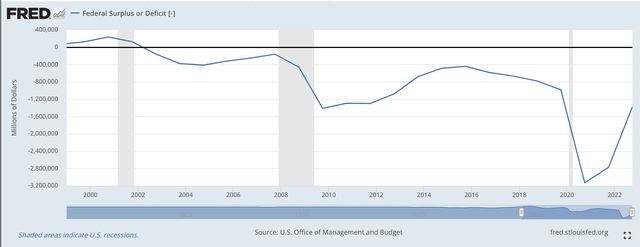
The big jumps in the deficits came as a result of The Great Recession n 2007-2009 and due to the spread of the Covid-19 pandemic in the early 20s.
But, the accumulation of debt during the twenty years or so, was major.
Federal Debt (Federal Reserve)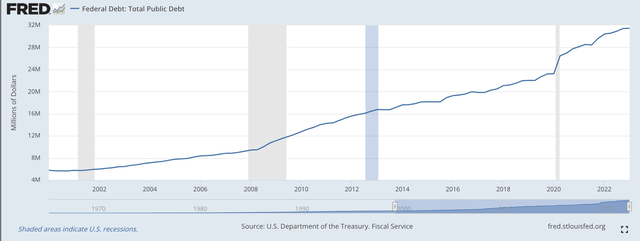
In the first quarter of 2001, when President Bush became president, the total debt outstanding was $5.8 trillion. In the first quarter of 2023, the total public debt outstanding totaled $31.5 trillion.
Federal Reserve Support
Did the Federal Reserve provide support for the U.S. Treasury Department?
Let’s look at the Fed’s balance sheet.
Securities Held Outright (Federal Reserve)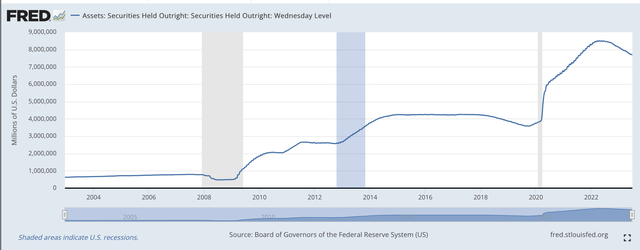
The Great Recession took place from December 2007 through June 2009.
Up through March of 2009, the total amount of securities held outright by the Federal Reserve totaled less than $800.0 billion…not even one trillion dollars.
One can see what has happened since then. (Of course the number began to drop after the middle of March 2022 and the Fed move into the policy of quantitative easing.
Note that before March 2009, the amount of securities held outright hardly changed over time.
Before the Great Recession, the Fed was not in the habit of expanding its securities holdings in a secular way in order to support the liquidity of the banking system and the financial system.
The Fed, did support the liquidity of the banking system as the economy moved through the business cycle, but, as can be seen from the chart, these hardly show up over time.
The Fed supplied liquidity needs to the banking system over the business cycle. It did not supply liquidity to support the system in a secular fashion as it did following the Great Recession.
This can be seen by looking at how the Fed managed the “excess reserves” of the banking system. On the Fed’s balance sheet, the proxy line item that can be related to the “excess reserves” in the banking system is titled “Reserve Balances” with Federal Reserve Banks. Here is the chart on this variable.
Reserve Balances With Federal Reserve Banks (Federal Reserve)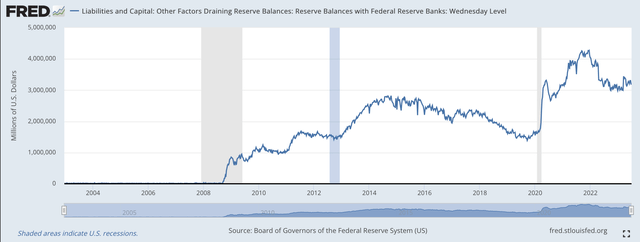
Notice that before the Great Recession, Reserve Balances with Federal Reserve Banks totaled no more than $50.0 billion and very often were somewhere around $10.0 billion to $20.0 billion .
The point here is that after the Great Recession, the Federal Reserve managed Reserve Balances with Federal Reserve Banks very differently than it did before the Great Recession.
SOMETHING CHANGED!!!!!
After the Great Recession, it appears as if the Federal Reserve moved to help support the expanding federal debt.
For one, the federal debt was growing faster than it had even grown before.
Secondly, the Federal Reserve wanted to keep down interest rates to reduce the cost to the government of the growing debt levels.
Furthermore, Federal Reserve chairman Ben Bernanke engaged in three rounds of quantitative easing over the last part of tenure as Fed chair.
Fed chairman Jerome Powell added a fourth round of quantitative easing before the dislocations of the Covid-19 pandemic hit the U.S.
One other point…the growth rate of the Monetary Base took off.
Monetary Base (Federal Reserve )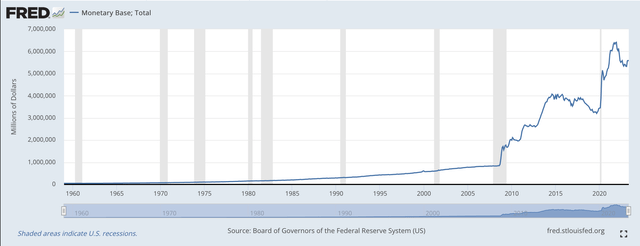
Like many of the other “monetary” series we have been talking about, the expansion of the Monetary Base was very modest going back to 1960.
After the Great Recession…SOMETHING CHANGED!!!!
Debt Support
Can the Federal Reserve continue to engage in a policy of quantitative tightening with the federal debt rising so strongly?
The growing market attitude seems to be that the Fed cannot continue to support quantitative tightening for much longer.
Look at the right-hand side of the chart on Reserve Balances With Federal Reserve Banks.
The Federal Reserve has continued to oversee the reduction in its portfolio of securities held outright. But, it has used other means, like relying upon Reverse Repurchase Agreements, to keep up the liquidity in the banking system.
Reserve Balances With Federal Reserve Banks (Federal Reserve)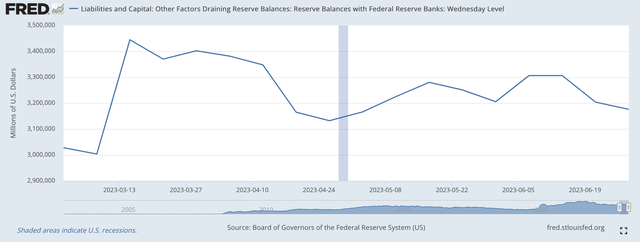
Note: commercial bank “excess reserves” have increased since the first week in March…that is, for four weeks, “excess reserves” have been rising.
If the Fed needs to keep the “excess reserves” so high, can it continue to keep letting the portfolio of securities held outright continue to decline?
Fiscal Policy and Monetary Policy
Right now, it looks as if the fiscal policy of the government and the monetary policy of the central bank are pushing in opposite directions.
Can this continue?
Who is going to win out?
Can the U.S. continue on with the world’s number one currency with such a battle going on?
I don’t think so. I think that the Biden administration has got to back off pushing its extreme fiscal program.
The program, as it stands, cannot be financed.
Credit: Source link