
I recently reviewed reMarkable’s Paper Pure, an e-paper writing tablet designed to be used in business meetings. The company markets itself as an almost analog space to think, pushing against the use of AI and the distractions of the digital age. Think of Cuneflow, then, as a rebuke of that philosophy, as its namesake e-paper writing slate has a built-in voice recorder to transcribe and extract insights from those very same business meetings. Is that a big enough draw for you to plonk down your money when it launches on Kickstarter?
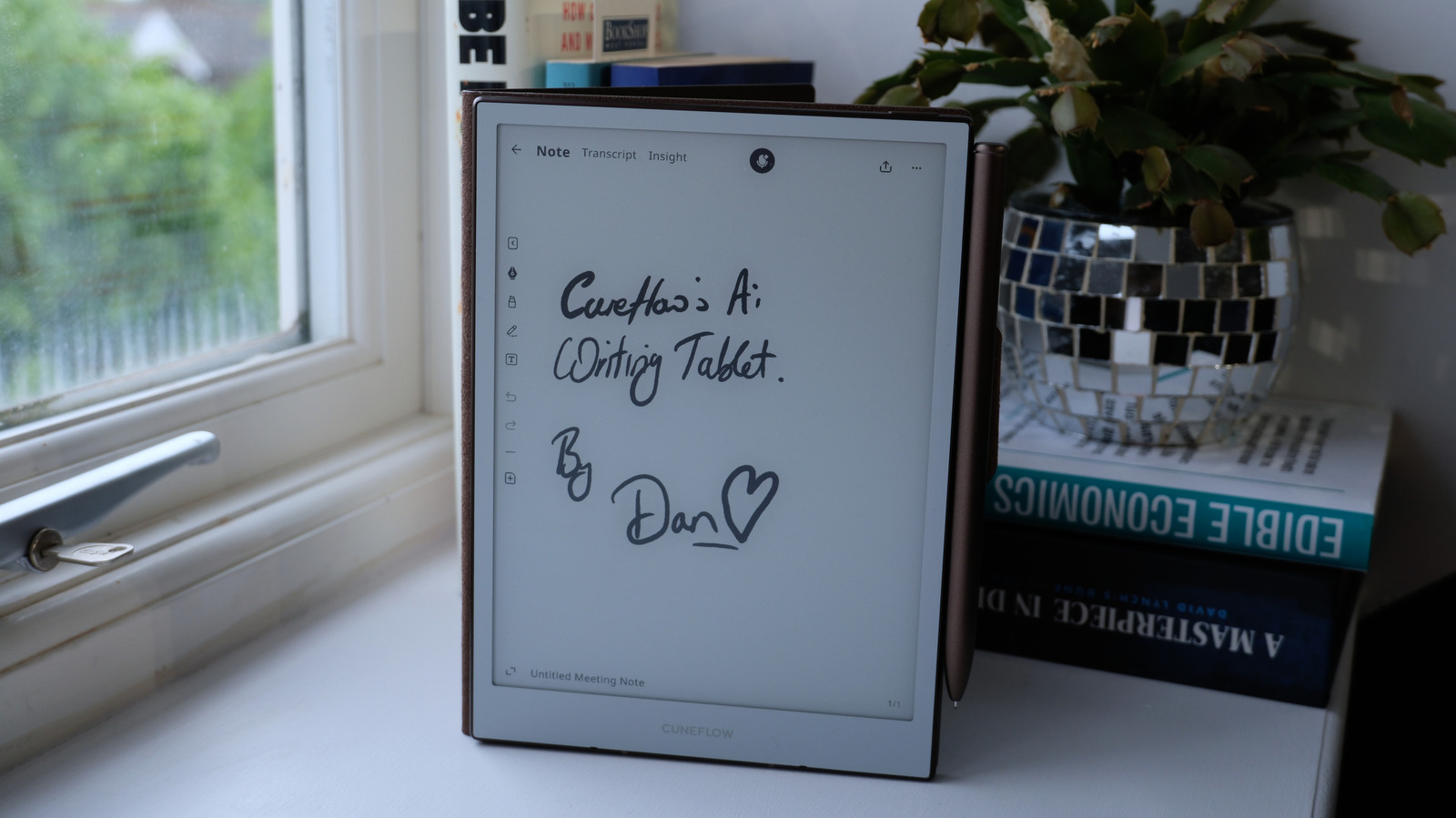
Cuneflow is an A5-sized e-paper writing tablet packing an 8.2-inch 1,920 x 1,440 E Ink Carta 1000 display. Magnetically attached to the side is a passive, pressure-sensitive Wacom EMR stylus, complete with button and eraser tip. Inside, you’ll find a 2 GHz dual-core ARM SoC with 4GB RAM and 128GB storage. There’s a 2,450mAh battery which is rated for 7-8 hours of continuous use, and a 24-level frontlight, enabling the slate to be used at any point of the day, which is key for a device like this.
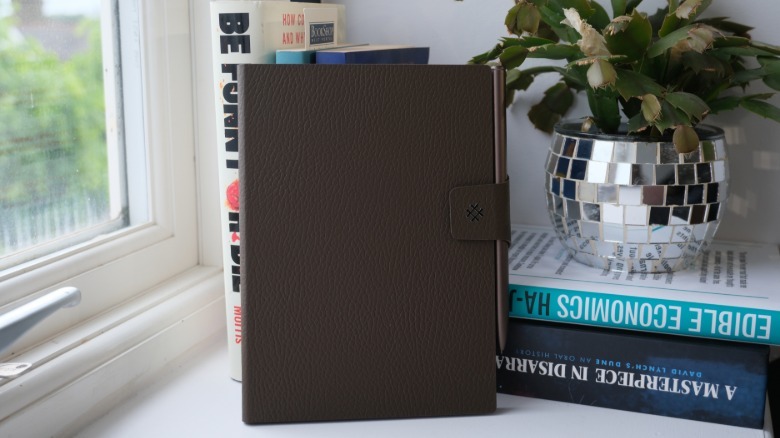
In addition to a lock screen password, you can use the power button as a fingerprint scanner for one-touch unlocking. The aluminum unibody case weighs 230 grams (8.1 oz), making it a little heftier than the equivalent Kindle. But it’s also got a heavenly sturdiness that makes you feel like you’re holding an ultra-premium device. Between that and the brown faux-leather folio, I get the sense the tablet’s creators wanted Cuneflow to feel as capital-C classy as they could.
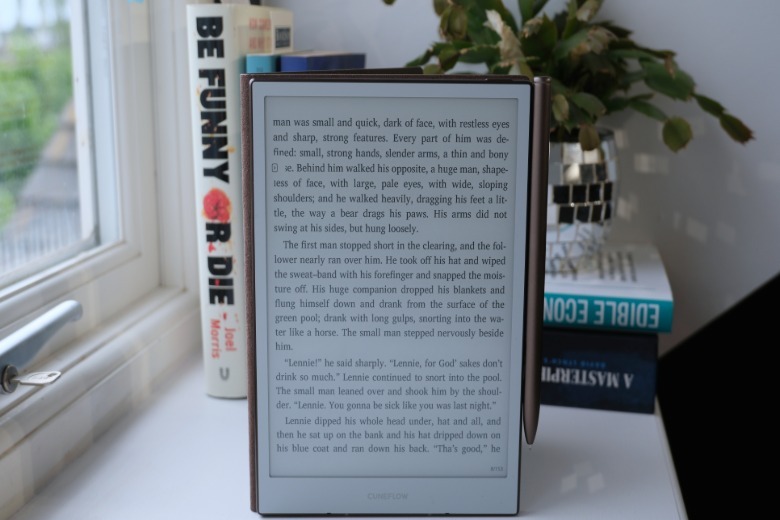
At the risk of sounding uncharitable, the operating system looks like someone pointed at a reMarkable and said “that, but let’s not get sued.” There’s a sortable two-column list of your notebooks, titled Meetings, and a separate tab for your Files. The latter is any PDF or EPUB file you wish to read on the slate, which you can transfer over via the company’s web client.
Each Meeting notebook is, as you might expect, a blank worksheet ready to accept your scrawls and doodles. The ceramic stylus nib is thin and scratchy, and there’s no sort of replacement tip in the packaging. I was surprised given the inherent risks of wear down, and that a nib that small could scratch the display cover (or just break).
As for the writing experience, it’s not bad, but you’re not going to forget you’re dragging a stylus on a screen. It’s tremendously responsive, and I don’t think I saw a single instance of lag or the display needing a refresh mid-way through writing a long paragraph. The persistent menu bar only has two options: pen or highlighter, the latter of which even on its lightest setting, makes it a lot harder to read your handwriting. If you want to tweak the weight of either, you’ll need to delve into a swipe-down-from-top-bezel menu, which is a little fussy. It’s nowhere near as polished and complete an experience as you’ll get using a reMarkable or even a Kindle Scribe.
Each notebook also has a microphone symbol that, when you tap it, will activate the slate’s recording mode which will offer a pretty instant transcription of the conversation. (You’ll also be able to see when the slate is recording, there’s a flashing red LED beside the USB port.) Once over, you’ll need to wait a minute or two for the AI-generated insights to populate on the next tab. Those include a summary, timeline and to-do list, as well as plenty of more niche options such as disagreements, key questions and potential risks.
 Daniel Cooper for Engadget
To appease security-minded folks, the audio is encrypted and piped to the cloud but not stored (Cuneflow lists OpenAI and Gemini as tools it uses). Once the words have appeared on the screen, the actual recording of what was said is wiped, with the AI-generated transcript all that remains. On the Insight tab, you’ll be able to identify where each conclusion came from, so you can double check if the system hallucinated. You can edit the transcript once completed, but you’d likely need to do those checks while everything’s still fresh in the meeting participants memory.
I can see the logical argument for the approach, but it’s something that won’t fit into everyone’s workflow. Maybe because journalism requires you to double and triple check a quote and, if it was contentious, I’d like to make sure I had a recording of whatever they said as proof. That’s probably not a concern if you’re running meetings with comparatively lower stakes, of course.
As far as I’ve seen, the transcripts are reasonably reliable, but struggle with some less common phrases. With so many AI-infused products, you shouldn’t expect gospel truth or reliability from it — it successfully realized I was saying “Phoenix Corporation” once, but misspelled it as ‘Felix Corporation’ the second time.
One problem with the Cuneflow is that there’s lots of quite useful tools in here, but there’s no way to make them cohere. For instance, in the AI-generated meeting insights tab, there is a to-do list with tickboxes for each action item. But you can’t actually tick them off with the stylus or your finger, which seems a little silly. And there’s no way to easily pull text from the transcript or the Insights tab and put it in the notebook section for you to doodle, edit or highlight.
 Daniel Cooper for Engadget
There’s a similar lack of joined-up thinking in Cunespace, the company’s web client where you can send files to the slate. You can look at your Meetings online, but you can’t interact with the transcripts or tick off the aforementioned to-do lists. Which means you’re left copypasting any material you need from your Cunespace to whatever document you’re using elsewhere.
I was overjoyed to learn you could connect a Bluetooth keyboard to the slate for ease of writing but, alas, my joy didn’t last long. Unfortunately, you need to open a text box inside the document and then expand it, a process which is deeply fiddly. And there’s no way for the box to grow to accommodate your text as you write more, unless you manually pull the handles wider. (Not to mention there’s no way to reorient the display to landscape, which is less than ideal.)
Part of this comes from being a young company with its first product, but also because of the limits of what these devices can do. After all, these sorts of distraction-free paper tablets are built to impose sometimes unnecessary roadblocks on our actions. Much like with reMarkable, once you’ve created a file on the slate, there’s no elegant way to pull that information out and work it in the traditional manner. Consequently, I’m not sure right now if it’s even possible to join the bifurcated use cases in a way that would make sense.
Unfortunately, there’s no word yet on how much Cuneflow will cost — the company says it’ll be “within the average market range,” with early backers getting a discount.
Credit: Source link