











































Hiroshi Watanabe
Thesis
Calamos Investments is a manager best known for their convertible securities closed end funds, but they are now making a push into the ETF space, namely into the ‘buffer ETF’ niche:
Buffer ETFs are funds that seek to provide investors with the upside of an asset’s returns (generally up to a capped percentage) while also providing downside protection on the first predetermined percentage of losses.
Source: Charles Schwab
As per Charles Schwab, buffer ETFs have become one of the fastest-growing corners of the ETF market, with over $27 billion in assets under management for this strategy.
Calamos S&P 500 Structured Alt Protection ETF – May (NYSEARCA:CPSM) is one of the funds which falls in the ‘buffer ETF’ strategy umbrella. Unlike other names, the Calamos fund offers 100% downside protection:
Calamos Structured Protection ETFs are designed to match the positive price return of the S&P 500® up to a defined cap while protecting against 100% of losses over a one-year period (before fees and expenses).
In this article, we are going to have an in-depth look at CPSM, its structuring and return profile, and highlight why it is a very robust fund to buy for equity exposure in today’s stretched markets.
What does CPSM actually do?
CPSM aims to track the S&P 500 on a 1-year outcome period, with a 9.81% capped upside. Therefore, as an investor, you will never make more than 9.81% during an outcome period, but at the same time the fund protects 100% of your downside – i.e. you do not lose money. The worst-case scenario here is a 0% return minus the fund’s expense ratio of 0.69%:
Information (Fund Website)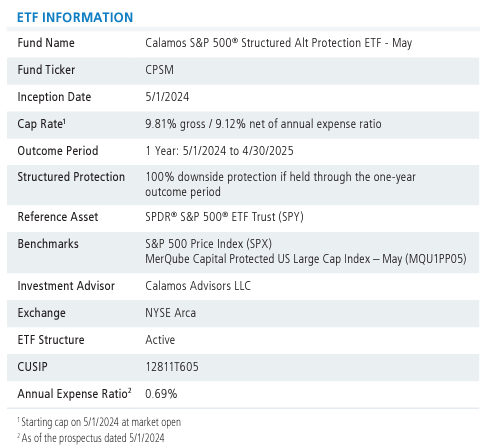
The outcome period ends on April 30, 2025, and the fund has a $25/share IPO price.
In the best-case scenario, an investor can make 9.81% minus the expense ratio, while any increases in the S&P 500 above that level are not captured.
How does CPSM actually do this?
Many retail investors are probably bemused at the ongoing financial engineering, and would like to understand how this is possible. Let us walk you through how the fund achieves its goal.
If a retail investor goes to the ETF’s website, they can find the current holdings:
Holdings (Fund Website)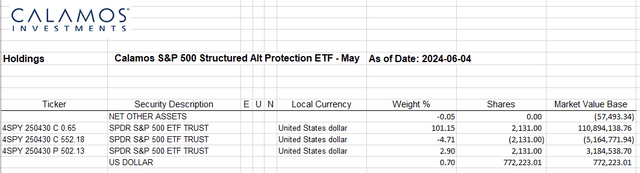
One will notice the fund holds a very high delta 0.65 strike call (long), sold a 552 strike call, and bought a 502 strike put. To note, the S&P 500 was at 502 on the first day of the outcome period, namely May 1, 2024.
The fund therefore can fully protect its downside via the purchased put, which was partially financed from the sold call at 552. An investor needs to understand though that these options are not standard American options traded on the NYSE, but customized ‘Flex Options’:
The Fund is designed to provide point-to-point exposure to the price return of the reference asset via a basket of Flex Options. As a result, the ETF is not expected to move directly in line with the reference asset during the interim period. Investors purchasing shares after an outcome period has begun may experience very different results than fund’s investment objective. Initial outcome periods are approximately 1-year beginning on the fund’s inception date. Following the initial outcome period, each subsequent outcome period will begin on the first day of the month the fund was incepted. After the conclusion of an outcome period, another will begin.
Flex options are customized European option (i.e. they can get exercised only on their maturity date) and their mark to market will be different from a standard exchange traded option. The pricing thus is more advantageous; thus, the manager can look at taking advantage of the skew in the market to fully protect the downside.
Now let us see how different the pricing is for flex options versus American options. If we look currently in the market, we can gauge the pricing of current at the money puts, and 9% out of the money calls:
- June 20, 2025 530 strike put costs $23.5/contract
- June 20, 2025 580 strike call (9.1% upside) costs $18.5/contract
- The net cost therefore is 23.5-18.5, equaling $5/contract
A retail investor with a position in the SPY right now needs to spend $500 for each $53,000 in notional in order to fully protect the downside while capping the upside at 9.1%. This is the cost via American options traded on the NYSE currently. Furthermore, you cannot buy deep in the money call options, with the highest delta one offered at a strike of 150.
Flex options are customized contracts which allow for better pricing given the discrete exercise date and the unique features. The current skew environment where investors seem to buy more calls than puts also favors the structuring for CPSM.
Make no mistake, in a down market, CPSM would have not been able to offer the same downside protection with the upside offered. On the outcome period date, the fund will need to price the next batch of flex options based on the equity conditions at that time.
Why this fund is attractive over an outright SPY buy for certain investors
CPSM is a fund for conservative investors who are concerned about a market crash. Nobody wants to see their investment portfolio burn down and incur significant drawdowns in a down market, thus the appeal for ‘buffer ETFs’ such as CPSM. A 9% upside on a 1-year time frame is a figure which most investors would find attractive on a net basis.
If you are an investor concerned with drawdowns then CPSM is for you. In the worst-case scenario, a 1-year investment in this fund from current levels can result in a loss equating to the fund expense ratio. Given the purchased put, even a -30% market drop would not impact the fund price upon the April 2025 expiration for the options.
Conclusion
CPSM is a new ‘buffer ETF’ from Calamos. The vehicle offers a capped 9% upside versus a fully protected downside. The fund utilizes 1-year Flex Options, and a prospective investor needs to hold the fund for the outcome period in order to obtain the full benefits of the fund’s structuring. With stretched equity markets, we like CPSM over an outright SPY purchase here.
Credit: Source link








