
sframephoto
While it was a rough start to the year for the Gold Miners Index (GDX), the index has bounced back sharply since March. This has continued the pattern of back-to-back 5% plus declines in January and February for the Gold Bugs Index resulting in significantly above-average returns in March, with the Gold Bugs Index outperforming nearly all other ETFs in March 2024 with a double-digit gain. Fortunately, the index has seen continued follow-through into April and is now even outperforming the Nasdaq Composite (COMP.IND) year-to-date.
Gold Bugs Index Monthly Returns Q1 – Author’s Data & Table
One of the best performers has been Coeur Mining, Inc. (NYSE:CDE), which will enjoy its highest average realized gold price in H1 2024 on record, even with the impact of hedges added in Q4 2023. In this update, we’ll dig into the company’s FY2023 results and its valuation relative to peers after its significant rally.
Q4 & FY2023 Production
Coeur Mining (“Coeur”) released its Q4 and FY2023 results last month in late February, reporting quarterly production of ~101,600 ounces of gold and ~3.1 million ounces of silver, and ~317,700 ounces of gold and ~10.3 million ounces of silver, respectively. This translated to a 4% dip in annual gold production, partially offset by a 5% increase in silver production.
Lower gold production was related to a softer year at Palmarejo (lower gold grades, recoveries, and throughput) and a sharp decline in production at Kensington (Alaska), with production down over 22% year-over-year to ~84,800 ounces (FY2022: ~109,100 ounces), also because of lower grades, recoveries, and throughput. On a positive note, Q4 gold production hit a multi-year high at ~101,600 ounces, helped by a much better Q4 from Rochester with ~19,800 ounces of gold produced. The increased production was driven by ounces recovered from the new leach pad, and Coeur has since declared commercial production on March 31st. Let’s inspect the results below:
Coeur Mining Quarterly Metals Production – Company Filings, Author’s Chart Coeur Mining – Quarterly Silver Production – Company Filings, Author’s Chart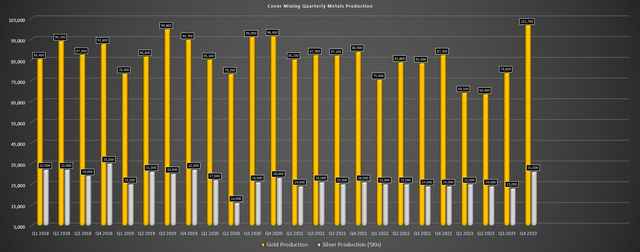
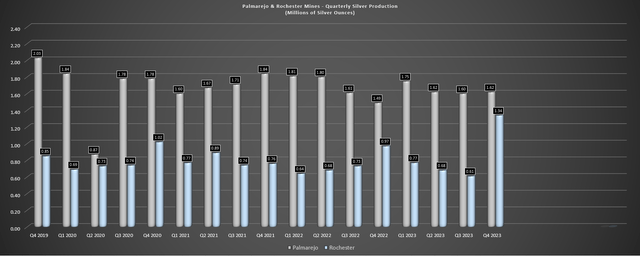
Starting with silver production, it was a better year overall for Coeur, with production of ~10.3 million ounces of silver and sales of ~10.1 million ounces (FY2022: ~9.8 million ounces), translating to higher silver-related revenue helped by a higher average realized silver price.
The increase in silver production was related to higher silver output from both Rochester and Palmarejo, with the former benefiting from the much-awaited Rochester Expansion and the latter benefiting from higher silver grades at 0.45 ounces per (FY2022: 0.41 ounces per ton). This helped the company to increase silver sales to $245.5 million (+15% year-over-year) to ~30% of total revenue, up from ~27% in the year-ago period. And while we did an improvement in silver production year-over-year, silver production increased materially in Q4, with ~3.1 million ounces of silver produced, up from 2.4 million ounces in Q4 2022. The increase in silver output is expected to continue into 2024, with the Coeur guiding for ~12 million ounces at the midpoint (+16% year-over-year).
Rochester Mine – Company Website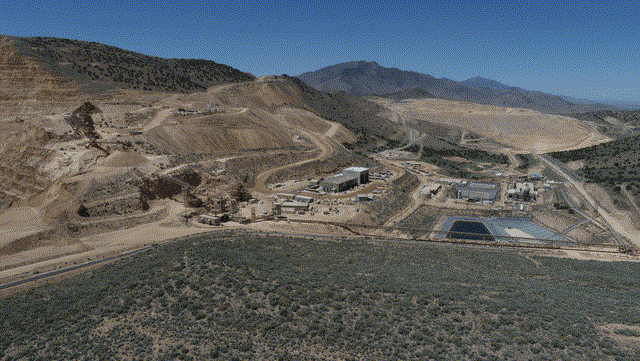
As for its gold operations, Wharf (South Dakota) had a solid year with ~93,500 ounces of gold produced at an adjusted cost of sales [CAS] of $1,152/oz, improving from ~79,800 ounces at $1,281/oz in FY2022. This solid performance translated to ~$82 million in mine site free cash flow, trouncing its FY2022 mine site free cash flow figure of ~$30 million. And while Kensington didn’t fare as well with much lower production and a significant decline in free cash flow generation (free cash outflow of ~$49 million vs. positive free cash flow of ~$11 million in FY2022), this was partially because of significantly higher capex, with this year being the last year of elevated drilling and development with a goal of extending the mine life and returning to consistent free cash flow generation.
Unfortunately, despite the impressive year at Wharf and higher gold production at Rochester, Coeur still delivered below its guidance midpoint of 11 million ounces for silver (10.3 million ounces) and came in below its downward revised guidance midpoint of 328,000 ounces of gold with just ~317,700 ounces produced last year.
I have shown another gold producer by comparison, K92 Mining (OTCQX:KNTNF), which has led the sector in per share growth, showing that there are smaller producers that have grown per share metrics consistently and highlighting how poorly Coeur stacks up.
Coeur Mining – GEOs Produced * Shares Outstanding Per Ounce Produced – Company Filings, Author’s Chart K92 Mining Share Count, Annual GEO Production, Forward Estimates & GEO Production Per Share – Company Filings, Author’s Chart & Estimates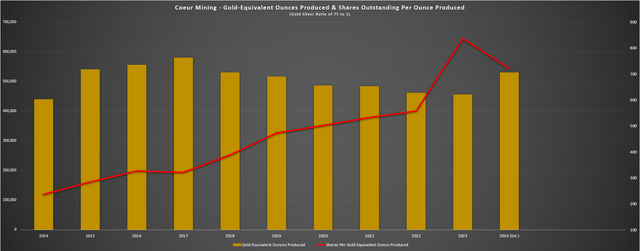
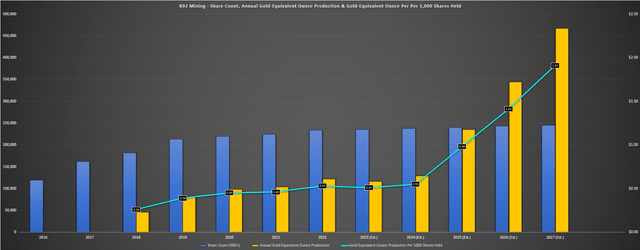
Unfortunately, while production was relatively flat for the year, we saw a further decline in production per share, with the number of shares that an investor needed to hold per gold-equivalent ounce [GEO] produced increasing by over 25%. This was related to a significant increase in the share count from ~290 million shares in February 2023 to ~380 million shares most recently, making Coeur a leader once again sector-wide from a share dilution standpoint among its mid-tier producer peer group despite no major acquisitions. And while Calibre Mining (OTCQX:CXBMF) saw similar share dilution year-over-year (February 2023 to February 2024), it acquired a ~200,000 ounce per annum asset in a Tier-1 ranked jurisdiction to transform its portfolio. Elsewhere, B2Gold (BTG) did the same, adding one of the highest-grade open-pit projects globally in a Tier-1 ranked jurisdiction for ~20% dilution.
And while Coeur has seen an upgrade to its portfolio with the recently completed Rochester Expansion, the growth in production hasn’t nearly measured up to the share dilution. This is because Coeur’s share count is up ~60% since 2020. When it began early-stage earthworks, it had to divest assets it previously purchased in the process (Sterling/Crown), and is still sitting on a mountain of debt (~$550 million). In fact, Sterling was expected to be a high-margin asset to bolster the company’s Nevada production and benefit from tax loss synergies, but it was sold to AngloGold Ashanti to ensure it could complete its Rochester Expansion after the significant capex blowout.
The point is that not all share dilution is equal, and Coeur has still seen a significant decline in production per share over the five-year period (2020-2025), even adjusting for the upcoming growth from the Rochester Expansion, while others have maintained their track record of per share growth.
Coeur Mining Capital Expenditures & Free Cash Flow – Company Filings, Author’s Chart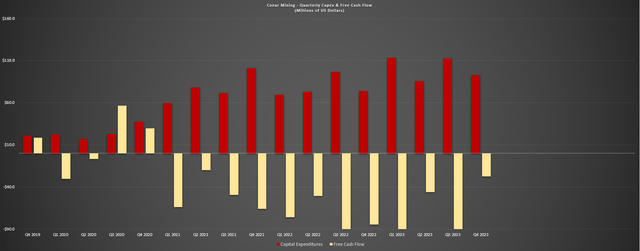
Finally, looking at Coeur’s financial results, the company reported revenue of ~$821 million (+5% year-over-year), an adjusted net loss of $78 million (FY2022: ~$89 million net loss), and a free cash outflow of $297 million (FY2022: free cash outflow of ~$327 million). This resulted in the company ending the year with ~$483 million in net debt, with the significantly negative free cash flow related to elevated capex at Rochester (~$230 million), elevated operating costs at Rochester (~$1,922/oz gold and ~$23.97/oz silver), and a stronger Mexican Peso at Palmarejo.
Fortunately, while these financial results are dismal, 2024 is looking a lot better. Let’s take a look at costs and margins.
Costs & Margins
As for costs and margins, there wasn’t much to write home about either, with adjusted CAS per gold ounce increasing to $1,355/oz (FY2022: $1,300/oz), while adjusted CAS per silver ounce increased to $18.10/oz ($17.00/oz). The cost increases were not overly surprising as the sector dealt with another year of inflationary pressures, with Coeur calling out impacts from higher consumables costs, and the stronger Peso didn’t help at Palmarejo.
On a positive note, adjusted CAS margins per silver ounce improved slightly year-over-year despite the increase in costs, helped by a higher average realized gold price of $24.21/oz. And while costs were brutal again at Rochester in 2023, the company is guiding for much more respectable in the second half once the Rochester Expansion fully ramps up, with expectations for adjusted CAS per silver ounce of $15.00/oz and adjusted CAS per gold ounce of $1,300/oz from this massive heap-leach operation.
Coeur Mining – Adjusted Costs Applicable To Sales Per Silver Ounce & Adjusted CAS Margin – Company Filings, Author’s Chart Coeur Mining Adjusted CAS Per Gold Ounce & Adjusted CAS Margins Per Ounce – Company Filings, Author’s Chart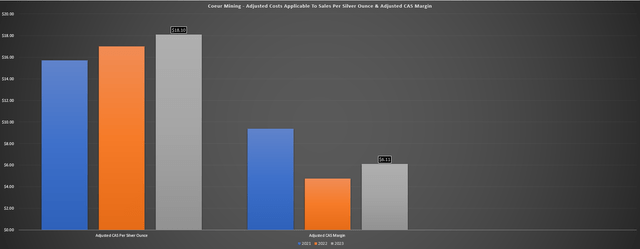
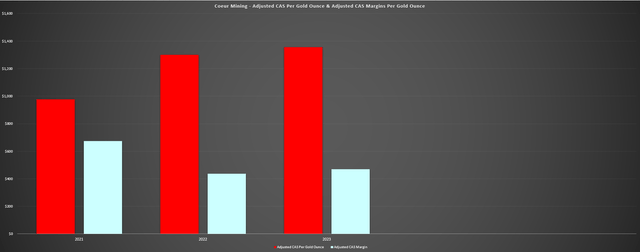
As for Coeur’s adjusted CAS per gold ounce, we also saw a moderate improvement in margins, helped by the higher gold price ($1,825/oz vs. $1,736/oz), and a better year from Wharf. And while costs are expected to increase year-over-year at Palmarejo with a guidance midpoint of ~99,000 ounces of gold and 6.3 million ounces of silver at $1,175/oz gold (FY2022: $957/oz) and $17.00/oz silver ($15.09/oz), the company is certainly getting some help from higher metals prices, which are more than offsetting the higher year-over-year costs. Let’s take a closer look below:
2024 Outlook & Recent Developments
As noted in my article on Gold Royalty Corp (GROY) last December, gold was looking primed for a significant breakout given that the more tests it saw of the $2,070/oz level and the shallower its pullbacks became, the more likely it was to charge through this level to all-time highs. Since then, we’ve seen a successful breakout and follow-through, and the metal is on track for two consecutive closes above the important $2,100/oz level. And while this is great news for high-margin producers like that, as they should enjoy $1,200/oz plus AISC margins this year, it’s even better news for marginal producers like Coeur Mining that will finally see positive free cash flow with the help from commodity prices.
Gold Monthly Chart – December 2023 Gold Monthly Chart – StockCharts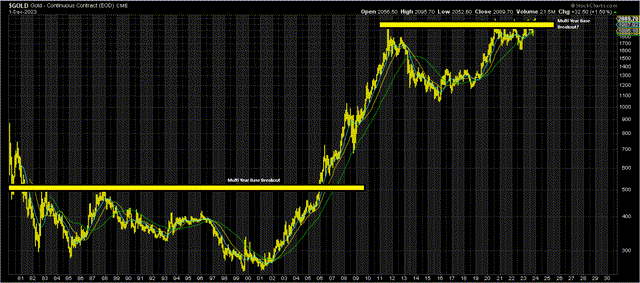
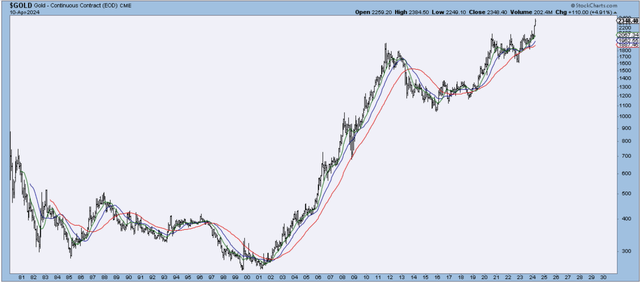
In fact, the persistent strength in the Mexican Peso over the past two years, which affects its largest Palmarejo Mine, has been more than offset by a sharp rise in gold and silver prices. And while the company won’t see the full benefit of these higher prices given that it sells close to 40% of its gold at Palmarejo to Franco-Nevada (FNV) at $800/oz under its stream and has hedged ~95,000 ounces of gold production (~$2,070/oz) and ~3.1 million ounces of silver production at ~$25.10/oz in H1 2024. Fortunately, these hedges will roll off in 2024, and less than ~20,000 ounces will be impacted in the second half of the year if Coeur doesn’t add additional hedges, with just Palmarejo stream ounces affecting its average realized gold price.
As an example of the impact of the Palmarejo gold stream, Coeur’s average realized gold price at this asset in 2023 was $1,565/oz, well below the average realized gold price sector-wide of ~$1,900/oz.
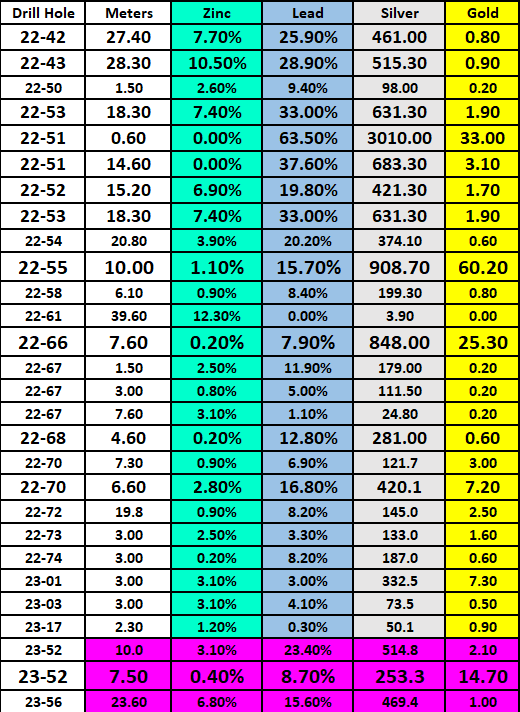
Finally, while I expect its Silvertip Project to be still at least four years out from a restart given that the focus is on debt pay down near term, the company has continued to report solid intercepts from this project with carbonate replacement deposit mineralization. In fact, the company reported its best intercept to date at the Southern Silver Zone, with 4.9 meters at 1,261 grams per ton of silver, and 44.4% lead/zinc or 4.9 meters at ~33 grams per ton gold equivalent. While this intercept pales compared to some of the best intercepts coming out of i-80 Gold’s (IAUX) Ruby Hill CRD discovery in Nevada, with i-80 reporting highlight intercepts of 10.0 meters at ~77 grams per ton gold-equivalent, 7.6 meters at ~39 grams per ton gold-equivalent and 28.3 meters at ~22.3 grams per ton gold-equivalent, it’s a solid intercept that should help to grow what’s already an impressive resource at Silvertip, with over 70 million ounces of silver.
Silvertip Project Resources – Coeur Presentation i-80 Gold – Upper Hilltop Drill Highlights (Ruby Hill) – Company Filings, Author’s Chart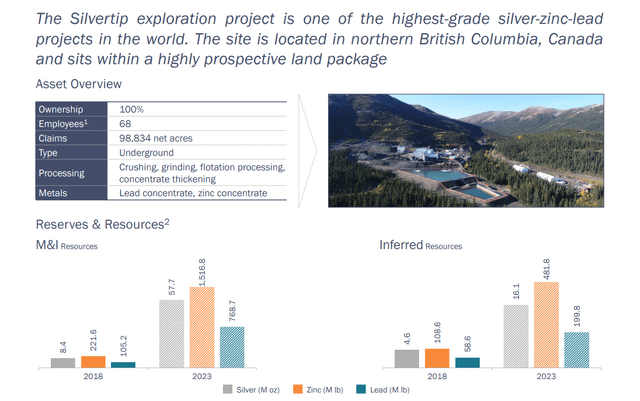
Overall, Coeur is certainly seeing a very favorable setup fundamentally, with costs at its massive heap-leach operation set to decline at the same time as gold and silver prices have enjoyed significant gains. This has set up a much better margin outlook for 2024 even if production is expected to be up only moderately year-over-year. Simultaneously, while lead and zinc prices may not be doing much, Silvertip certainly looks a lot better at $26.00/oz plus silver prices than it did at $20.00/oz – $23.00/oz silver where the metal has averaged out over the past few years.
Hence, I think there’s certainly reason to be optimistic about this asset restarting with robust economics, even if it is still a few years away and will require a hefty capex bill based on their plan to look at a higher throughput rate.
Valuation
Based on ~400 million shares and a share price of US$5.10, Coeur Mining is trading at a market cap of ~$2.04 billion and an enterprise value of ~$2.50 billion. This makes it one of the most expensive producers sector-wide on an EV/FCF standpoint, trading at over 55x EV/FCF based on more conservative free cash flow estimates of $45 million in 2024 ($2,175/oz gold price assumption with impact of hedges). This compares to other names like Endeavour Mining (OTCQX:EDVMF) which trades at ~5x FY2025 EV/FCF with a 5.0%+ shareholder yield, and B2Gold, which also has better assets, pays a 5.0%+ dividend yield, and trades at barely 5x FY2025 free cash flow estimates using a $2,200/oz gold price assumption.
CDE Shares Outstanding – TIKR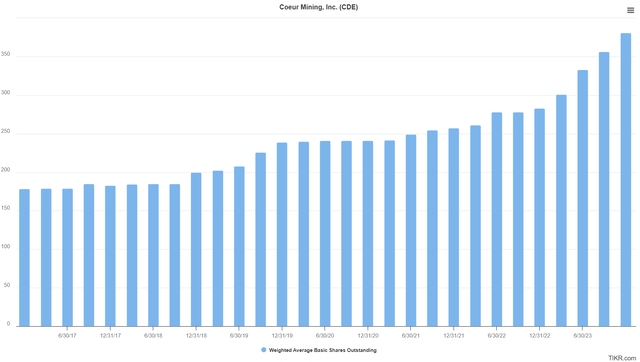
Plus, even if we look ahead to FY2025 with higher production and lower capex and maintain the benefit of higher gold prices, Coeur is still trading at ~21x EV/FCF and ~1.1x P/NAV, a steep multiple for a company that has struggled to create shareholder value with consistently declining per share metrics. Obviously, valuation alone does not dictate where a stock price will go, but based on what I believe to be more conservative multiples of 1.2x P/NAV (silver exposure) and 7.0x FY2025 cash flow estimates and a 65/35 weighting to P/NAV vs. P/CF, I see a fair value of US$5.20, pointing to limited upside from current levels. Hence, while this has undoubtedly been a great run for the stock, I see the reward/risk setup as much less favorable at current levels.
Assuming one wants to model much higher gold and silver prices and assume prices at spot levels or higher, there is no arguing that CDE could higher. However, I prefer to model using conservative gold price assumptions and find what’s undervalued at these prices to ensure an adequate margin of safety. And even using gold prices of $2,200/oz this year for Coeur Mining to take into the impact of its H1 2024 hedges and stream impacts at Palmarejo, I don’t see a ton of upside from here, so I don’t see any way to justify chasing the stock above US$5.20.
Summary
Coeur had another disappointing year in 2023 with significant share dilution relative to its producer peers, continued net losses, and a massive free cash outflow. However, Coeur Mining, Inc. is finally past the hump of significant capital expenditures at its Rochester Expansion and will begin to enjoy the fruits of this labor with fortunate timing as gold prices soar to new highs. However, using more conservative gold price assumptions, the stock is not cheap, and remains one of the most expensive names sector-wide on an EV/FCF standpoint, and especially when adjusted for overall quality. Hence, if I were looking to put new capital to work in the sector, I think there are more attractive opportunities, which I discuss with my Investing Group subscribers.
Editor’s Note: This article discusses one or more securities that do not trade on a major U.S. exchange. Please be aware of the risks associated with these stocks.
Credit: Source link