












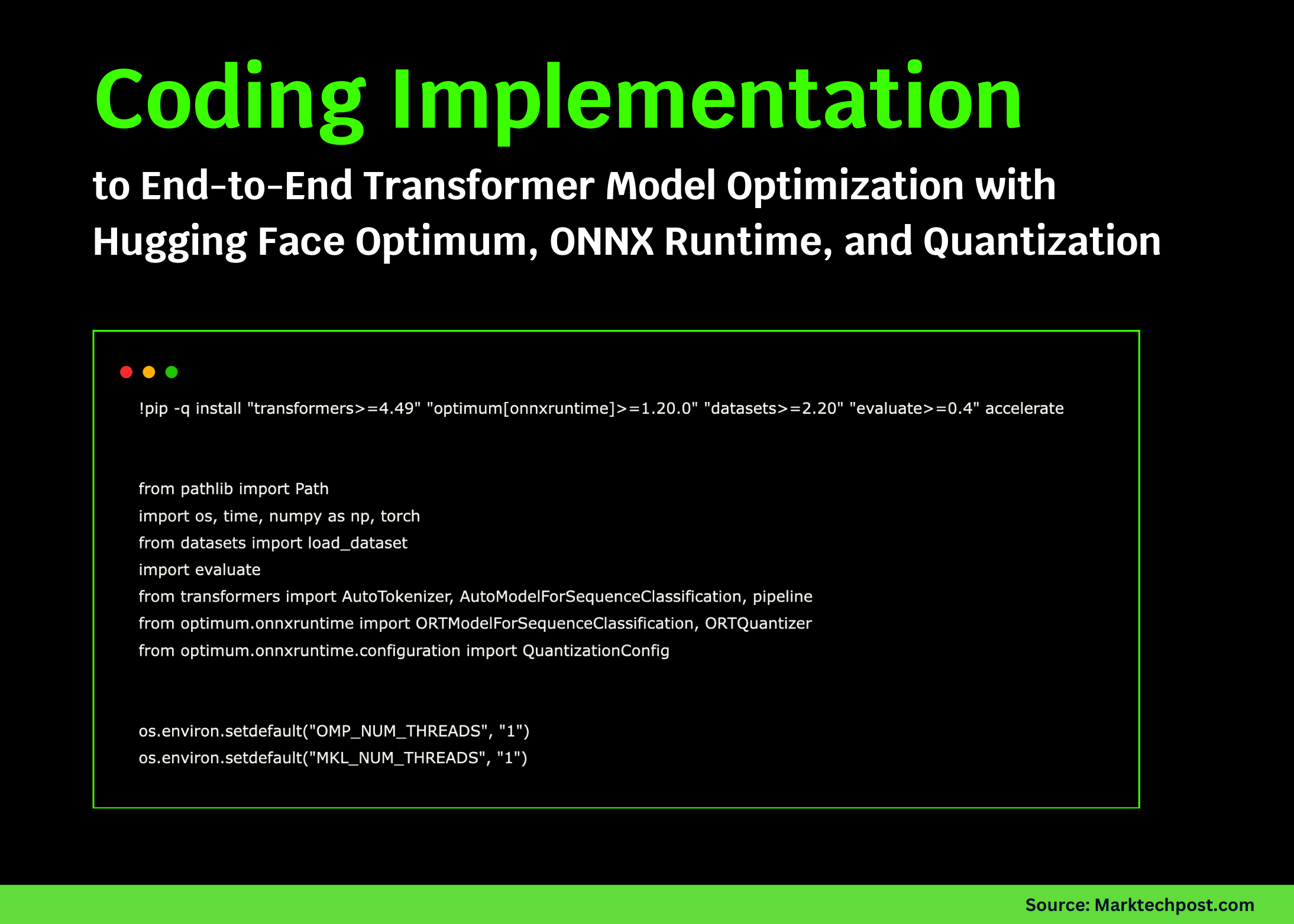

In this tutorial, we walk through how we use Hugging Face Optimum to optimize Transformer models and make them faster while maintaining accuracy. We begin by setting up DistilBERT on the SST-2 dataset, and then we compare different execution engines, including plain PyTorch and torch.compile, ONNX Runtime, and quantized ONNX. By doing this step by step, we get hands-on experience with model export, optimization, quantization, and benchmarking, all inside a Google Colab environment. Check out the FULL CODES here.
!pip -q install "transformers>=4.49" "optimum[onnxruntime]>=1.20.0" "datasets>=2.20" "evaluate>=0.4" accelerate


from pathlib import Path
import os, time, numpy as np, torch
from datasets import load_dataset
import evaluate
from transformers import AutoTokenizer, AutoModelForSequenceClassification, pipeline
from optimum.onnxruntime import ORTModelForSequenceClassification, ORTQuantizer
from optimum.onnxruntime.configuration import QuantizationConfig


os.environ.setdefault("OMP_NUM_THREADS", "1")
os.environ.setdefault("MKL_NUM_THREADS", "1")


MODEL_ID = "distilbert-base-uncased-finetuned-sst-2-english"
ORT_DIR  = Path("onnx-distilbert")
Q_DIR    = Path("onnx-distilbert-quant")
DEVICE   = "cuda" if torch.cuda.is_available() else "cpu"
BATCH    = 16
MAXLEN   = 128
N_WARM   = 3
N_ITERS  = 8


print(f"Device: {DEVICE} | torch={torch.__version__}")
We begin by installing the required libraries and setting up our environment for Hugging Face Optimum with ONNX Runtime. We configure paths, batch size, and iteration settings, and we confirm whether we run on CPU or GPU. Check out the FULL CODES here.
ds = load_dataset("glue", "sst2", split="validation[:20%]")
texts, labels = ds["sentence"], ds["label"]
metric = evaluate.load("accuracy")
tokenizer = AutoTokenizer.from_pretrained(MODEL_ID)


def make_batches(texts, max_len=MAXLEN, batch=BATCH):
   for i in range(0, len(texts), batch):
       yield tokenizer(texts[i:i+batch], padding=True, truncation=True,
                       max_length=max_len, return_tensors="pt")


def run_eval(predict_fn, texts, labels):
   preds = []
   for toks in make_batches(texts):
       preds.extend(predict_fn(toks))
   return metric.compute(predictions=preds, references=labels)["accuracy"]


def bench(predict_fn, texts, n_warm=N_WARM, n_iters=N_ITERS):
   for _ in range(n_warm):
       for toks in make_batches(texts[:BATCH*2]):
           predict_fn(toks)
   times = []
   for _ in range(n_iters):
       t0 = time.time()
       for toks in make_batches(texts):
           predict_fn(toks)
       times.append((time.time() - t0) * 1000)
   return float(np.mean(times)), float(np.std(times))
We load an SST-2 validation slice and prepare tokenization, an accuracy metric, and batching. We define run_eval to compute accuracy from any predictor and bench to warm up and time end-to-end inference. With these helpers, we fairly compare different engines using identical data and batching. Check out the FULL CODES here.
torch_model = AutoModelForSequenceClassification.from_pretrained(MODEL_ID).to(DEVICE).eval()


@torch.no_grad()
def pt_predict(toks):
   toks = {k: v.to(DEVICE) for k, v in toks.items()}
   logits = torch_model(**toks).logits
   return logits.argmax(-1).detach().cpu().tolist()


pt_ms, pt_sd = bench(pt_predict, texts)
pt_acc = run_eval(pt_predict, texts, labels)
print(f"[PyTorch eager]   {pt_ms:.1f}±{pt_sd:.1f} ms | acc={pt_acc:.4f}")


compiled_model = torch_model
compile_ok = False
try:
   compiled_model = torch.compile(torch_model, mode="reduce-overhead", fullgraph=False)
   compile_ok = True
except Exception as e:
   print("torch.compile unavailable or failed -> skipping:", repr(e))


@torch.no_grad()
def ptc_predict(toks):
   toks = {k: v.to(DEVICE) for k, v in toks.items()}
   logits = compiled_model(**toks).logits
   return logits.argmax(-1).detach().cpu().tolist()


if compile_ok:
   ptc_ms, ptc_sd = bench(ptc_predict, texts)
   ptc_acc = run_eval(ptc_predict, texts, labels)
   print(f"[torch.compile]   {ptc_ms:.1f}±{ptc_sd:.1f} ms | acc={ptc_acc:.4f}")
We load the baseline PyTorch classifier, define a pt_predict helper, and benchmark/score it on SST-2. We then attempt torch.compile for just-in-time graph optimizations and, if successful, run the same benchmarks to compare speed and accuracy under an identical setup. Check out the FULL CODES here.
provider = "CUDAExecutionProvider" if DEVICE == "cuda" else "CPUExecutionProvider"
ort_model = ORTModelForSequenceClassification.from_pretrained(
   MODEL_ID, export=True, provider=provider, cache_dir=ORT_DIR
)


@torch.no_grad()
def ort_predict(toks):
   logits = ort_model(**{k: v.cpu() for k, v in toks.items()}).logits
   return logits.argmax(-1).cpu().tolist()


ort_ms, ort_sd = bench(ort_predict, texts)
ort_acc = run_eval(ort_predict, texts, labels)
print(f"[ONNX Runtime]    {ort_ms:.1f}±{ort_sd:.1f} ms | acc={ort_acc:.4f}")


Q_DIR.mkdir(parents=True, exist_ok=True)
quantizer = ORTQuantizer.from_pretrained(ORT_DIR)
qconfig = QuantizationConfig(approach="dynamic", per_channel=False, reduce_range=True)
quantizer.quantize(model_input=ORT_DIR, quantization_config=qconfig, save_dir=Q_DIR)


ort_quant = ORTModelForSequenceClassification.from_pretrained(Q_DIR, provider=provider)


@torch.no_grad()
def ortq_predict(toks):
   logits = ort_quant(**{k: v.cpu() for k, v in toks.items()}).logits
   return logits.argmax(-1).cpu().tolist()


oq_ms, oq_sd = bench(ortq_predict, texts)
oq_acc = run_eval(ortq_predict, texts, labels)
print(f"[ORT Quantized]   {oq_ms:.1f}±{oq_sd:.1f} ms | acc={oq_acc:.4f}")
We export the model to ONNX, run it with ONNX Runtime, then apply dynamic quantization with Optimum’s ORTQuantizer and benchmark both to see how latency improves while accuracy stays comparable. Check out the FULL CODES here.
pt_pipe  = pipeline("sentiment-analysis", model=torch_model, tokenizer=tokenizer,
                   device=0 if DEVICE=="cuda" else -1)
ort_pipe = pipeline("sentiment-analysis", model=ort_model, tokenizer=tokenizer, device=-1)
samples = [
   "What a fantastic movie—performed brilliantly!",
   "This was a complete waste of time.",
   "I’m not sure how I feel about this one."
]
print("\nSample predictions (PT | ORT):")
for s in samples:
   a = pt_pipe(s)[0]["label"]
   b = ort_pipe(s)[0]["label"]
   print(f"- {s}\n  PT={a} | ORT={b}")


import pandas as pd
rows = [["PyTorch eager", pt_ms, pt_sd, pt_acc],
       ["ONNX Runtime",  ort_ms, ort_sd, ort_acc],
       ["ORT Quantized", oq_ms, oq_sd, oq_acc]]
if compile_ok: rows.insert(1, ["torch.compile", ptc_ms, ptc_sd, ptc_acc])
df = pd.DataFrame(rows, columns=["Engine", "Mean ms (↓)", "Std ms", "Accuracy"])
display(df)


print("""
Notes:
- BetterTransformer is deprecated on transformers>=4.49, hence omitted.
- For larger gains on GPU, also try FlashAttention2 models or FP8 with TensorRT-LLM.
- For CPU, tune threads: set OMP_NUM_THREADS/MKL_NUM_THREADS; try NUMA pinning.
- For static (calibrated) quantization, use QuantizationConfig(approach="static") with a calibration set.
""")
We sanity-check predictions with quick sentiment pipelines and print PyTorch vs ONNX labels side by side. We then assemble a summary table to compare latency and accuracy across engines, inserting torch.compile results when available. We conclude with practical notes, allowing us to extend the workflow to other backends and quantization modes.
In conclusion, we can clearly see how Optimum helps us bridge the gap between standard PyTorch models and production-ready, optimized deployments. We achieve speedups with ONNX Runtime and quantization while retaining accuracy, and we also explore how torch.compile provides gains directly within PyTorch. This workflow demonstrates a practical approach to balancing performance and efficiency for Transformer models, providing a foundation that can be further extended with advanced backends, such as OpenVINO or TensorRT.
Check out the FULL CODES here. Feel free to check out our GitHub Page for Tutorials, Codes and Notebooks. Also, feel free to follow us on Twitter and don’t forget to join our 100k+ ML SubReddit and Subscribe to our Newsletter.
For content partnership/promotions on marktechpost.com, please TALK to us
Asif Razzaq is the CEO of Marktechpost Media Inc.. As a visionary entrepreneur and engineer, Asif is committed to harnessing the potential of Artificial Intelligence for social good. His most recent endeavor is the launch of an Artificial Intelligence Media Platform, Marktechpost, which stands out for its in-depth coverage of machine learning and deep learning news that is both technically sound and easily understandable by a wide audience. The platform boasts of over 2 million monthly views, illustrating its popularity among audiences.
Credit: Source link