




Maskot
The Roundhill Generative AI & Technology ETF (NYSEARCA:CHAT) has been up big in the past year. Shares have rallied about 20% since mid-July 2023, and that’s after a significant correction took place from August through much of October last year. Thus, it might seem like I have egg on my face for putting a sell rating on the ETF in late Q2 2023.
My assertion, though, was that CHAT’s high expense ratio and a “near-term peak” in AI froth warranted that investors should steer clear of the fund, favoring a longer-term view on ETFs like QQQ, XLK, and SMH. Following the Q3 pullback, shares of AI and tech-related equities soared, following historical seasonal patterns.
Today, I reiterate a sell rating for some of the same reasons. With a high valuation, still-lofty expense ratio, and bearish seasonality on tap, avoiding CHAT seems once again prudent looking further out into the second half. I’ll also detail a key technical downside move that has occurred.
CHAT: Underperforming Tech-Related Index Funds
Stockcharts.com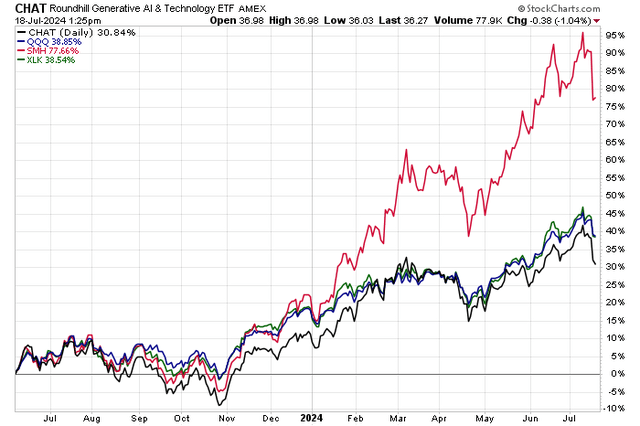
According to the issuer, CHAT is an actively managed ETF that seeks to own shares of companies operating across information technology, semiconductors and semiconductors equipment, software and services, system software, software research, artificial intelligence software, cloud infrastructure services, network infrastructure, and AI services industries.
CHAT has not caught the eye of many investors. Total assets under management is just $202 million as of July 17, 2024, while its annual expense ratio is high at 0.75%. Income investors won’t be drawn to the fund either considering that there is no current dividend yield; that could change if the portfolio managers choose to add holdings different from what it owns currently, as it is not a passive ETF.
Share-price momentum has been decent in the last handful of months, but strength has turned south just in the last handful of sessions while relative strength compared to other lower-cost index funds in the tech area has been exceptionally poor. CHAT is also a risky product when analyzing historical standard deviation trends and its current concentrated allocation.
Liquidity is a strong point, however, despite its low volume, though I would still encourage investors to use limit orders considering that its 30-day median bid/ask spread is material at 13 basis points, per Roundhill.
Looking closer at the portfolio, the Negative-rated ETF by Morningstar is focused in the top-right section of the style box, indicative of its bent to large-cap growth. That style has been in favor for much of this year, but a key risk is if we see a continued broadening out or rotation in the market favoring small caps and value. With a price-to-earnings multiple of 24, it’s a more than two-handle earnings multiple premium to the S&P 500.
CHAT: Portfolio & Factor Profiles
Morningstar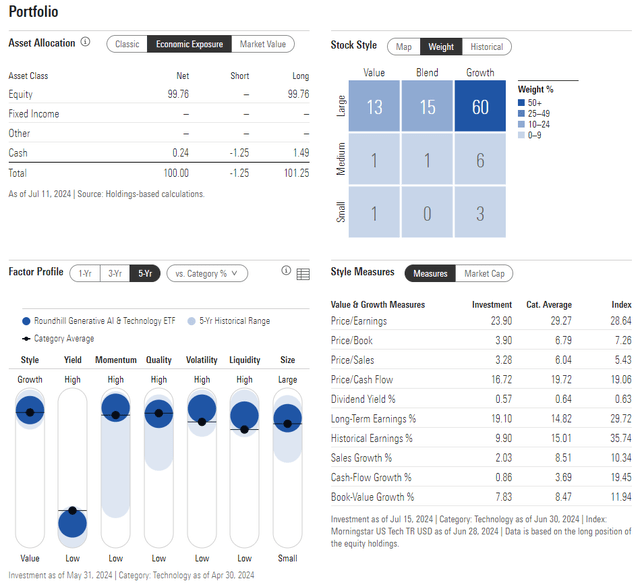
CHAT’s current mix of stocks is not all that dissimilar from the Nasdaq 100 ETF and the Select Sector SPDR Technology ETF. Both QQQ and XLK are heavy into mega-cap tech, but investors will pay a much lower cost for those products.
With more than three-quarters of CHAT invested in the I.T. sector, being aware of risk should tech’s performance sag to the broader market is important. What’s more, nearly half of the allocation consists of the top 10 holdings. Also, keeping tabs on major holdings such as NVIDIA (NVDA), Microsoft (MSFT), and Alphabet (GOOGL) is important.
CHAT: Holdings Information, No Dividend
Seeking Alpha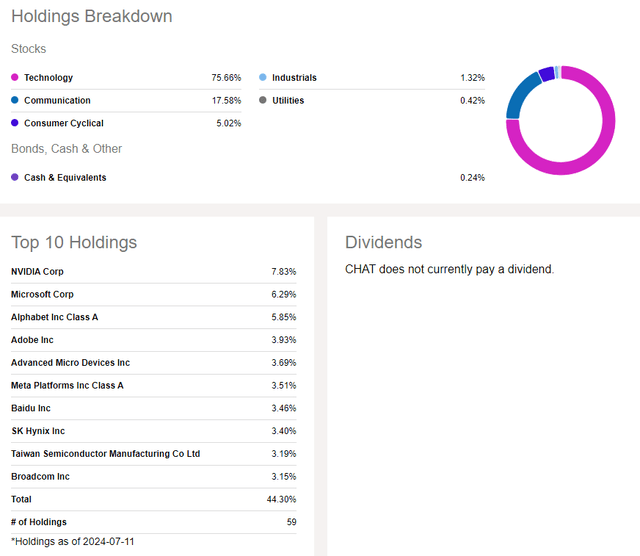
Seasonally, we are once again entering a bearish stretch. The image below displays the historical trends on QQQ, which I believe is a decent ballpark indicator of CHAT’s potential seasonal trend.
The late July through September period has been riddled with volatility and downside price action, and we’ve seen that in each of the past two years. So, calendar tendencies likely do not favor CHAT right now.
QQQ Seasonality Turns Weaker in August and September
Seeking Alpha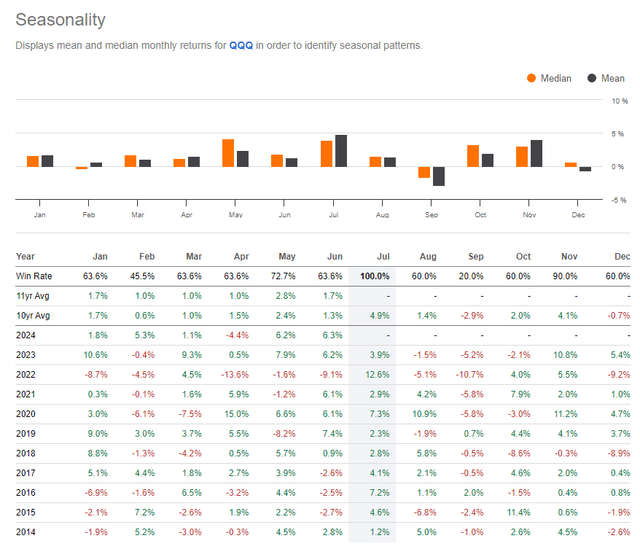
The Technical Take
Cementing my sell rating is the reality that technicals have turned less favorable for CHAT. Notice in the chart below that shares have fallen below the March 2024 peak, which triggers a potential false breakout pattern. Technicians like to say, “From false moves come fast moves in the opposite direction,” and we could just now be seeing that get underway. The ETF is lower for four straight sessions as of this writing with increased downside momentum, evidenced by a multi-month low in the RSI oscillator at the top of the graph.
The good news for AI-stock bulls is that CHAT’s long-term 200-day moving average remains upward sloping, suggesting that the bulls control the primary trend. Moreover, there is a decent amount of volume by price in the $33 to $36 range that could offer some cushion during the current selloff. Still, I would not be surprised to see the fund test the previous resistance point of $31 if we see a trendline break.
CHAT: Bearish False Breakout Watch, Rising 200dma, $31 Support
Stockcharts.com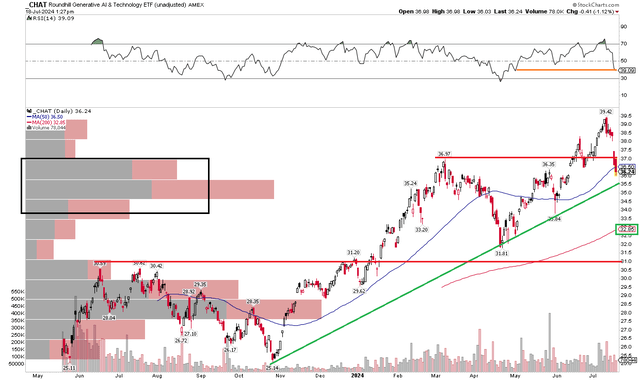
The Bottom Line
I have a sell rating on CHAT. The fund has been an underperformer in the past 13 months, despite a surge from November through mid-July. Technicals now appear weak on this high-fee tech ETF.
Credit: Source link