

Bet_Noire
All financial numbers in this article are in Canadian dollars unless noted otherwise. Please note that oil and gas prices are always in US dollars.
Introduction
Two years ago, I came out as a huge fan of Canadian energy companies, as the nation’s big oil names, Canadian Natural (CNQ), Suncor (SU), and Cenovus Energy (NYSE:CVE), have everything I’m looking for in oil companies:
- Deep reserves, which lowers the risks of “forced” M&A to keep production numbers steady.
- Efficient production provides these companies with low breakeven prices and elevated free cash flow at elevated oil prices.
- A focus on shareholder distributions, as all three companies are dedicated to returning roughly all of their free cash flow to shareholders (after achieving their target leverage ratios).
As the title of this article suggests, it’s about Cenovus Energy, the third-largest Canadian oil and gas company.
In this case, we’re dealing with an integrated oil and gas company, as it also owns substantial downstream assets capable of refining roughly 745 thousand barrels per day.
Cenovus Energy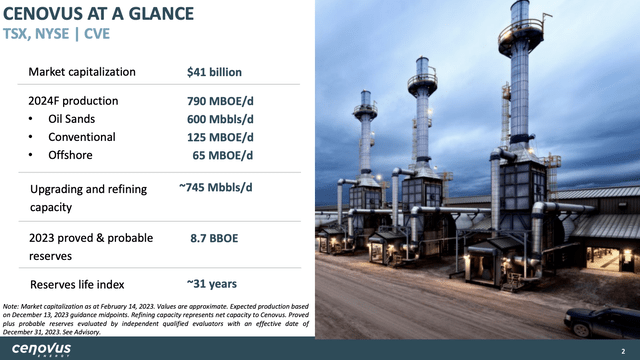
My most recent article on this company was written on November 6, titled “Canada’s Best – Cenovus Is A Significantly Undervalued Buyback Powerhouse.”
In this article, I’ll elaborate on this, using the company’s just-released earnings and favorable developments in the North American oil and gas industry that could increasingly favor Canadian players.
So, with all of this in mind, let’s get to it!
Between Headwinds And Tailwinds
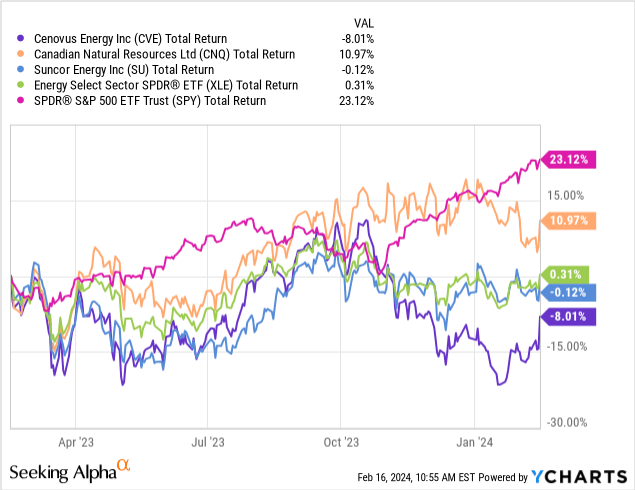
Over the past twelve months, energy hasn’t been the best place to be, as the Energy Select Sector ETF (XLE) returned just 0.3%, lagging the S&P 500 by roughly 23 points.
Poor economic growth conditions (at least in cyclical industries), pressure on Chinese consumers and construction, recession risks in Europe, and the fact that tech has been such a great place to be have caused energy to perform poorly.
However, Cenovus, which has been the worst performer among its peers, is doing rather well when it comes to positioning its company for growth and its shareholders for higher distributions.
For example, in the fourth quarter of 2023, Cenovus Energy achieved significant operational milestones across its business segments.
Notably, the company successfully restarted two refineries and made substantial progress on the West White Rose project, reaching a completion rate of 75%.
Cenovus Energy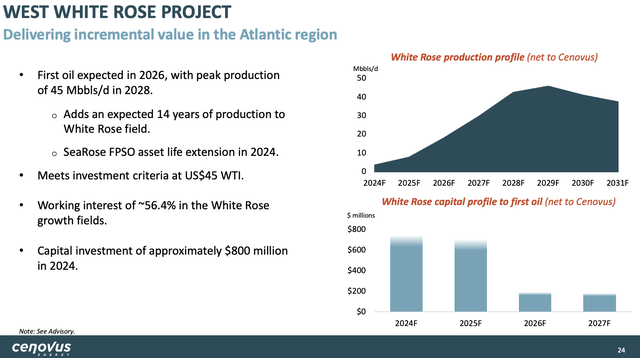
As I said in the introduction, CVE is much more than an upstream business, as it owns downstream (refining) assets capable of turning roughly 745 thousand barrels of oil into value-added products.
This means that a big part of its 770 to 810 thousand barrels of oil equivalent (“BOE”) production in 2024E remains in its own value chain until it leaves in the form of a wide range of refined products.
Cenovus Energy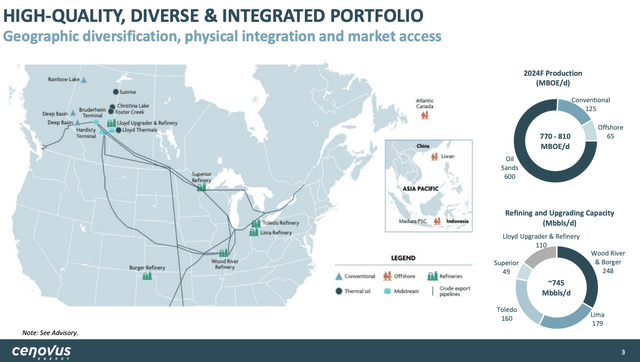
With that in mind, Cenovus Energy’s upstream business (oil and gas production) demonstrated strong performance during the fourth quarter, with production reaching nearly 810,000 barrels of oil per day.
This marked the highest quarterly production for the year and the second-highest in the company’s history!
Bear in mind that this company has no pressure to limit output, as it has proven and probable reserves of 8.7 billion barrels of OE, which is roughly 31 years’ worth of production, one of the highest numbers in the entire industry.
According to the company, this performance was driven by robust operations at the oil sands assets, particularly Foster Creek, where the ramp-up of new sustaining pads contributed to increased production levels.
Additionally, the commencement of steaming at Sunrise signaled the initiation of a multiyear development plan aimed at maximizing production volumes.
Cenovus Energy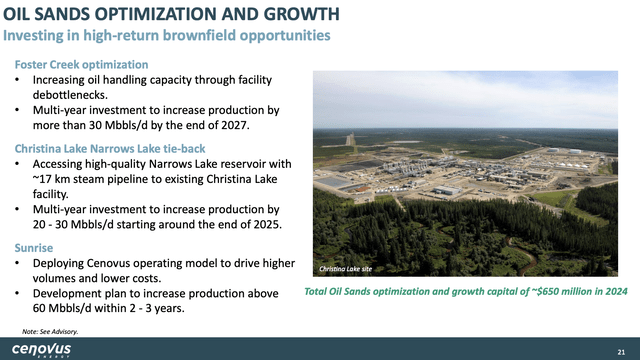
However, despite these developments, the upstream business faced challenges related to lower crude prices and wider heavy oil differentials.
Speaking of unfavorable Canadian oil differentials, these headwinds could soon turn into tailwinds.
Earlier this month, Bloomberg’s Javier Blas wrote an article titled “The $10 Billion Mistake That Will Revive Canadian Oil.”
According to him, after years of “pain,” Canada’s expensive new TMX pipeline is expected to provide tailwinds for the industry.
I added emphasis to the quote below.
The bottleneck has cost Canadian oil companies billions of dollars in forgone revenue, delaying the industry’s growth. With existing pipelines full, any extra barrels have had to move via costly railway, depressing their value. At the worst point in late 2018, Canadian crude sold at a discount of $50 a barrel less than American petroleum.
Bloomberg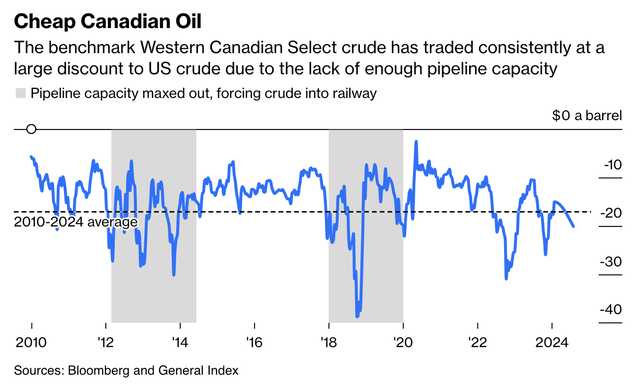
Furthermore:
The consensus is, that’s going to trend now toward minus $10 a barrel. Crucially, TMX probably means that the differential will no longer suffer from its perennial blowouts, when it has widened to as much as minus $40 and even minus $50 a barrel.
Although we should expect that continuing output growth in Alberta could result in a widening spread in the years ahead if no new pipelines are permitted, we should see increasing tailwinds for Canada’s largest producers in the mid-term.
Going back to Cenovus, its downstream operations were somewhat of a mixed bag in the fourth quarter.
While the company’s operated refining businesses continued to perform well, challenges were encountered in certain areas.
Canadian refining achieved a crude utilization rate of 91%, with the Lloydminster Upgrader demonstrating consistent and strong performance.
However, planned maintenance activities impacted throughput, particularly at the Superior Refinery, where efforts to improve reliability were ongoing.
Cenovus Energy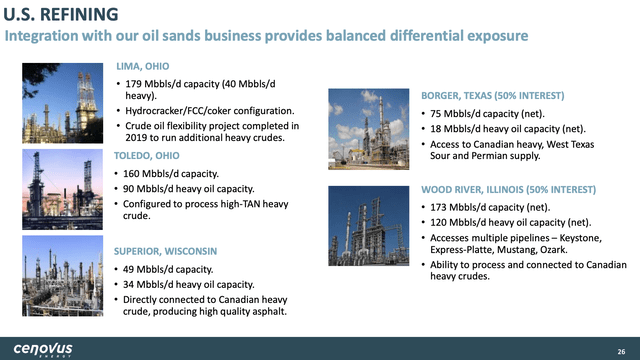
The downstream business faced headwinds due to a weak Chicago crack crush environment, resulting in a decline in refining margins and throughput.
According to the company, the Chicago 3-2-1 crack spread averaged US$13.24 per barrel, reflecting a significant decline compared to the previous quarter.
Shareholders Remain In A Great Place
Despite temporary headwinds related to lower crude prices, unfavorable price differentials, and crack spread headwinds, the company delivered approximately $2.1 billion of adjusted funds flow in the fourth quarter.
The company also made significant progress in debt reduction, with net debt decreasing by over $900 million from the third quarter.
Cenovus Energy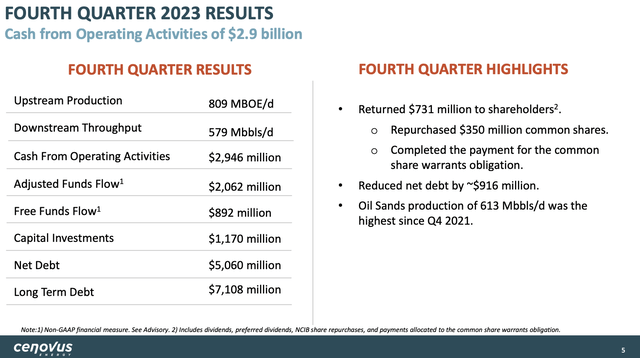
As we can see below, the company has an investment grade rating of BBB- from Standard & Poor’s and a weighted average interest rate on its long-term debt of 4.5%.
It has no major debt maturities until 2027, which buys the company a lot of time in this unfavorable environment.
Cenovus Energy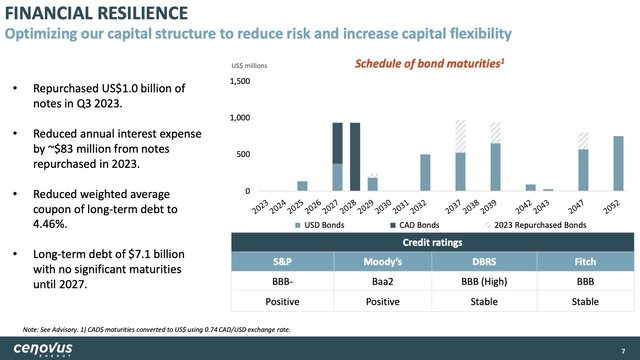
Additionally, Cenovus distributed over $700 million directly to shareholders through dividends, share buybacks, and the final payment of common share warrant obligations.
Looking ahead to 2024, the company remains focused on achieving its $4 billion net debt target, advancing high-return growth projects in the upstream segment, and enhancing the profitability of the downstream business.
With regard to shareholder distributions, Cenovus is committed to returning excess free funds flow to shareholders and will provide further insights into its strategy and plans at an upcoming Investor Day on March 5.
Once the company achieves its net debt target of $4 billion, it aims to return every penny of free cash flow to shareholders, likely using buybacks.
Cenovus Energy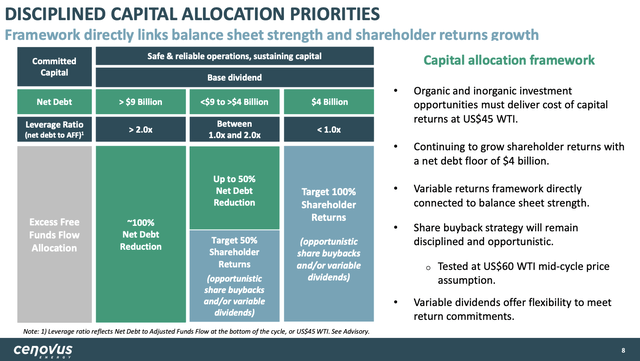
This bodes well for shareholders.
Why?
Because CVE is in a fantastic position to boost shareholder value.
The company, which currently yields 2.6%, has a fully covered dividend and capital programs at US$45 WTI. This includes sustaining capital of $3 billion per year.
Analysts expect that CVE will end this year with $3.7 billion in debt, which means it will likely hit its leverage target in the second half of this year.
It is also expected to generate $5.0 billion in free cash flow, likely followed by $5.5 billion in 2025E free cash flow.
These numbers translate to free cash flow yields of 11.4% and 12.5%, respectively. That’s based on the company’s $44 billion market cap.
In other words, once the company reaches its debt target, this is the kind of annual return investors can expect in a mid-cycle oil environment like the one we’re currently witnessing.
Once oil starts a meaningful rally, which I expect to happen when global cyclical demand improves, we could see much higher free cash flow potential.
Valuation
CVE is not only in a great spot to reward shareholders, but it is also very cheap.
Using the data in the chart below:
- CVE trades at a blended price/OCF (operating cash flow) ratio of just 4.9x, which is significantly below its long-term normalized multiple of 7.6x OCF.
- This year, analysts expect OCF to rise by 10%, potentially followed by unchanged OCF in 2025 and 26% growth in 2026.
- While these numbers are obviously highly dependent on the price of oil, they indicate that under current circumstances, the stock has a fair value of $50 in Toronto. That’s roughly twice its current price.
FAST Graphs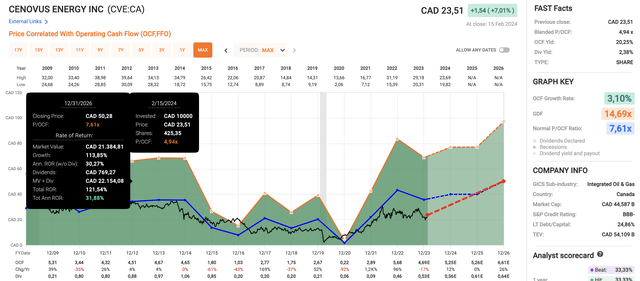
While I won’t make the case that CVE will double overnight, I really like the risk/reward and would be a buyer if I didn’t have so much exposure in Canadian Natural already.
Also, my personal preference is buying upstream and downstream as separate companies, which is why I opted for Canadian Natural.
All things considered, if I were looking for more diversified oil exposure, I would be a buyer of CVE – especially if cyclical headwinds push the stock down a bit more.
Takeaway
Cenovus Energy stands out in the energy sector with its strategic focus on shareholder distributions, operational efficiency, and robust production capabilities.
Despite industry headwinds, including lower crude prices and unfavorable differentials, CVE’s integrated business model and strong balance sheet position it for growth and value creation.
With a commitment to debt reduction and returning excess free cash flow to shareholders, CVE offers an attractive investment opportunity, especially considering its performance relative to peers.
As the company progresses toward its debt target and generates significant free cash flow, investors can anticipate substantial returns, making CVE a compelling option for those seeking exposure to the Canadian energy sector.
Pros and Cons
Pros:
- Shareholder-Friendly Approach: The company prioritizes returning excess cash flow to shareholders through dividends and buybacks, enhancing investor returns.
- Undervalued: Trading at a significant discount to its fair value, CVE presents an attractive opportunity for potential capital appreciation.
- Strong Fundamentals: With a focus on debt reduction and maximizing free cash flow, CVE is well-positioned to weather market volatility and deliver long-term value.
- Potential for Growth: As the energy sector rebounds and oil prices recover, CVE’s strategic initiatives could drive future growth and profitability.
Cons:
- Industry Challenges: CVE operates in a cyclical industry prone to fluctuations in commodity prices and market conditions, which could impact financial performance.
- Refining Margin Pressures: The downstream segment faces challenges such as refining margin pressures, which could affect overall profitability.
- Risk of Regulatory Changes: Regulatory changes or environmental policies could impact CVE’s operations and profitability, adding to investment risk.
Credit: Source link