BAY ISMOYO/AFP via Getty Images
Despite trumping electric vehicles [EVs] biggie Tesla, Inc. (TSLA) to become the biggest EV seller in 2023, China’s BYD Company Limited (OTCPK:BYDDF) hasn’t seen positive price movements in recent times. It’s down by ~13% year-to-date [YTD], and its fall over the past year has been even bigger (see chart below).
Price Chart (Source: Seeking Alpha)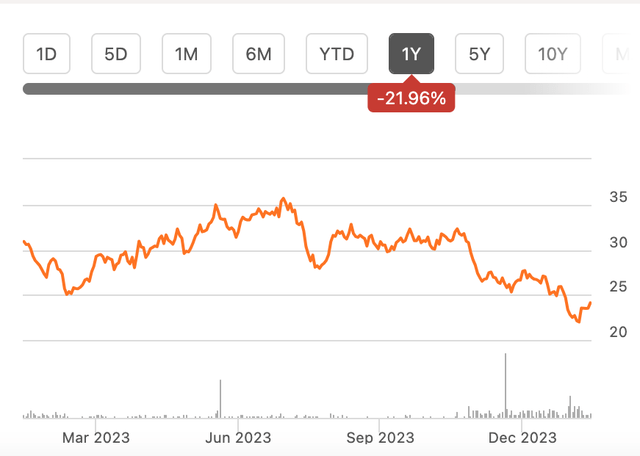
Plenty of reasons explain the price decline. From the latest developments at the company and the broader EV and macroeconomic environment, there’s a lot to unpack here. But the bigger question is whether there are arguments for a price rise going forward, or if BYDDF will continue to weather challenges in 2024.
Why is the price falling?
Revised profit forecast as sales growth loses some steam
The most direct reason for investor diffidence on BYD stock may well be the latest developments in production, sales and full-year 2023 financials. While they are still rather positive, there’s no denying that they have softened since last year. Here are the details:
- The company estimates net profit attributable to shareholders to come in the RMB 29-31 billion range for 2023. While this represents a robust 74.5-86.5% increase, there are two points to note. First, this is a slight reduction from the earlier forecast of RMB 31.5 million Second, even at its best, this is a slowing down from the 129.5% rise seen for the figure for the first nine months of 2023 (9m 2023).
- Next, production volume and sales growth came in at 33.3% YoY and 33.1% YoY, respectively, in January 2024. By comparison, the numbers had grown by 61.8% and 61.9% respectively in 2023.
EV price cuts put margins at risk
These developments only reinforce the decline that started last year due to the price war among EV manufacturers as competition rises. It’s worth noting that the share price decline coincided with the company offering discounts on several models at a time when rival Tesla is slashing prices to stay competitive.
But here’s the rub. Tesla is more capable of absorbing the price cuts presently with its operating margin at 9.2% for 2023. By comparison, BYD’s operating margin for 9m 2023 is at 6.3%. Moreover, in a break from the usual trend, Tesla’s net margins for the year are even higher than its operating margin at 15.5% due to higher investment income and a tax benefit. By comparison, BYD’s 9m 2023 net margin is at 5.1%. Even the year before, though, Tesla’s margins were way higher than BYD’s.
China’s softer consumer economy
These cuts come at a time when China’s consumer economy is seeing signs of weakness, the most obvious one being deflation. Consumer prices fell by 0.8% in January, for instance, the biggest decline in 14 years and more than the 0.5% penciled in by forecasters. Consumer confidence, too, sustained at sub-100 levels in 2023 (see chart below). The index stretches from 0 to 200, with 0 representing maximum pessimism and 200 is maximum optimism. It follows that 100 is the neutral level, and anything below that is in pessimistic territory.
China, Consumer Confidence (Source: Trading Economics)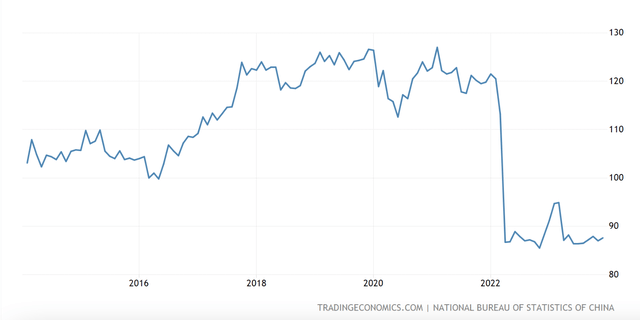
It’s no wonder, then, that the forecasts for the country’s EV market are softening too. According to the China Passenger Car Association, EV shipments to the country will rise by 25% this year, down from 36% last year and a much bigger 96% in 2022. This, of course, represents a bigger challenge for BYD, as only 8% of its sales were international in 2023 compared to Tesla, only 22% of whose revenue came from the China market during the year.
Will the expansion to Europe succeed?
But the company plans to get more competitive, with 800,000 sales targeted in Europe by 2030. However, when seen in the context of the fact that the figure is only 26.5% of its 2023 sales, it’s already not as significant as would be hoped. And by 2030, it would be a far smaller proportional contributor to sales, if they continue to see sustained growth.
Moreover, these plans could falter considering the European Commission’s ongoing investigation on subsidies received by China’s EV manufacturers. The investigation followed “a surge in EU imports of electric vehicles (EVs) from China, outstripping other Chinese export markets” as per the commission. The investigation runs the risk of resulting in countervailing tariffs on these imports. Essentially, the likes of BYD may lose their price advantage.
However, there’s also a possibility that BYD might still come out ahead. A key reason for its price competitiveness is its in-house battery manufacturing capabilities. This stems from its original business as a battery manufacturer and sets it apart while peers rely on third-party sources.
Attractive market multiples
In the meantime, the stock itself is trading at attractive market multiples. Its price-to-earnings (P/E) ratios aren’t high compared to the other two biggest EV stocks by revenue, TSLA and China’s Li Auto (LI) (see chart below).
Source: Seeking Alpha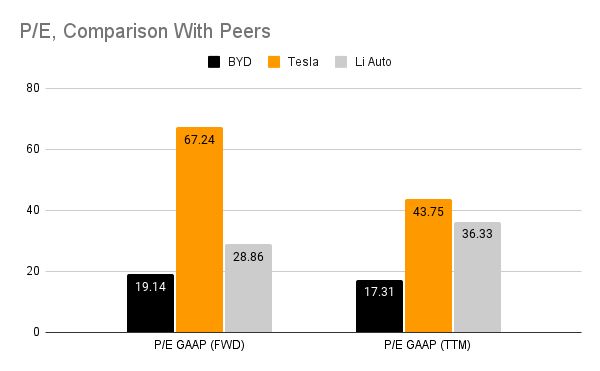
Even if we disregard TSLA for a moment, considering its history as the leading EV company and its higher margins, the fact remains that BYD is still trading below LI. This is even though it has been profitable for far longer and both companies have almost the same forward EPS growth estimates for 2024 at 43% YoY.
What next?
The discussion makes it amply clear that a lot is going well for BYD. While racing ahead of Tesla has been its most eyeball-grabbing aspect in recent months, its healthy financials, EPS projections for 2024, expansion plans, in-house battery manufacturing capabilities and attractive market multiples all go in its favor, too.
However, the EV sector is not one for the fainthearted right now. The price wars risk margin reduction, which is particularly disappointing since BYD’s margins already fall behind Tesla’s. The company’s recent reduced earnings forecast for 2023 confirms this possibility further.
A relative slowing down in China’s consumer market can also impact sales growth, especially as BYD only has a small export share. Its plans to expand into EV markets like the EU can come under threat on ongoing investigations on Chinese imports and the continued U.S.-China limit the potential for growth in the big U.S market.
Much like my take on other EV stocks such as Tesla and NIO, which incidentally are down by 22% and 30%, respectively, since I last wrote on them, I’d much rather wait for the dust to settle for the sector than buy BYD Company Limited shares right now. Especially at a time when the momentum doesn’t support them either. I’m going with a Hold rating on BYDDF.
Editor’s Note: This article discusses one or more securities that do not trade on a major U.S. exchange. Please be aware of the risks associated with these stocks.
Credit: Source link