
JHVEPhoto
After a period in purgatory, Bristol-Myers Squibb Company (NYSE:BMY) finally returned back into growth mode, though relatively slow. The biopharma has faced a period of excruciating LOEs on key drugs like Revlimid pressuring sales. My investment thesis remains Bullish on the biopharma stock, even after a solid bounce off the lows.
Source: Finviz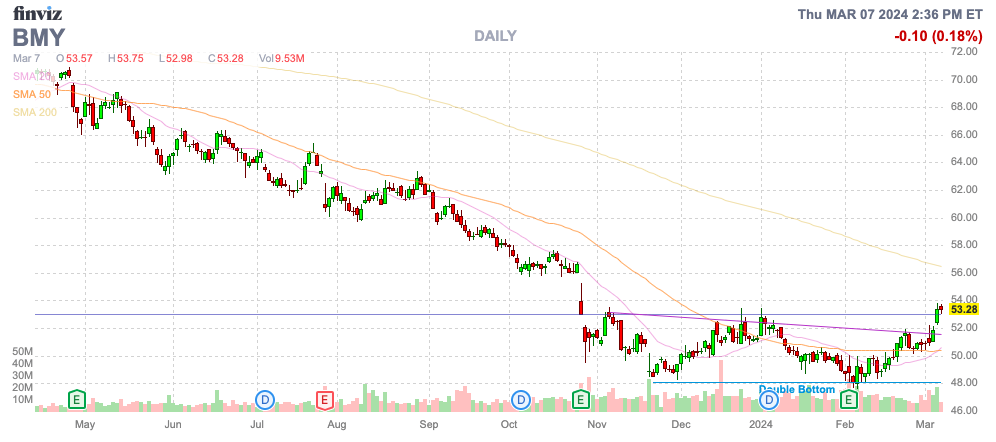
Turnaround Quarter
Bristol-Myers just reported a quarter where sales actually returned to growth after a period of 5 quarters with sales dipping YoY. For the year, the biopharma still reported a 2% sales dip to $45.0 billion, but the key is that signs emerged of the business finally moving beyond the LOE drug losses.
Source: Bristol-Myers Q4’23 presentation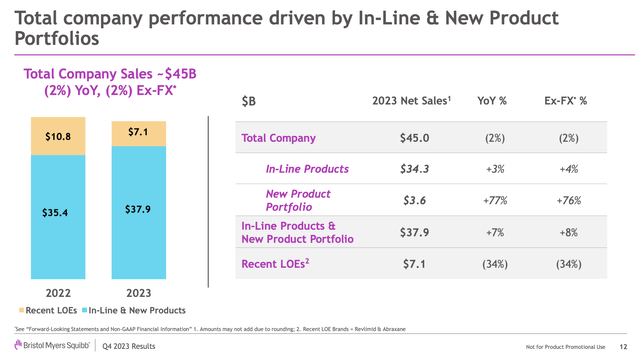
The company saw key LOE drug revenues dip to $7.1 billion in 2023 and only $1.7 billion in Q4. Revlimid sales were down 36% to only $1.45 billion in Q4 while new hematology drugs like Reblozyl and Breyanzi saw sales ramps and combined for Q4 sales of $423 million.
Overall, Bristol-Myers lists the in-line product portfolio at $34.3 billion and growing 3% last year. The new product portfolio grew 77% to reach $3.6 billion for the year and hit nearly $1.1 billion in the quarter.
As the biopharma exited Q4, the new product portfolio was approaching the quarterly sales of the LOEs. The end result is consensus estimates back in growth mode with sales targeted to reach $46 billion in 2024 for ~2% growth, mostly in line with the corporate guidance for low single-digit growth this year.
Like most large biopharmas, Bristol-Myers is a cash machine with 76% gross margins and operating expenses at ~40% of sales. In addition, the company acquirers small biotechs for R&D to limit the costs spent chasing new drug development areas.
The end result was a 2023 EPS of $7.51 and strong operating cash flows of $14.0 billion. Bristol-Myers will now utilize this cash flow to pay for growth starting in 2024.
Dilutive Hits
The stock appears to have already hit bottom at $48 in early February and Bristol-Myers is already trading up at $53 now. The biopharma still faces EPS pressure due to several dilutive acquisitions, but the market is clearly looking past those numbers towards the positives.
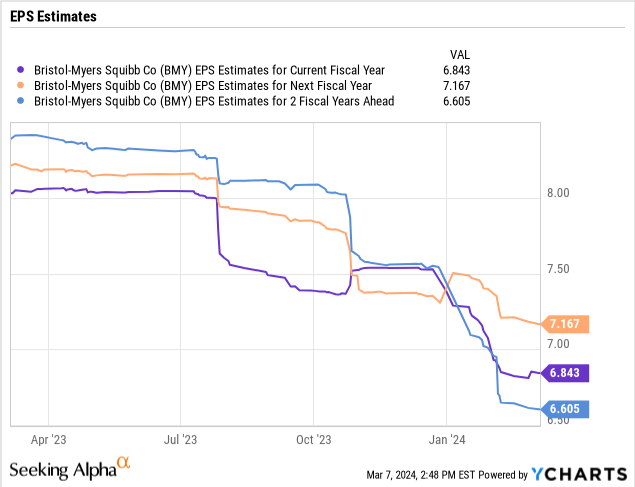
Bristol-Myers guided to 2024 EPS in the range of $7.10 to $7.40 per share, excluding a couple of pending dilutive deals. The consensus estimate has the EPS target dip to only $6.84.
The company provided 2024 EPS guidance reflective of the recent acquisition of Mirati Therapeutics closed in January 2024 for nearly $5 billion, but the numbers excludes the impact of announced strategic acquisitions of RayzeBio and Karuna Therapeutics (KRTX) with anticipated 1H’24 closings. Bristol-Myers forecast a $0.30 dilution for Karuna and a $0.13 dilution hit for RayzeBio.
Source: Bristol-Myers Q4’23 presentation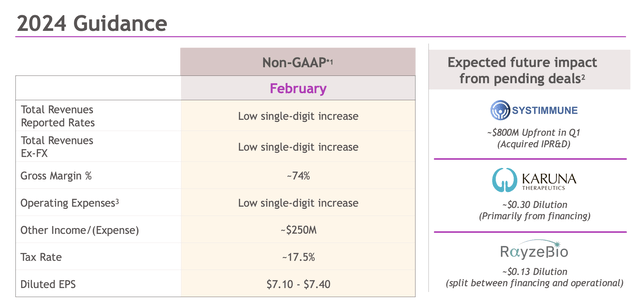
The Karuna deal involves a $14 billion cash payment for its experimental schizophrenia drug KarXT. The consensus analyst estimates have the biotech reporting minimal revenues this year and jumping to over $250 million in 2025 before possibly topping $1 billion in sales by 2027.
The addition of these biotechs to an already strong pipeline of drugs either already on the market or in the pipeline should lead to a return to solid growth in the years ahead. The market is now looking past the dilutive hits to EPS and the targets for an EPS topping $7 with Bristol-Myers returning to growth mode.
The stock only trades at ~7x 2025 EPS targets on the rally back above $53. Bristol-Myers will be heavily indebted with net debt at year-end of $27 billion and plans to pay up to $23 billion in these 3 cash deals discussed above.
The company still manages to pay a 4.5% dividend yield with only spending slightly below $5 billion on dividend payouts. Bristol-Myers has up to $9 billion in operating cash flows to help pay down debt from these deals, while these biotechs should ultimately contribute to cash flow growth in future years.
Takeaway
The key investor takeaway is that the market prefers biopharma stocks with growth. Bristol-Myers just returned to growth after a trough year in 2023, leading to more upside potential in the stock. The company faces a volatile year as the next 2 dilutive deals are added to financial targets when the deals close. Investors should use any weakness to load up on the stock going forward.
Credit: Source link