








Machine translation, a critical area within natural language processing (NLP), focuses on developing algorithms to automatically translate text from one language to another. This technology is essential for breaking down language barriers and facilitating global communication. Recent advancements in neural machine translation (NMT) have significantly improved translation accuracy and fluency, leveraging deep learning techniques to push the boundaries of what’s possible in this field.
The main challenge is the significant disparity in translation quality between high-resource and low-resource languages. High-resource languages benefit from abundant training data, leading to superior translation performance. In contrast, low-resource languages need more training data and better translation quality. This imbalance hinders effective communication and access to information for speakers of low-resource languages, a problem that this research aims to resolve.
Current research includes data augmentation techniques like back-translation and self-supervised learning on monolingual data to enhance translation quality for low-resource languages. Existing frameworks involve dense transformer models that use feed-forward network layers for the encoder and decoder. Regularization strategies such as Gating Dropout are employed to mitigate overfitting. These methods, although helpful, often need help with the unique challenges posed by limited and poor-quality data available for many low-resource languages.
Researchers from Meta’s Foundational AI Research (FAIR) team introduced a novel approach using Sparsely Gated Mixture of Experts (MoE) models to tackle this issue. This innovative method incorporates multiple experts within the model to handle different aspects of the translation process more effectively. The gating mechanism intelligently routes input tokens to the most relevant experts, optimizing translation accuracy and reducing interference between unrelated language directions.
The MoE transformer models differ significantly from traditional dense transformers. In the MoE models, some feed-forward network layers in the encoder and decoder are replaced with MoE layers. Each MoE layer consists of several experts, each being a feed-forward network and a gating network that decides how to route the input tokens to these experts. This structure helps the model better generalize across different languages by minimizing interference and optimizing available data.
The researchers employed a methodology involving conditional computational models. Specifically, they used MoE layers within the transformer encoder-decoder model, supplemented with gating networks. The MoE model learns to route input tokens to the corresponding top two experts by optimizing a combination of label-smoothed cross-entropy and an auxiliary load-balancing loss. To further improve the model, the researchers designed a regularization strategy called Expert Output Masking (EOM), which proved more effective than existing strategies like Gating Dropout.
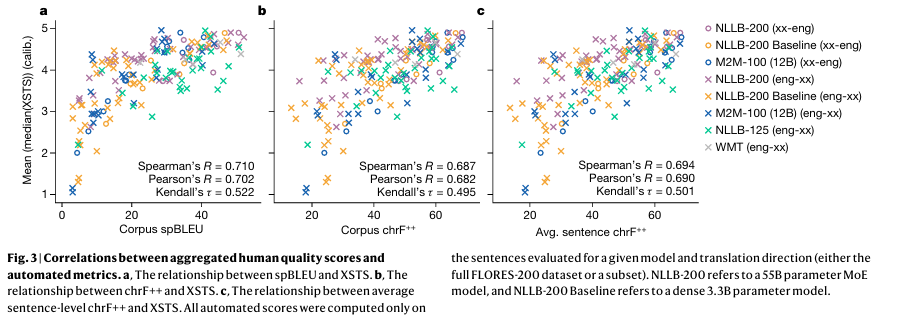
The performance and results of this approach were substantial. The researchers observed a significant improvement in translation quality for very low-resource languages. Specifically, the MoE models achieved a 12.5% increase in chrF++ scores for translating these languages into English. Furthermore, the experimental results on the FLORES-200 development set for ten translation directions (including languages such as Somali, Southern Sotho, Twi, Umbundu, and Venetian) showed that after filtering an average of 30% of parallel sentences, the translation quality improved by 5%, and the added toxicity was reduced by the same amount.
To obtain these results, the researchers also implemented a comprehensive evaluation process. They used a mix of automated metrics and human quality assessments to ensure the accuracy and reliability of their translations. Using calibrated human evaluation scores provided a robust measure of translation quality, correlating strongly with automated scores and demonstrating the effectiveness of the MoE models.
In conclusion, the research team from Meta addressed the critical issue of translation quality disparity between high- and low-resource languages by introducing the MoE models. This innovative approach significantly enhances translation performance for low-resource languages, providing a robust and scalable solution. Their work represents a major advancement in machine translation, moving closer to the goal of developing a universal translation system that serves all languages equally well.
Check out the Paper. All credit for this research goes to the researchers of this project. Also, don’t forget to follow us on Twitter. Join our Telegram Channel, Discord Channel, and LinkedIn Group.
If you like our work, you will love our newsletter..
Don’t Forget to join our 44k+ ML SubReddit

Nikhil is an intern consultant at Marktechpost. He is pursuing an integrated dual degree in Materials at the Indian Institute of Technology, Kharagpur. Nikhil is an AI/ML enthusiast who is always researching applications in fields like biomaterials and biomedical science. With a strong background in Material Science, he is exploring new advancements and creating opportunities to contribute.
Credit: Source link