
Chainarong Prasertthai
Introduction
Block (NYSE:SQ). “A large solid piece of hard material, especially rock, stone, or wood, typically with flat surfaces on each side.” Or at least that’s the definition according to Oxford Languages via the first result from Google. The Block we’re interested in on the other hand is a company that most will recognize as the owners of the largely successful Cash App – although their original business goal was to make credit card readers utilized by phones. But that’s not all that they are – and not what they’re trying to achieve. In 2022, Block announced they’re trying to build the “ecosystems of ecosystems” by combining their ecosystems currently being utilized by both buyers and sellers, to offer a unique experience that is seamless for everyone involved. In fact, they’re so dedicated to this mission that they changed their original name (Square) in 2021 due to the fact they didn’t want to just be known for the selling side of their business.
I’ve jumped into Block’s fundamentals/financials and believe there are two large opportunities in front of this company which makes them a buy – which is the ability to take market share and future profitability through margin expansion. Due to these opportunities, I’ve calculated an intrinsic value for the stock of $101.15. Let’s dive in and I’ll show you why.
What’s Block’s opportunity?
In the “ecosystems of ecosystems”, there are 6 main parts that make up the whole – with 2 of these being their own ecosystems. Each of these parts has their own opportunity that will need to be capitalized on in order for Block to succeed. In no particular order, these are:
-
Square ecosystem
-
Cash app ecosystem
-
TIDAL
-
TBD
-
Spiral
-
Afterpay
Starting with the Square ecosystem, this is the part of Block’s business that empowers sellers to start and run businesses with as little stress as possible, through their offerings of both hardware and software. While Square products can technically be utilized by any business – their main audience is smaller businesses, although they are also gaining some interest by mid-size businesses. In order to grow revenue, Block therefore needs to find businesses that are currently using products and services from different competitors – and offer them the Square ecosystem as a solution to keep everything as simple as possible. Block earns money from this by taking a fee from each transaction that takes place, as well as through subscription fees that offer a hierarchy of tiers with varying functions. It’s estimated there are currently around 305 million small businesses in the world – with an estimated 31.7 million of these being located in the USA. As the average small business prints around $46,979 in revenue, that’s a roughly $1.5 trillion market in the USA alone. There is therefore a massive volume opportunity for them to sell software, hardware and services to business so they can conduct all of their sales – and of course in addition they’ll be earning a cut through the transaction fees. The best part is that the world runs on business – so Square’s total addressable market will continually grow in perpetuity as new small businesses are created each year and existing small business grow their revenue.
Moving on to the next big boy – the Cash App ecosystem. Cash App is similar to PayPal (which I’ve previously written an article on) in that you can use both platforms to make purchases and send p2p transactions. However, there are some unique features to the Cash App ecosystem that can give it an edge over other competitors such as PayPal. For example, Cash App allows users to invest in stocks or bitcoin. While there are plenty of brokerages that offer users the ability to buy stocks, not many allow users to buy bitcoin and even less in a simple manner – and having a simple UI is something that Cash App excels at. The Cash App ecosystem opportunity is a lot easier to understand, as the addressable market is a combination of the total volumes of money that is sent, spent and invested by users. In the USA, this totals to approximately $9 trillion of volume – or an approximate $60 billion in revenue that’s up for grabs as per the calculations in Block’s 2021 investor presentation.
Next up are the 4 smaller players of Block’s business model. Let’s get the worst one out of the way – TIDAL. TIDAL is a music streaming platform like Spotify – but with more of an emphasis on supporting artists and exclusive content to fans. Block acquired TIDAL in 2021 and it was a very controversial acquisition for three reasons. One, TIDAL doesn’t fit into Block’s business model at all. Two, TIDAL is losing money and will put unneeded stress on Block’s already pressured margins. Three, a lawsuit that was launched alleges that only Jack Dorsey (the CEO) wanted the acquisition and did so solely on the fact that he and Jay-Z (TIDAL’s previous owner) were friends. This purchase was a major mistake on Block’s part in my opinion. Even if this platform does become profitable, the music streaming market is anticipated to grow at a 4.7% CAGR until 2027 – so TIDAL would be primarily relying on market disruption to grow revenue. Far from impossible, but in a highly competitive market dominated by stronger companies like Spotify, it just doesn’t make sense.
Next up are two segments which have the same opportunity – TBD and Spiral. TBD is an open developer platform designed to allow easy access to bitcoin and other technologies based on the blockchain. Spiral, on the other hand, does research on bitcoin open source work. The opportunities here are difficult to measure as they’re entirely reliant on how well bitcoin does. My belief is that the price of Bitcoin continues to increase due to continual adoption (case in point, the bitcoin ETF’s that were released recently) and therefore the revenue that Block would get would rise. Bitcoin also drives a large portion of Block’s revenue – approximately 43% of their Q3 print. Overall, these are welcome additions to Block’s ecosystem and will help the functionality of Cash App’s investing service.
Lastly, we have Afterpay. To state the obvious, Afterpay is a buy now pay later (BNPL) platform that most of us are at least aware of. The great thing about Afterpay is that it integrates well with both the Square and Cash App ecosystems. Merchants are also incentivized to use Afterpay as they will receive the full order value (excluding a fee) straight away, which helps to increase their sales, while Block will assume the risk. BNPL is a rapidly growing market, with an estimated $120 billion of transaction value in 2021 which is around 3% of the global market share. However this is set to grow rapidly up until at least 2026 to reach $566 billion. This isn’t without risk, however. If a client isn’t able to pay their full order value, then Block will be left holding the bag. Either way however, the business is a nice fit into Block’s ecosystem and should help to drive revenue growth.
What about Block’s management team?
Having a strong management team is incredibly important for any company, but especially for one that needs to grow rapidly and improve their bottom line. For Block, their management team does appear to be solid – apart from one potential individual – and his name rhymes with “Stack Moresy”. Jack Dorsey is obviously a very ambitious man, having founded both Twitter (now X) and Block, but he has also made a lot of decisions that don’t make a whole lot of sense. Such as the previously mentioned decision to purchase TIDAL. Jack has also admitted (after the fact) that during his time as the Twitter CEO he basically lost control of the company and it became overrun by activists – which he now regrets. Obviously not a great vote of confidence now that he’s taken over from Alyssa Henry as CEO back in October of 2023. To be fair, Jack has reiterated his focus on efficiency and profitability for Block – and I’m sure he’s learned a lot from his past mistakes and has no intention of repeating them. However I would be lying if I said I was 100% confident in his leadership. I’m really hoping he proves me wrong, however as investors we need to monitor his performance closely and see if he keeps his promises.
What about Block’s financial position?
Block’s financial position is a mixed bag. Their balance sheet isn’t too bad, but the issues arise when we look into their income and cash flow statements. Starting with the bad, for the full year of 2022 they reported $5.1 million in FCF and $-0.93 of GAAP EPS. The positive free cash flow is nice to see, but it’s a massive decline from their 2021 number of $713.5 million. This is the same story with their net income, where they reported $0.36 of GAAP EPS in 2021. I expect these numbers to improve in 2023, but there still will be room for improvement.
In their recent quarter they reported $5.62 billion in revenue, with a net loss of $-0.05 EPS. Not great, but they are showing improvement on the efficiency side of things. They raised their guidance in Q3 with an expectation of $1.66 billion to $1.68 billion in adjusted EBITDA and $205 million to $225 million in adjusted operating income. They also stated their intention to achieve the rule of 27 in 2023, by achieving an adjusted operating income of 3% and gross profit growth of 24%. They also reiterated their intention to achieve the rule of 40 by 2026, which for them is an approximate 15% gross profit growth and 25% adjusted operating income margin. It’s great to see them having a plan to become more efficient in the future, but one thing I don’t like is how often they mentioned the word “adjusted” in their earnings. In fact, in their Q3 earnings call they say “adjusted” 17 times. They can adjust their numbers more than a chameleon would adjust its colours tap dancing across a rainbow – the fact is they need to prove their profitability by showing it in the actual numbers.
Another thing to mention is share dilution. Block has diluted its shareholder base by approximately 50% since the end of 2018. They have announced their plan to offset future dilution by repurchasing approximately $1 billion in shares – however this is currently around 15.4 million shares at the current price. Still, given the amount of cash relative to debt on their balance sheet, it’s not the worst idea.
Block currently has around $6.27 billion in cash and $4.98 billion in long term debt, which is a solid position to be in. I’ve taken a few key metrics and outlined them in the table below, along with a few important ratios that I’ll discuss. In case you were wondering, the yellow cells indicate information I’ve input and the green cells are output cells via specific formula:
Author’s calculations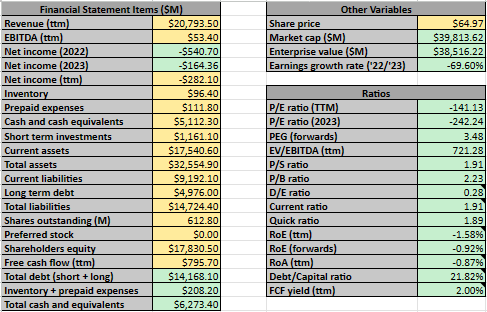
I’ll discuss the P/E and EV/EBITDA ratios later on, however in regards to the balance sheet ratios, the majority of these are within acceptable parameters. The P/S, P/B, D/E, current/quick ratios and debt/capital ratios all look extremely attractive. I would expect their RoE, RoA and FCF yield to improve going forwards as the company becomes more profitable – because these need a lot of work at the current levels.
What’s Block’s intrinsic value?
I’ve decided to undertake 3 different approaches to determine the fair value per share of Block stock: A net income analysis, an EV/EBITDA analysis and a DCF analysis. But firstly, please see the below financial projections, which I’ll provide a brief discussion on:
Historical financials and projections
Author’s calculations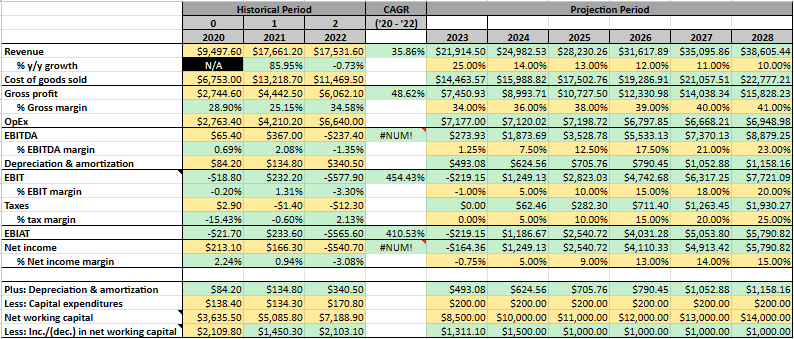
Block have proven they know how to grow revenue, excluding the tough y/y comps presented to them from 2021 to 2022. I would expect this to remain above 10% per year for at least the next 5 years.
For their margin expansion, I decided to model in both their guidance as well as what I believe is realistic for them to hit based on how their markets are projected to grow into the future. After 2026 I decided to rapidly slow down their margin expansion, as I’m unsure if they’d want to continue their efficiency mission once this has been achieved. I’ll be happy to update my model once we have more colour on this issue, however I’ve decided to err on the side of caution for now.
I’ve also kept CapEx spending constant and working capital increasing a constant rate, which I believe is reasonable based on the values I used.
Net income analysis
I’ve put together the below net income analysis based on the above projections:
Author’s calculations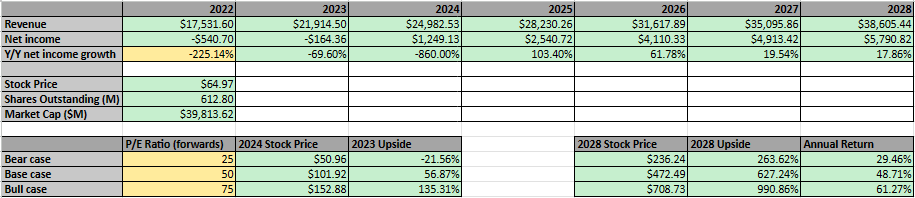
As stated earlier, I’ve chosen a 50 P/E ratio for Block as a base case. I understand this is quite high, however I believe once Block starts to rapidly increase their profitability, the premium valuation would be expected – at least until their bottom line growth starts to slow down by around 2026.
Assuming they are able to generate $1.25 billion in net income I projected for 2024, then a 50 P/E would give us a fair valuation of $101.92 per share – an approximate 56.87% upside from the current share price.
It should also be noted that if my projections are correct and the 50 P/E ratio is maintained, we could see the stock price reach $472.49 by 2028 – implying a 627.24% return which is huge.
EV/EBITDA analysis
I’ve put together the below EV/EBITDA analysis based on the earlier projections:
Author’s calculations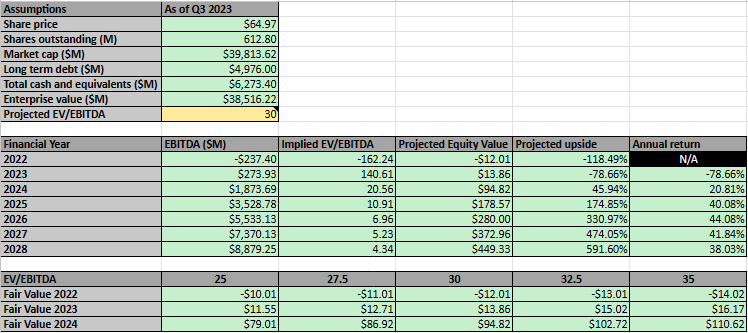
Once again, as stated earlier I’ve decided that an EV/EBITDA of 30 should be fair for Block. This is definitely quite high, however I believe that the premium will be justified as long as Block rapidly expands its margins over the upcoming years – which they are aiming to do.
From this, the fair value for Block should be around $94.82 per share based on the projected EBITDA for 2024. I’ve also conducted a mini-sensitivity analysis for the EV/EBITDA – in case you believe this should be lower/higher than 30.
Assuming my EBITDA projections are correct, we should see the stock price reach $449.33 by 2028, which implies a return of 591.60% over the next few years.
DCF analysis
I’ve put together the below DCF analysis based on the earlier projections. Please note that I’ve calculate the terminal value using the average of the EV/EBITDA exit multiple method and WACC method:
Author’s calculations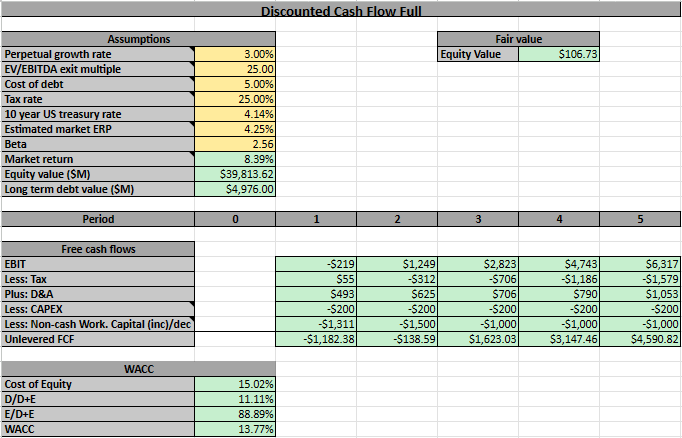
Author’s calculations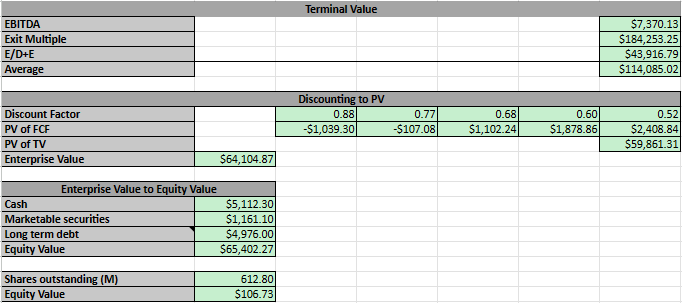
I believe a 3% perpetual growth rate is more than fair for Block. I was tempted to increase this to 3.5%, however I wanted to be conservative as I’m unsure how their growth will stack up past 2028. I would expect this to be at least high single digits, but it’s possible they progress at obtaining market share starts to slow down. Also, if my revenue projections from 2024 to 2028 are too aggressive, then this lower perpetual growth rate will help to negate this.
I believe a 25 EV/EBITDA exit multiple is appropriate for Block at this point. I don’t think 30 could be justified past 2028 as I would expect margin expansion and revenue growth to slow down significantly from the current year. I estimated their cost of debt as 5%, although this is probably very conservative. I also used an effective tax rate of 25% and chose the 10 year treasury rate as the risk free rate, which was 4.14% at the time of writing.
Block’s current agreed beta is 2.56 according to various financial services and I used a market return of 8.39% as not only does this lie within the within the average annual returns for the S&P 500, but it also is an approximation of the risk free rate added to the current estimated market ERP (currently around 4.25%)
Using these numbers, I’ve calculated a fair share price of approximately $106.73. I’ve also conducted the below sensitivity analysis, should any of you want to move the numbers a bit:
Author’s calculations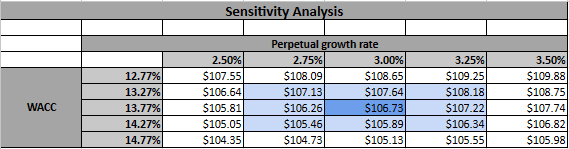
Average share price
As per the below screenshot, the average of these 3 methods gives us a fair share price of $101.15 – marking a 55.69% upside from the current share price. This therefore implies that Block is undervalued and is a buy.
Author’s calculations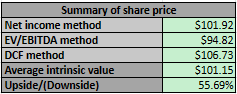
What are the risks?
There are definitely a few risks to investing in Block, some of them I’ve already hinted at. Starting with what I’ve already mentioned, Block’s management team needs to prove they can achieve a decent level of profitability/margin expansion. They’re definitely making the right tracks with this venture, by taking actions such as limiting their overall headcount to 12,000 (as per their Q3 conference call) until they feel they’re growth is starting to become significantly impacted by this ceiling. Jack has also stated in this call that the cost cutting measure they’ve put in place should actually allow more room for growth and innovation, due to removing redundancies as well as internal “red tape.”
The other risk that I touched on earlier is with their Afterpay business. If clients don’t pay the full sum for whatever reason, Block has to cover it. This therefore has the potential to be quite negative to Block’s margins.
Trust is also a key risk. Last quarter, the Square ecosystem saw an outage for 15 hours. This is obviously unacceptable, as that means businesses reliant on Block’s products couldn’t make any transactions for the majority of the day. If some of these transactions turned out to be critical, it’s possible they may consider leaving Block.
Lastly, regulatory concerns are a main factor. As Block’s marketplace is still relatively new and evolving, laws and regulations are evolving with it. Block needs to stay on top of these to ensure that nothing could catch them off guard that would negatively impact their business model.
Conclusion
Based on the analysis I’ve conducted, I believe Block is a buy and I’ve added this to my portfolio. However, the reason I haven’t given it a strong buy due to the significant undervaluation I’ve calculated is that their margin story is still highly speculative. If they’re able to execute on their efficiency goals and reach their 2026 targets, then they’re in the running. If they don’t, then the stock price will flounder.
There are definitely risks to Block, however I believe that Block’s opportunity outweighs these risks. The opportunity to grow in their market, expand their margins and turn a decent profit is definitely enticing. But in order to make their stock a stronger buy, they need to prove they can grow their bottom line first.
Overall, I’m excited to see how Block performs in the future. I’ll be tuning into their next earnings to see how their full year shapes up – as well as any possible colour on what we can expect for the full year of 2024. So you can bet I’ll be there – or be Square.
Credit: Source link