

Richard Drury
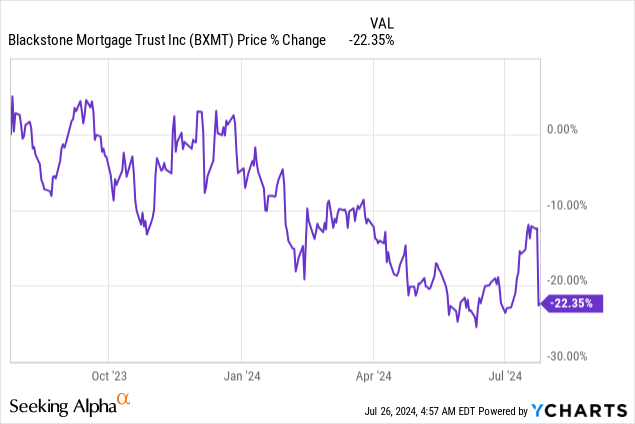
As I suspected months ago, Blackstone Mortgage Trust, Inc. (NYSE:BXMT) finally decided to cut its dividend amid continual problems in its loan portfolio. Blackstone Mortgage suffered a further decline in its performing loan percentage in the second quarter and chose to respond to the resulting deterioration of its portfolio quality by cutting its dividend by 24%. The move will save the company some cash, approximately $100M annually, and the distribution coverage metrics are set to improve as a result. Shares of Blackstone Mortgage continue to trade at a very large discount to book value which now seems more deserved given the dividend cut!
Previous rating
In my May 27, 2024 work titled “A Dividend Cut Is Likely” I suggested that Blackstone Mortgage was headed for a dividend cut given its deteriorating distribution coverage and continual loan losses/reserve increases in the first quarter. Blackstone Mortgage’s loan problems, which mainly affect its office loan segment, now resulted in a major dividend cut. In my opinion, the dividend cut is now fully priced into shares of BXMT, and I am keeping my hold rating.
Continual loan problems lead to dividend cut
Blackstone Mortgage’s performing loan percentage continued to decline in the second fiscal quarter: 90% of BXMT’s loans were performing at the end of the June quarter which was down 2 PP compared to the end of March. About $1.5B of office loans (out of a total of $21.0B) have been classified as impaired or non-performing by Blackstone Mortgage, meaning the REIT is still dealing with significant loan problems.
BXMT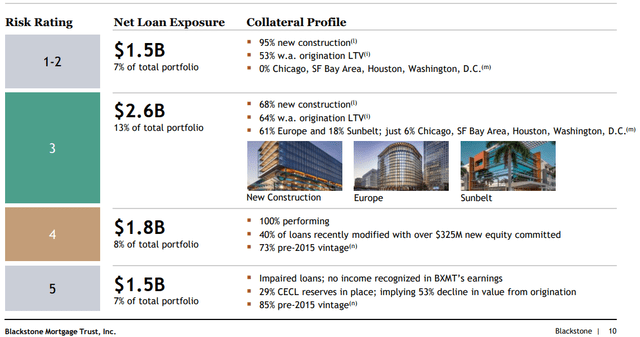
Offices accounted for 36% of the REIT’s investment in the second quarter with 26% of investments falling into the U.S. office category. Multi-family investments represented 27% of investments for Blackstone Mortgage in the second quarter. The majority of multi-family loans (99.5%), however, are performing which means most of Blackstone Mortgage’s problems are almost exclusively concentrated in the office portfolio.
BXMT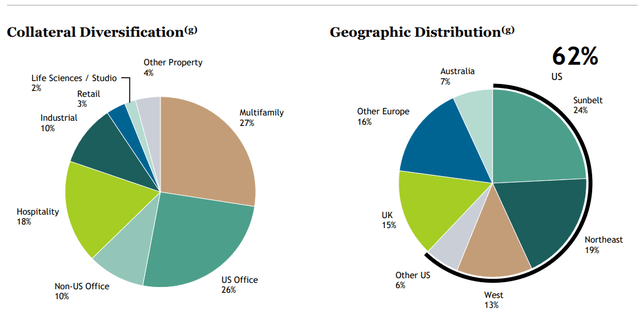
The U.S. office sector has suffered a serious decline since the pandemic, in part due to rising interest rates as well as permanent changes to work habits (remote working) that have lowered the income prospects of office buildings, especially in large cities. Declining occupancy and weaker income projections have pressured office valuations, which has caused even some big investors to just walk away from their loan obligations.
Due to these problems, Blackstone Mortgage was forced to increase its reserves and suffered a decline in its distributable earnings in the last two quarters. In Q1’24, Blackstone Mortgage was forced to add $234.9M to its CECL reserve (a credit loss reserve meant to anticipate future loan losses). In Q2’24, BXMT had to add another $152.4M to its CECL reserve.
As a result, Blackstone Mortgage had only $0.49 per share in distributable earnings in the second fiscal quarter… which was not enough to support the $0.62 per share dividend. Even on an adjusted basis ($0.56 per share), earnings were insufficient to keep in place the dividend. In my last work on the mortgage REIT in May I projected a 10-20% decrease in the dividend, so Blackstone Mortgage did slightly worse than I expected.
Consequently, Blackstone Mortgage decided it no longer made sense to pay $0.62 per share quarterly and the REIT cut the dividend down 24% to a new rate of $0.47 per share which translates to a forward dividend yield of 10.8%. Based off of adjusted Q2’24 distributable earnings, assuming things won’t get worse for BXMT, the dividend reset implies a forward dividend coverage ratio of ~119%.
BXMT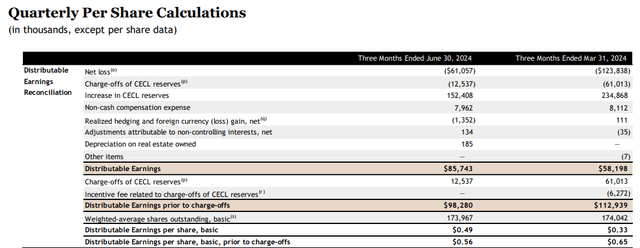
Large discount to book value
Shares of Blackstone Mortgage continue to trade at a large discount to book value which is not surprising since the REIT’s loan issues have been well-covered and the dividend cut added to the discount as well.
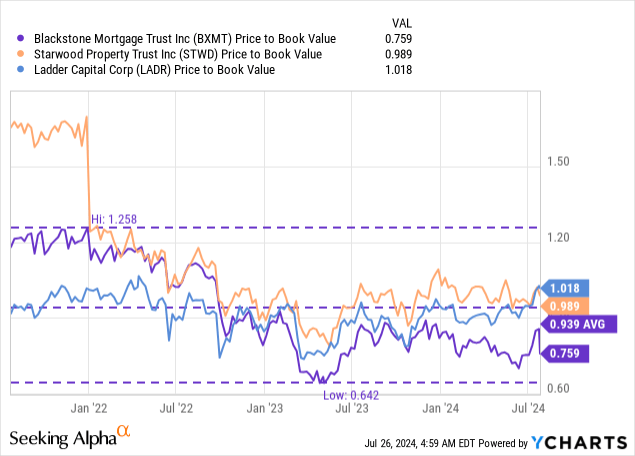
In addition to the issues discussed in this article, Blackstone Mortgage’s large book value discount — in relation to CRE investment REITs like Starwood Property Trust, Inc. (STWD) and Ladder Capital Corp (LADR) — is due to BXMT having an exceptionally large (36%) allocation of investment capital to the office market. Starwood Property had about 14% of its assets invested in offices (11% in U.S. offices) and Ladder Capital 17%. Starwood Property is my choice for quality in the commercial real estate sector, given the REIT’s long payment history and more diversified income streams. I recommended STWD in May when a non-traded Starwood REIT announced redemption limitations.
Because of Blackstone Mortgage’s increase in the CECL reserve in the first quarter (and resulting $61M net loss for the second quarter), BXMT’s book value declined 4.3% quarter over quarter to $22.90 per share. Blackstone Mortgage is currently trading at a 24% discount to book value while Starwood Property is priced at a 1% discount to book value and Ladder Capital is actually already trading at a premium. I recommended Ladder in May, chiefly because of strong distribution coverage metrics.
I continue to apply a 20% risk discount to Blackstone Mortgage’s book value in order to account for higher-than-average risks. I apply this risk discount because BXMT has more exposure to office investments than its rivals and because the dividend has just been cut. With a book value of $22.90 per share, Blackstone Mortgage may have a fair value of $18.32 (compared to a previous fair value estimate of $19.10 per share).
Risks with Blackstone Mortgage
Now that the dividend cut is out of the way, the risk profile may improve going forward, especially if the REIT can avoid incremental loan problems creeping up in its challenged office portfolio. However, the dividend cut was a disappointment and the REIT is now tasked with proving to investors that it can sustain its new $0.47 per share dividend payout. While shares are trading below my fair value target of $18.32, I need to see improvement in the loan portfolio as well as better distribution coverage before upgrading shares to buy.
Final thoughts
The dividend cut was not that surprising, given the trend in the REIT’s distribution coverage ratio in the previous quarters. By cutting the dividend by 24%, Blackstone Mortgage is resetting its dividend to lower expected distributable earnings. The distribution coverage metrics should therefore improve, but the REIT still needs to prove that its loan loss reserves are sufficient and that its distributable earnings sustainably cover BXMT’s new dividend rate. While the discount to book value is still large, it reflects the high risks in Blackstone Mortgage’s office portfolio. For those reasons, I continue to rate shares a hold after the dividend cut!
Credit: Source link