
• bitcoinBitcoin(BTC)$78,867.000.27%
  • ethereumEthereum(ETH)$2,492.220.67%
  • tetherTether(USDT)$1.00-0.01%
  • binancecoinBNB(BNB)$750.66-0.29%
  • rippleXRP(XRP)$1.422.30%
  • usd-coinUSDC(USDC)$1.000.01%
  • solanaSolana(SOL)$103.820.66%
  • tronTRON(TRX)$0.3385800.52%
  • Figure HelocFigure Heloc(FIGR_HELOC)$1.040.00%
  • zcashZcash(ZEC)$1,207.106.69%
  • HyperliquidHyperliquid(HYPE)$85.561.52%
  • dogecoinDogecoin(DOGE)$0.0899560.07%
  • RainRain(RAIN)$0.016020-1.43%
  • USDSUSDS(USDS)$1.000.01%
  • whitebitWhiteBIT Coin(WBT)$81.657.26%
  • moneroMonero(XMR)$503.99-2.46%
  • chainlinkChainlink(LINK)$12.47-1.80%
  • leo-tokenLEO Token(LEO)$9.19-0.30%
  • cardanoCardano(ADA)$0.2183680.08%
  • stellarStellar(XLM)$0.188669-1.34%
  • bitcoin-cashBitcoin Cash(BCH)$258.35-0.39%
  • daiDai(DAI)$1.00-0.02%
  • Ethena USDeEthena USDe(USDE)$1.000.02%
  • CantonCanton(CC)$0.1084072.17%
  • USD1USD1(USD1)$1.00-0.01%
  • uniswapUniswap(UNI)$6.85-2.89%
  • litecoinLitecoin(LTC)$54.03-2.16%
  • the-open-networkGram (prev. Toncoin)(GRAM)$1.39-0.30%
  • hedera-hashgraphHedera(HBAR)$0.078943-3.03%
  • avalanche-2Avalanche(AVAX)$7.97-1.16%
  • suiSui(SUI)$0.81-0.97%
  • Global DollarGlobal Dollar(USDG)$1.000.01%
  • shiba-inuShiba Inu(SHIB)$0.000005-0.43%
  • nearNEAR Protocol(NEAR)$2.331.75%
  • crypto-com-chainCronos(CRO)$0.0597622.89%
  • paypal-usdPayPal USD(PYUSD)$1.000.02%
  • BlackRock USD Institutional Digital Liquidity FundBlackRock USD Institutional Digital Liquidity Fund(BUIDL)$1.000.00%
  • tether-goldTether Gold(XAUT)$4,391.08-0.67%
  • MemeCoreMemeCore(M)$1.180.48%
  • Circle USYCCircle USYC(USYC)$1.140.01%
  • BittensorBittensor(TAO)$255.85-0.16%
  • Ripple USDRipple USD(RLUSD)$1.000.00%
  • okbOKB(OKB)$114.29-1.11%
  • Ondo US Dollar YieldOndo US Dollar Yield(USDY)$1.14-0.02%
  • mantleMantle(MNT)$0.631.09%
  • AsterAster(ASTER)$0.76-1.56%
  • polkadotPolkadot(DOT)$1.1911.49%
  • aaveAave(AAVE)$128.85-2.26%
  • pax-goldPAX Gold(PAXG)$4,395.41-0.67%
  • Pump.funPump.fun(PUMP)$0.0044673.49%
TradePoint.io
  • Main
  • AI & Technology
  • Stock Charts
  • Market & News
  • Business
  • Finance Tips
  • Trade Tube
  • Blog
  • Shop
No Result
View All Result
TradePoint.io
No Result
View All Result

Bizarre Rare Space Explosion Seen Somewhere It Shouldn’t Be : ScienceAlert

October 8, 2023
in Market & News
Reading Time: 3 mins read
A A
Bizarre Rare Space Explosion Seen Somewhere It Shouldn’t Be : ScienceAlert
ShareShareShareShareShare

We may know a heck of a lot less about a bizarre kind of cosmic explosion than we thought.

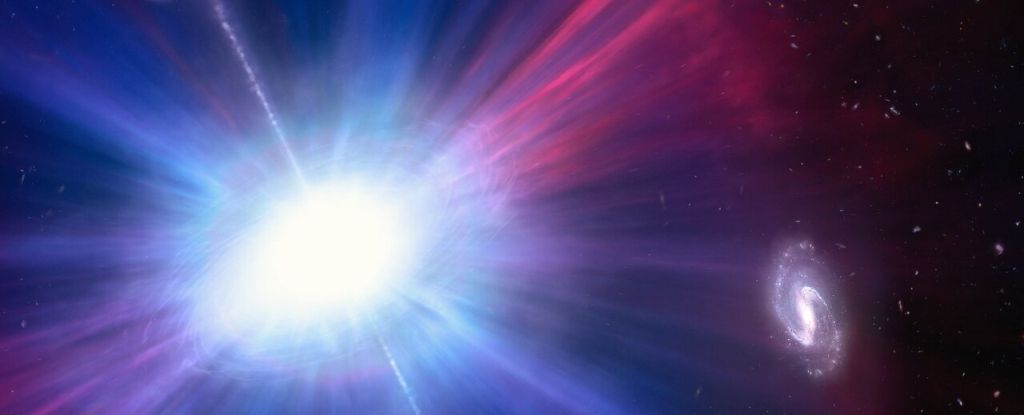
They’re known as luminous fast blue optical transients, or LFBOTs, and one nicknamed the Finch (AT2023fhn) has been spotted in intergalactic space, at a significant distance from the nearest galaxy.

YOU MAY ALSO LIKE

Ashmore Group Plc (AJMPF) Q4 2026 Earnings Call Transcript

New Hampshire Senate Primary Election 2026 Live Results: Chris Pappas, Karishma Manzur, John Sununu and More – NBC News

This is a problem, because astronomers thought that LFBOTs could be a type of massive supernova – something thought only really to occur within galactic borders.

“The more we learn about LFBOTs, the more they surprise us,” says astronomer Ashley Chrimes of the European Space Agency and Radboud University in the Netherlands.

“We’ve now shown that LFBOTs can occur a long way from their nearest galaxy, and the location of the Finch is not what we expect for a supernova.”

The first LFBOT was spotted in 2018, and since then we have detected around a handful. With each new discovery, LFBOTs have continued to puzzle scientists. These space explosions are tremendously bright – at least 10 times brighter than a normal supernova – and tremendously brief.

Normal supernovas tend to flare to a peak, then fade over weeks or months; LFBOTs are like a camera flash in space. And they’re tremendously hot; that’s what gives them a bluish hue.

Artist’s impression of AT2023fhn, AKA the Finch. (NASA, ESA, NSF’s NOIRLab, M. Garlick , M. Zamani)

Scientists thought that these events might be caused by an unusual type of core collapse supernova, in which a dying star’s core directly collapses into a neutron star or black hole. This requires a massive progenitor star, at least eight times the mass of the Sun.

Another possibility is that the flashes could be caused by a black hole devouring another ultradense object, such as a white dwarf star.

Massive stars don’t live very long main sequence lives. It’s less than 100 million years for a star eight times the mass of the Sun. And they’re born in regions that are very rich with thick gas and dust, which means galaxies. There’s not a lot of matter in intergalactic space.

Although some stars can get kicked out of orbit onto an escape trajectory and velocity out of their host galaxies, massive neutron star and black hole progenitors are not expected to get that far before their eventual supernovae.

In fact, all previous LFBOTs have been discovered in the spiral arms of galaxies in which star formation is occurring – the expected place to spot a supernova.

This brings us to the problem of the Finch. It was detected by the Zwicky Transient Facility on 10 April 2023. Its temperature was measured at a whopping 20,000 degrees Celsius (around 36,000 Fahrenheit). Hubble was then called in to figure out where it came from. And this is where things started to get a little hinky.

The explosion took place some 2.86 billion light-years away – but in intergalactic space, some 50,000 light-years from the nearest spiral galaxy, and 15,000 light-years from the nearest dwarf satellite galaxy of that spiral galaxy. This poses a significant challenge to the supernova hypothesis.
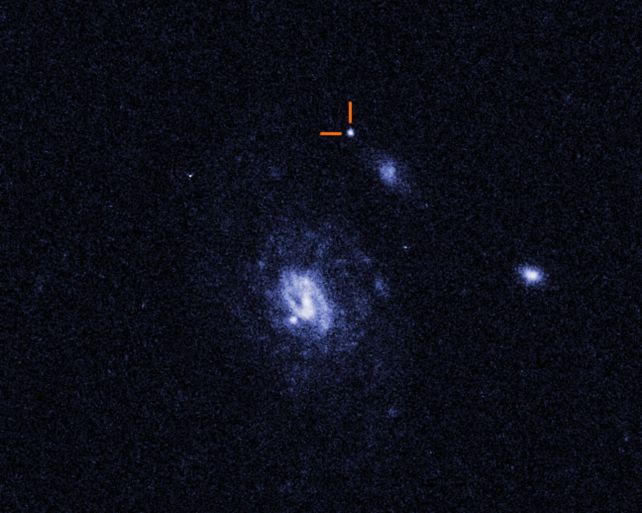
Hubble image of the Finch. (NASA, ESA, STScI, A. Chrimes/Radboud University)

But the black hole hypothesis is still on the table. It’s possible, the researchers say, that an old, isolated ball of stars known as a globular cluster is lurking in intergalactic space.

Globular clusters are thought to be riddled with black holes, of the rarely-seen intermediate mass variety. If there’s a globular cluster there, too dim to be seen, it’s possible that we caught one of these black holes snacking indiscreetly.

Another possibility is that the explosion was caused by a collision between two neutron stars, one of which could have been a magnetar, whose extreme magnetic field could have amplified the resulting kilonova. Theoretical analysis will need to be done to determine the plausibility of this scenario.

“The discovery poses many more questions than it answers,” Chrimes says. “More work is needed to figure out which of the many possible explanations is the right one.”

One thing is certain, though. The more of these things we find, the weirder they get.

The research has been accepted into the Monthly Notices of the Royal Astronomical Society Letters, and is available on arXiv.

Credit: Source link

ShareTweetSendSharePin

Related Posts

Ashmore Group Plc (AJMPF) Q4 2026 Earnings Call Transcript
Market & News

Ashmore Group Plc (AJMPF) Q4 2026 Earnings Call Transcript

September 9, 2026
New Hampshire Senate Primary Election 2026 Live Results: Chris Pappas, Karishma Manzur, John Sununu and More – NBC News
Market & News

New Hampshire Senate Primary Election 2026 Live Results: Chris Pappas, Karishma Manzur, John Sununu and More – NBC News

September 9, 2026
Headwater Exploration-Tamarack Valley Combination: Something For Everybody
Market & News

Headwater Exploration-Tamarack Valley Combination: Something For Everybody

September 9, 2026
Missouri’s redistricting in flux after dissonant court rulings – politico.com
Market & News

Missouri’s redistricting in flux after dissonant court rulings – politico.com

September 9, 2026
Next Post
2023 Global Citizen Festival to Kick Off

2023 Global Citizen Festival to Kick Off

Leave a Reply Cancel reply

Your email address will not be published. Required fields are marked *

Search

No Result
View All Result
U.S. Strategic Petroleum Reserve hits lowest level since 1983 as oil prices surge

U.S. Strategic Petroleum Reserve hits lowest level since 1983 as oil prices surge

September 6, 2026
Doctor restores sight at war-torn South Sudan border

Doctor restores sight at war-torn South Sudan border

September 3, 2026
Morning News NOW Full Episode – July 22

Morning News NOW Full Episode – July 22

September 7, 2026

About

Learn more

Our Services

Legal

Privacy Policy

Terms of Use

Bloggers

Learn more

Article Links

Contact

Advertise

Ask us anything

©2020- TradePoint.io - All rights reserved!

Tradepoint.io, being just a publishing and technology platform, is not a registered broker-dealer or investment adviser. So we do not provide investment advice. Rather, brokerage services are provided to clients of Tradepoint.io by independent SEC-registered broker-dealers and members of FINRA/SIPC. Every form of investing carries some risk and past performance is not a guarantee of future results. “Tradepoint.io“, “Instant Investing” and “My Trading Tools” are registered trademarks of Apperbuild, LLC.

This website is operated by Apperbuild, LLC. We have no link to any brokerage firm and we do not provide investment advice. Every information and resource we provide is solely for the education of our readers. © 2020 Apperbuild, LLC. All rights reserved.

No Result
View All Result
  • Main
  • AI & Technology
  • Stock Charts
  • Market & News
  • Business
  • Finance Tips
  • Trade Tube
  • Blog
  • Shop

© 2023 - TradePoint.io - All Rights Reserved!