




Matteo Colombo
Investment Thesis
Ball Corporation (NYSE:BALL) is one of the world’s largest suppliers of aluminum packaging solutions. It has deep customer networks across the beverage, personal care, and household products industries. BALL’s aluminum packaging products are competitive with other substrates such as plastics and glass.
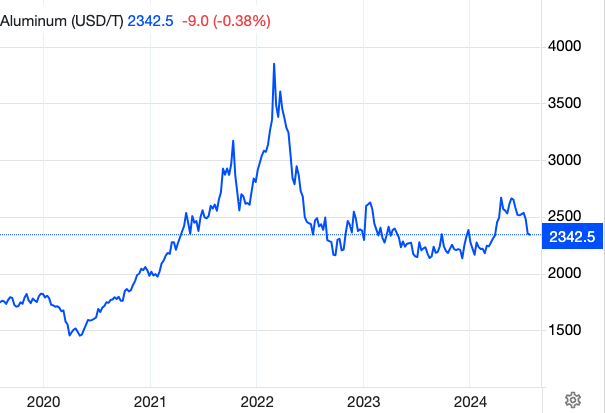
Its offerings cater to various end uses that don’t require much of an imagination to understand (think food and beverage markets, aerosols and so forth). The aluminum beverage and aerosol container industries are expected to continue their growth trajectory in the medium to long term and the price of aluminum has compressed heavily off its FY’24 highs of $2,627/tonne in May and has displayed fairly elastic price action since FY’22 (Figure 1). Whilst I’m certainly aware these contractions reflect a weaker demand outlook in the near-term, the fact is it will recoil when pricing stabilizes on the downside in my view – indicating demand strength on the upside.
Figure 1.
Trading Economics
The stock has cycled lower following its Q1 FY’24 numbers that missed Wall St’s top-line estimates, and findings from my analysis suggest the valuation calculus is heavily tied up to what multiple investors pay vs. the fundamental economics of the business. Thus, I am hold on BALL due to 1) softening fundamentals [it has lost ~200bps post-tax margin since FY’21 + ~0.3x capital turnover since FY’22, classic commodity cycle revenues], 2) absent competitive advantage despite commodity-like economics [margins, asset turns + ROICs are all in-line with industry, durability of ROICs has been soft since FY’21, and my numbers have ~50bps of ROIC fade to FY’26E], and 3) valuations that imply BALL is fairly valued at current levels. Net-net, rate hold.
Business characteristics
To gauge what’s happening in this business, you really need to dig into the value drivers and see what’s turning BALL’s crankshaft. Sales in the TTM are +$5Bn vs. FY’14 at $13.9Bn on operating earnings of $1.36Bn, up from $920mm 10yrs ago. But they are ~$1.3Bn behind the FY’22 peak.
This is an industry with commodity economics where either (a) those with cost or production advantages, or (b) those with differentiated offerings to attract higher-paying consumers, command exceptional multiples. The entire market, from supply to end-use, is highly sensitive to the price of aluminum, which drove to all-time highs of nearly $4K/tonne in FY’22. Thus, I’m not surprised to see BALL’s sales crimp in line with this.
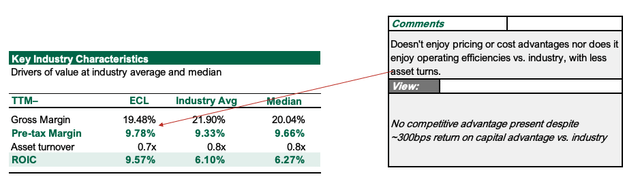
BALL doesn’t enjoy cost or price advantages (gross margins are in line with industry at ~20%, capital turns is 0.1x below industry, yet operating costs as a function of sales are the same), nor does it enjoy the consumer advantage through its offerings as operating profit margins are in line too. This makes sense – operating costs reflect capital costs in these industries because all competitors are trying diligently to lower prices and become more efficient, investing huge sums of money to do so. My view is that BALL does not enjoy competitive advantages above the industry, despite ~300bps more ROIC vs. peers.
Figure 2.
Company filings, Seeking Alpha, Bloomberg
Aside from that, the impacts of cyclical pricing of the underlying is abundantly clear when examining its value drivers and how the market’s responded to changes in these.
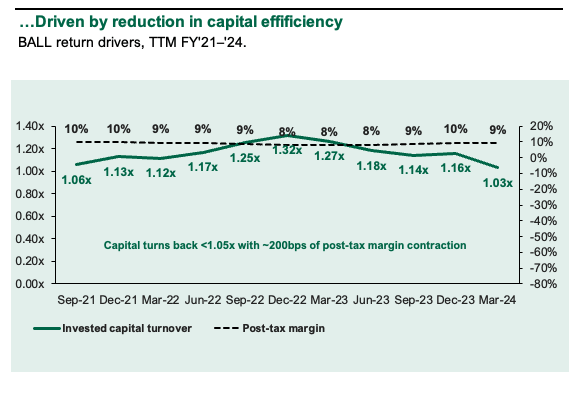
- Capital turns are ~0.3x lower vs. highs of 1.3x in FY’22 when spot aluminum peaked at $3,849/tonne in Feb. FY’22. But it has realized ~200bps less post-tax margin since even 1yr prior, and efficiencies were down during this period [post-tax margin in FY’22 = 8% vs. 10% in FY’21]. The fact is that 1) growth is highly dependent on capacity changes in the industry – conditions of short supply will drive both margins and capital turns, but 2) the runway to deploy capital is therefore hindered by what the demand cycle is for its end products. This phenomenon explains why, sales have increased $2.3Bn since FY’18, yet operating earnings are +$235mm – alas the business realized just 10% of incremental sales before CapEx. Operating earnings are +$76mm since FY’22, despite sales tapering off. But it has had to invest ~$2Bn to produce these new earnings (3.8% pre-tax ROIC), and grew post-tax earnings just $102mm, ~5% return on incremental capital.
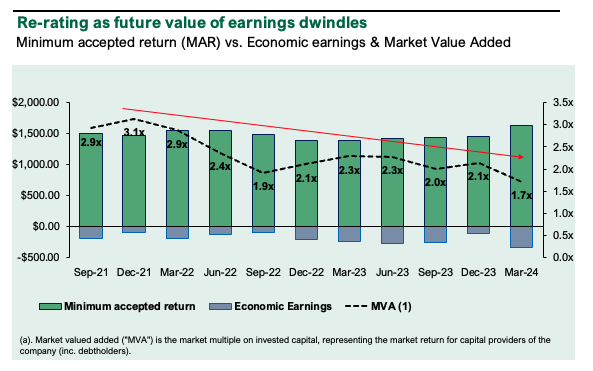
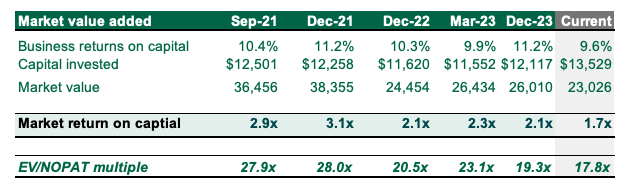
- These are unattractive economics in my view, for several reasons – 1) the market wants to see capital compound at reasonable rates, so $2Bn throwing off ~$100mm pre-tax doesn’t cut it. Why? Say you believe the market returns ~10-12% long-term, as ~100yrs of history has shown us. If that’s the ‘opportunity cost’, BALL management is compounding investor capital (debt + equity inc. retained earnings) at suboptimal rates. Unsurprising given the industry’s figures (avg. ROICs are ~6% anyways) but the issue I see is there is no escape from this due to these commodity-like economics. As such, market values are largely a reflection of whatever multiple investor decide to pay, not a combination of both earnings growth/(decline) and multiple expansion/(contraction). Such has been the case on the downside for BALL; as ROICs rolled down from ~10-11% in FY’21–’22 to <10% in Q1 FY’24, investors now value the company at 1.7x EV/IC – lower than (i) FY’22, and (ii) March, June + September FY’23 – despite post-tax earnings growth of +$95mm over these periods on a TTM basis (Figure 4). BELL’s earnings are less valuable.
- It’s also worth noting the company sold its aerospace business to BAE Systems in April, netting ~$4.7Bn pre-tax. Management paid ~$2.8Bn in debt and will buy back ~$1.3Bn in stock. In my view – bad move right now. The stock’s not heavily discounted in my view. I mentioned it has insufficient runway to deploy capital back into the business to expand or become more efficient – this is primary evidence of such.
Figure 3.
Company filings
Figure 3.a.

Company filings, author
Figure 4.
Company filings, author
Appropriately valued
Two questions need answering in the valuation debate – 1) what’s BALL worth, i.e., what’s the discounted value of cash it can produce, after-tax + reinvestment for growth and maintain its competitive position, and 2) what’s the propensity for investors to pay historical multiples on this company?
Valuation insights
- You can see the cyclicality in owning this name in Figure 5 – it’s traded in a range of 18x – 28x in the last 3 years, despite little variance in operating drivers.
Figure 5.
Author, company filings
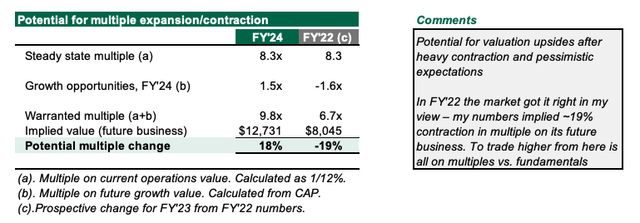
- In my view, there is high potential for valuation upsides after 1) the heavy contraction from FY’23-date, and 2) the lower embedded expectations indicated by this. In FY’22 the market got it right in my view – my numbers implied ~19% contraction in multiple on its future business, and the multiple has, in fact, compressed by roughly that amount (Figure 6). To trade higher from here is all on multiples vs. fundamentals as I mentioned earlier, which is fine for many [you’re either getting investment return (earnings growth), or speculative return (multiples expansion), or both, as a total market return], but this isn’t our investment tenets. Nevertheless, based on 1) the cyclicality of the industry, 2) BALL’s historical multiples are >20x NOPAT, and 3) the value of its future business is worth 1.5x in my view, implying an 18% growth in multiple to ~21x.
Figure 6.
Author’s assumptions
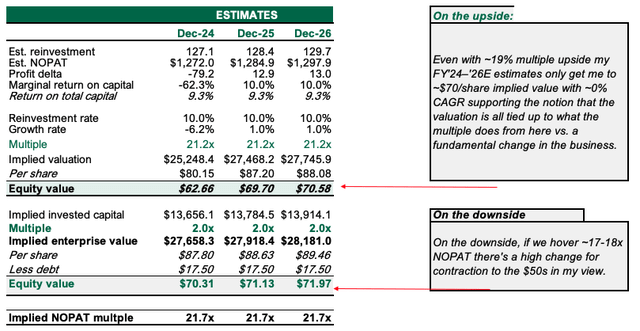
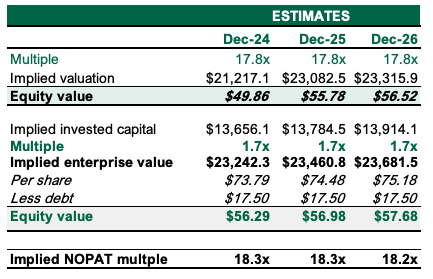
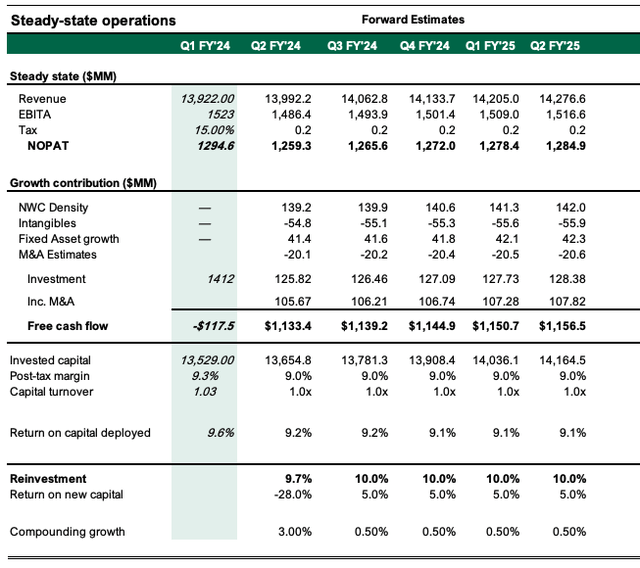
- But even with ~18% multiple upside to 21x NOPAT my FY’24–’26E estimates only get me to ~$70/share implied value with ~0% CAGR [see: Appendix 1]. This supports the notion that the valuation is all tied up to what the multiple does from here vs. a fundamental change in the business – which I cannot wrap my investment cortex around. On the downside, if we hover ~17-18x NOPAT, there’s a high change for contraction to the $50s in my view (Figure 8).
Figure 7.
Author’s assumptions
Figure 8.
Author
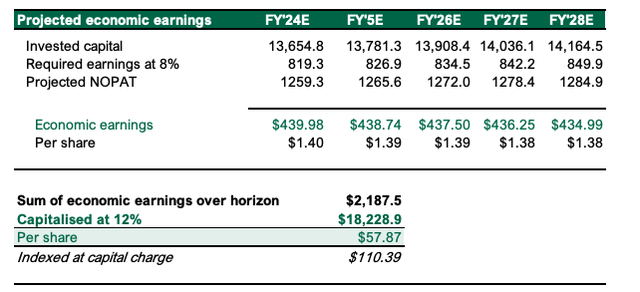
- Second question is what’s the value of the discounted cash we can strip out of this name in the next 5 years – notably I’m excluding dividends [forward yield’s only ~100-120bs] and I’ll take it one step further by indexing this value against a capital charge to decipher if it’s a smart use of capital or not. All NOPAT >6% hurdle rate is economically valuable in this sense (the 6% is the starting yield on many investment-grade corporates around this level of risk) then discounting this at our 12% opportunity cost gets to ~$58/share, roughly where the stock trades today. The market has it appropriately valued in my view. My forward estimates assume ~3% sales growth, 11% pre-tax margins + investment of $1.70 per $1 of new sales with ROICs fading to ~9.1%. Tweaking these yields little change to the outcome.
Figure 9.
Author’s assumptions
Risks
Upside risks are 1) another price swing in spot aluminum to previous all-time highs, 2) ROICs back to 11% or higher, 3) post-tax margins >10%< and 3) general drift in the broad market driven by rates or inflation-based decisions.
On the downside, the stock can trade lower based on a further contraction in valuation multiples, in my view.
Investors must realize these risks in full before proceeding.
In short
BALL is a good business that has an extensive global footprint in its domain. The company is a hold in my opinion due to 1) its commodity-like economics that leave little room to deploy capital on a stable, effective runway, at an advantage and 2) valuations that aren’t supportive even with aggressive assumptions. It is all tied up to the multiple – and whilst there’s scope for expansion back to previous range, there isn’t enough flesh to put on the skeleton in this instance in my view. Net-net, rate hold.
Appendix 1.
Author
Credit: Source link