

Klaus Vedfelt
Investment Thesis
AudioEye’s (NASDAQ:AEYE) stock is up 300% in the past year. This is one of the strongest-performing small caps. Meanwhile, its Q2 2024 results are met with further cheer, with its share price up 4% premarket.
As it stands, the stock is priced at 29x next year’s EBITDA. While I fail to see a compelling risk-reward, I’m firmly cognizant that an overhyped stock can become even more extravagantly priced.
As the saying goes, after all, twice a silly price is not twice as silly; it’s still just silly.
Along these lines, I’m savvy enough to leave room for doubt in my analysis, for this stock to continue heading higher. Therefore, I won’t issue a sell rating on this name, but stick to the sidelines here.
Rapid Recap
Back in April, I said,
Although AEYE’s guidance undoubtedly was positively revised higher, I question whether investors are getting much of a bargain here. Yes, the stock is a small cap. And yes, small caps are under-followed.
But I argue that this under-followed small cap is not undervalued. Therefore, I’m firmly neutral on this name.
Author’s work on AEYE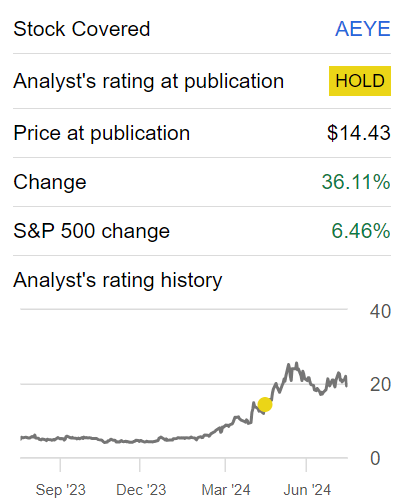
Since I made those comments, this stock has gained legs and a strong following. But beyond a hyped up narrative, I don’t see a lot of value to its stock. Therefore, I remain neutral. Here’s why.
AudioEye’s Near-Term Prospects
AudioEye helps make websites and mobile applications accessible for people with disabilities. The company uses a combination of artificial intelligence and human expertise to identify and fix accessibility issues, ensuring digital content compliance with the Disabilities and Rehabilitation Act.
In Q2 AudioEye expanded its enterprise and partner channels, showing the fastest growth rate in several years due to an effective go-to-market approach. Also, despite maintaining flat operating expenses, AudioEye achieved record adjusted EBITDA and free cash flow, highlighting efficient expense management. Further, AudioEye expects this positive momentum to continue, aiming for the Rule of 40 in the third quarter.
Yet, despite AudioEye’s positive growth trajectory, it faces challenges. The company must navigate the complexities of scanning thousands of pages across various industries, which is a monumental task. Furthermore, as regulations become more stringent, the company must ensure that its AI and human-assisted solutions can scale efficiently.
Given this background, let’s now delve into its financials.
AudioEye’s Revenue Growth Rates Will Moderate in 2025
AEYE revenue growth rates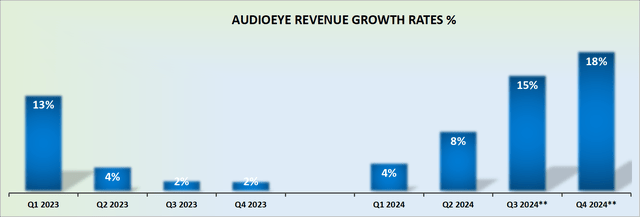
AudioEye Q2 2024 essentially met the high end of its revenue guidance, and the revenues were up 8% y/y. This is not a high-growth company, this much is clear.
But what complicates matters further, is that the comparables with the prior year are so easy, that naturally, its outlook for H2 2024 looks rather enticing. But I urge readers to think about this from this perspective.
The market is a forward looking mechanism. The market is always looking ahead by 6 months. Therefore, you must look ahead 12 months to be ahead of the market. There’s no point extrapolating beyond 12 months because the future becomes highly unpredictable. This is the unavoidable truth.
Back to AudioEye, what do readers think is a likely growth rate in 2025? Particularly given these tougher comparable figures from this year? I struggle to see AudioEye delivering more than 15% CAGR. And that’s a generous assumption.
So, what we have here, is a company that isn’t even reporting $50 million in revenues, already delivering subpar growth. Consequently, this stock won’t merit a high multiple on its stock, a topic that we’ll jump right into, next.
AEYE Stock Valuation — 29x Forward EBITDA
One thing that I believe AudioEye has done prudently is to stop repurchasing its shares in the quarter. Having bought back approximately $3.1 million worth of stock in Q1 management decided to reconsider its capital allocation strategy. A prudent move.
After all, AudioEye’s balance sheet has now dipped into a slight net debt position of $1.7 million. For a business with just $5 million of cash on its books, buying back stocks is in my opinion foolish. The market can be so wild and unpredictable, that using what spare resources the company has to buy back stock, makes little sense to me.
If AudioEye’s long-term opportunity is as attractive as management declares it to be, then why repurchase shares in Q1? After all, investing in the company would deliver stronger growth, especially for a company that is still far from delivering $50 million in revenues, with an ARR of $33 million.
Along these lines, management reminds investors that they have an ATM. This means they have the ability to raise capital At The Market, at any time, and are likely to use it if shares become too expensive.
Moving on, let’s assume that AudioEye exceeds the high end of its $6 million EBITDA guidance and delivers $7 million of EBITDA this year. Furthermore, let’s make the case that next year this EBITDA line grows by 20% y/y to $8 million.
This leaves investors paying 29x next year’s EBITDA. From this multiple, what sort of multiple expansion are investors hoping to get? 35x forward EBITDA? 40x forward EBITDA? On the back of maybe 15% topline growth? This doesn’t make any sense to me. I honestly believe there are much better risk rewards elsewhere. If anything, the market has opened up quite a lot in the last 2 weeks. Finding bargains now isn’t difficult.
The Bottom Line
Given the current valuation, paying 29x next year’s EBITDA for AudioEye does not offer an enticing risk-reward profile for investors.
Despite AudioEye’s fair growth and its stock’s impressive gains over the past year, the company’s expected EBITDA growth and revenue figures do not justify such a high multiple.
The projected EBITDA of $8 million next year, coupled with revenue growth rates that are likely to moderate, suggests limited potential for significant multiple expansion.
With revenues not yet reaching $50 million and an annual recurring revenue of $33 million, the company still has substantial hurdles to clear in scaling its operations efficiently and meeting stringent regulatory demands.
Given the company’s modest growth prospects, this steep valuation seems overly optimistic, making it prudent for investors to seek better opportunities with more favorable risk-reward ratios elsewhere in the market.
Credit: Source link