
powerbeephoto/iStock via Getty Images
Introduction
Atkore Inc. (NYSE:ATKR), a mid-cap play on the growing importance of electric infrastructure in the country, (over 90% of the company’s products are used to support electric infrastructure) has proven to be a solid source of alpha over the past year. During the last 12 months, we’ve seen the stock expand by over 50%, and in the process, also outperform both the key benchmark (by 1.79x), as well as its peers from the broad industrial landscape (by 1.21x).
YCharts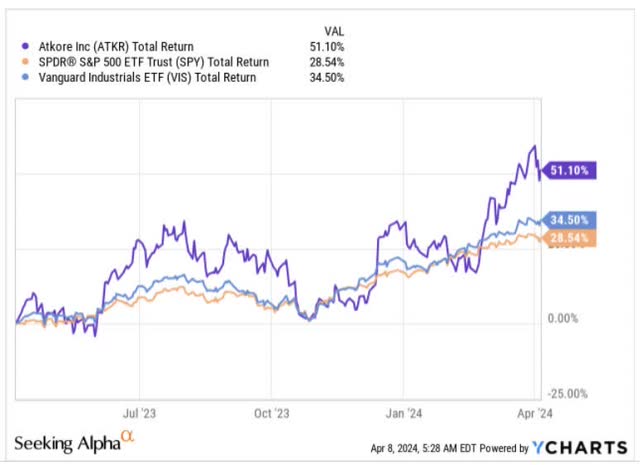
ATKR essentially provides electrical (this segment accounts for over three-fourths of the business and mainly conduits, cable, and installation products), safety, and infrastructure products (includes products and solutions such as metal framing, perimeter security, cable management), and could well become a pivotal cog in the electrification movement if electricity is to become the primary energy source over time. As things stand, only a third of total energy demand comes from electricity, but the heightened growth potential of end-markets such as data-center, manufacturing, healthcare, etc. (all of which are becoming more electrified) suggest that this share will likely grow over time.
Besides ATKR’s well-established stance in electrical product manufacturing, its stature in the investment community has also recently been enhanced by its decision to commence a new quarterly dividend program from this year onward.
ATKR may be in a good way, but at this juncture, we would choose not to go overboard with our enthusiasm. Here’s why we think it may be prudent not to get too euphoric about ATKR.
Industry Gauges Suggest Some Weakness Ahead, And Forward Valuations Don’t Reflect This
What’s key to note is that Atkore’s prospects are keenly linked to dynamics in the non-residential construction space, as this drives an overwhelming chunk of the company’s product installations. Looking at some key industry gauges, we’re inclined to believe that things may not be too rosy.
For instance, consider the trend with non-residential starts, which typically leads Atkore’s product installation momentum by 2-4 quarters. As per the latest reports, non-residential starts dropped by 16% in February, a lot worse than the 8% decline seen by total construction starts. Even if things don’t get much worse once the Fed pivots from its rate stance, it is worth noting that the commercial sub-sector within non-resi construction is unlikely to make a meaningful comeback. On a 12-month basis, non-resi building starts are down 2% on a YoY basis.
Even the Association of General Contractors of America has suggested that things like adverse weather patterns have prompted sequential declines for all non-residential projects in February.
It’s also worth noting that on the Q1 earnings call at the start of February, ATKR management had flagged that January was a particularly difficult month for them, and Q2 as a whole would see lower volume growth than what was seen in Q1 (ATKR follows a September year ending fiscal).
Now, this may be relatively backward-looking commentary, but don’t dismiss what the forward-looking Dodge Momentum Index (DMI) is suggesting. For the uninitiated, this metric measures the non-resi building projects that are going into planning and provides some leading context on non-resi construction spending by roughly one year.
Construction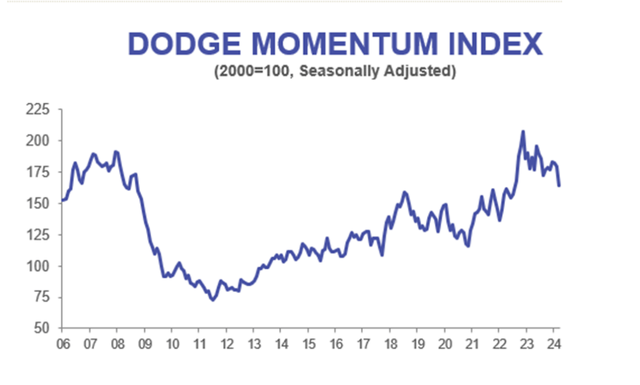
The latest report for March which came out at the end of last week pointed to an 8% decline, with institutions-related planning work being particularly weak (down by 17%).
If these types of demand conditions take hold, we’re not sure ATKR will be best positioned to regain some pricing strength. For context, note that in Q1, pricing had a -16% impact on the topline.
These pricing pressures will also be keenly felt on the EBITDA front with EBITDA poised to decline by -11% (at the mid-point of management’s FY24 guided range of $900-$950m), and EBITDA margins poised to come off by 350bps this year. Note that this EBITDA margin decline is unlikely to be a one-off, with YCharts consensus suggesting that EBITDA margins could decline even further by close to 70bps in aggregate over the next two years.
YCharts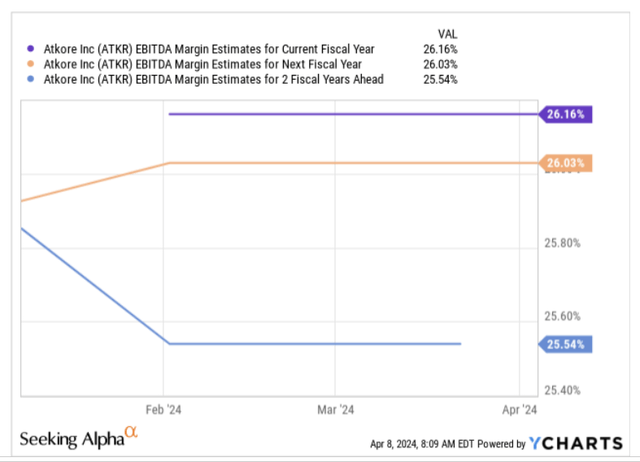
In light of this unappealing EBITDA outlook, we feel it is difficult to justify paying a forward EV/EBITDA multiple of 7.7x, which translates to a whopping 60% premium over the stock’s long-term average of 4.81x.
YCharts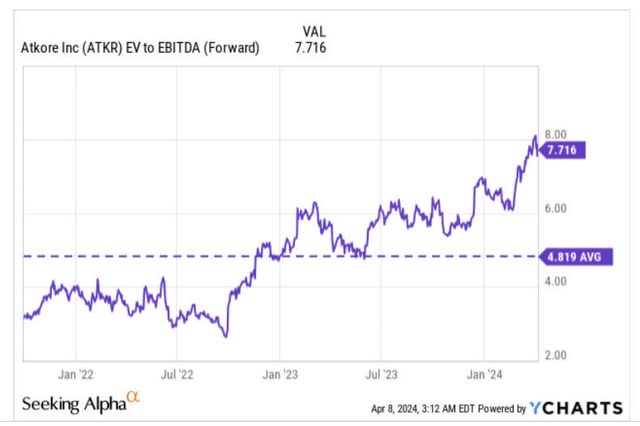
Then, whilst we acknowledge ATKR’s consistency in generating FCF (free cash flow) over time, questions may certainly be asked if this is the most optimal point to be looking at ATKR. Already consider that ATKR’s FCF yield of almost 7.6% is a good 400bps lower than what it normally yields, and with the company now targeting double-digit volume growth, and the ramp-up in volumes from the new Indiana plant, inventory and accounts receivable will likely be a drag on the operating cash flow position.
YCharts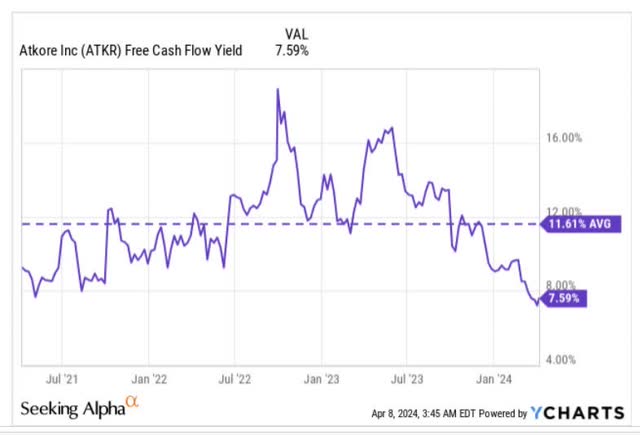
Closing Thoughts – Risk-Reward On The Charts Look Unappealing
Even technically, we don’t think it would make a great deal of sense to be gung-ho on the stock at this point.
For instance, if we view the weekly price imprints of ATKR over the last 30 months or so, we have a fairly consistent upward-sloping resistance, and a steeper support line that seeks to converge with the upward-sloping line over time. Put another way, the price has been trending within a rising wedge pattern, which generally points to a risk of reversal. Recently, a fair few may have thought that ATKR was well-poised to break out of this wedge and drive further upside, but we had our doubts, as volumes on the stock were on a declining trend since March.
Investing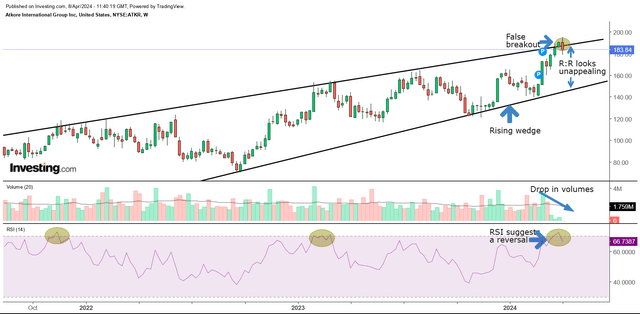
Separately, also note that the smart money used the March rally to actually reduce their stake in ATKR by around 3%
YCharts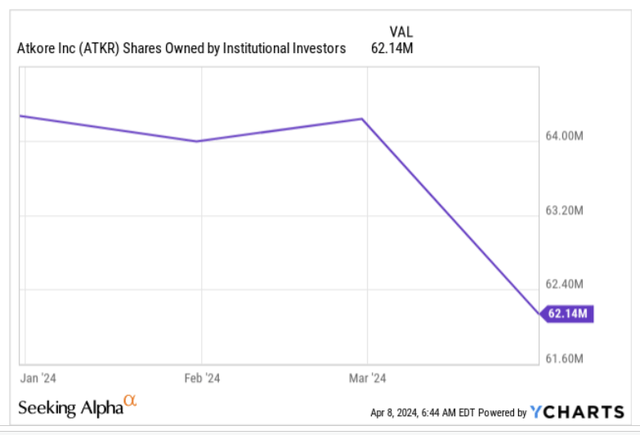
Regardless, what we’ve seen in recent weeks is a false breakout, with the price now falling back into its old wedge. Note also that the RSI recently hit overbought levels, and we’ve seen previously in 2021 and 2023 where it hit these levels, and then we saw a drop in price in the following weeks. Within the wedge as well, clearly the risk-reward looks rather unappealing, and we would be open to considering ATKR only if drops closer to the lower boundary of the wedge.
Even within the broad industrial universe, ATKR’s stock does not look like an appropriate beaten-down name that could benefit from mean-reversion. Rather, what we can see is that ATKR’s current relative strength ratio versus other industrials is at record highs and a good 120% greater than its long-term average. This may prompt rotational specialists who focus on the industrial sector to move out of ATKR into other bargain offerings.
YCharts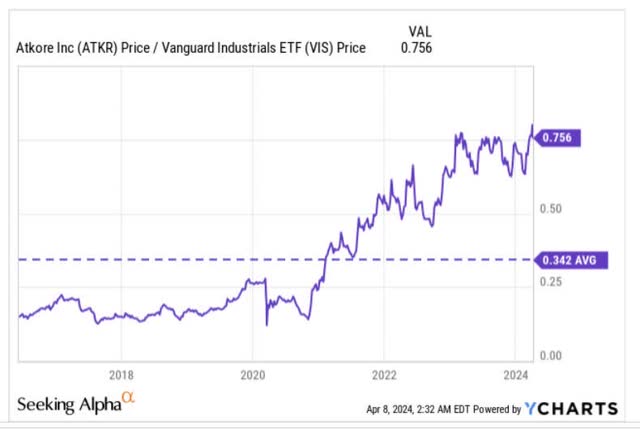
Credit: Source link