

pick-uppath
Background on Supply Chain Problems for ASML
I have written extensively about ASML (NASDAQ:ASML) and its supply chain issues beginning in my October 24, 2021 Seeking Alpha article entitled “ASML: Too Inconsistent, Too Overbought To Recommend.” I noted:
ASML blamed supply chain issues for shipment delays. How is it that a monopolistic company selling just 20+ systems a month experience supply shortages?
Poor supply chain management/executive management may be the problem. Yes there are shortages, but for 20 units per month! And this poor supply chain management is a factor in uneven revenues and earnings and significant misses in guidance.
Five months later on March 22, 2023 I wrote another Seeking Alpha article entitled “ASML: Fire And Supply Chain Woes Plague Shipments And Revenues.” I noted:
My analysis suggests that the fire on January 3, 2022 has caused such significant financial disruption that ASML will miss Q1 2022 guidance.
The fire at ASML’s plant and continued supply chain shortages have wreaked havoc on the company’s revenues.
But the most problematic issue is ASML’s “Fast Shipments,” which continues today. In a January 13, 2023 Seeking Alpha article entitled “ASML: Important Questions Are Still Unresolved Leading Up To 4Q Earnings Call,” I noted:
Currently “fast shipments” are significant. As ASML’s Skip Miller notes:
“We currently have $2.2 billion coming out of 2022 into ’23, and depending on how fast shipments evolve, we may have some coming out of Q4 next year unless we’re able to result some of the accounting issues with respect to revenue recognition.”
And I explained in the article and will repeat it here for the uninformed:
Because of the complexity of the EUV systems, ASML has a unique way of categorizing EUV sales vs. shipped. ASML uses the term “fast shipments,” which is in support of customers’ desire to bring systems into production as quickly as possible. By skipping some of these testings in its factory, ASML can shorten the cycle time. Final testing and formal acceptance then take place at the customer side, at which time ASML will recognize revenue.
ASML’s Poor Q1 2024 results
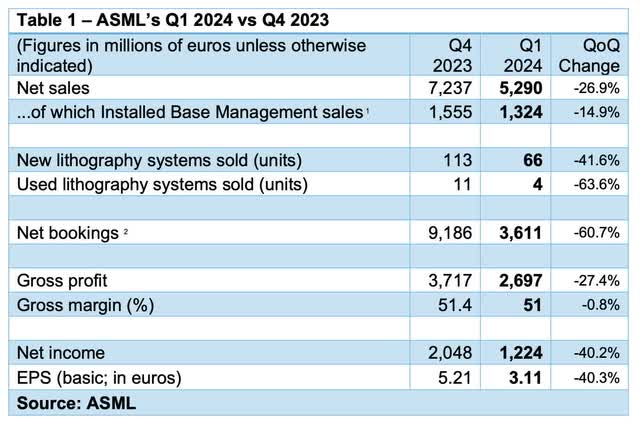
ASML reported Q1 2024 earnings on April 17, 2024. The company’s results were net well accepted by investors, as the stock closed down 7% on the day. Table 1 compares the recent Q1 2024 results with the previous quarter. Results were worse in every category, with QoQ changes noted.
ASML
Just Speculation?
What’s important for this article is that net bookings were down 60.7% QoQ to €3,611 million. On the face of it, ASML expects 2024 total net sales to be similar to 2023. In CY 2023, ASML generated €27,559 in net sales.
ASML’s CFO Roger Dassen clarified this issue in the earnings call:
There is quite a bit of speculation around order numbers, so I will make a few comments here. In the past six months, we’ve had orders of almost EUR13 billion, which is quite significant. As we said in the past, our order flow can be lumpy and may not be evenly distributed over the year.
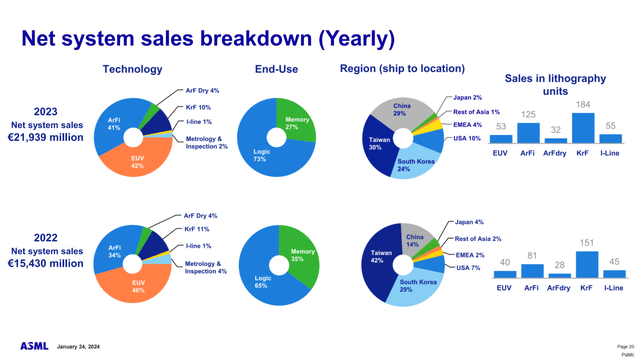
But this speculation has a lot of holes. Importantly, Q4 2023 revenues won’t be included in CY 2024’s revenues. Secondly, as shown in Chart 1, 29% of ASML’s 2023 revenues came from China, up from just 14% in 2022. And that growth was largely attributed by hording of ASML’s DUV immersion lithography systems by the Chinese semiconductor equipment companies in anticipation of U.S. sanctions.
ASML
Chart 1
Also note that EUV shipments increasing from 40 in 2022 to 53 in 2023. But don’t be fooled because these EUV systems were “fast shipments” meaning they were shipped, but not counted as revenues. While unit shipments increased 32.5% YoY, revenues increased 28.4% to €9,090 million. But average selling prices (“ASPs”) decreased from €181 million in 2022 to €172 million because of Fast Shipments since revenue for EUVs wasn’t recognized upon shipping, according to The Information Network’s report entitled Sub-100nm Lithography: Market Analysis and Strategic Issues.
How Will ASML Succeed in Equaling 2024 Revenues After a Poor Q1?
In my analysis, I have determined that ASML’s large backlog of DUV systems from the long period of supply chain disruptions will make up for low Q1 2024 revenues discussed above.
I reported in my February 13, 2024 Seeking Alpha article entitled “ASML Led Global WFE Equipment Market In 2023 As China’s Naura Maintains 9th Position,” that ASML took over the #1 position in WFE semiconductor equipment in 2023 from Applied Materials (AMAT). The only other time AMAT was dethroned as market leader was in 2019 by ASML.
Between the intervening 2020-2022 when ASML was #2, it was because of the “supply chain” issues I discussed in my series of articles noted above.
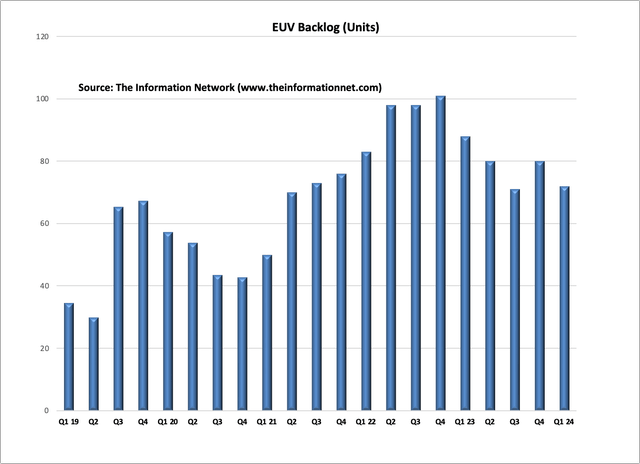
During that period of time, the backlog of EUV systems, systems ordered but not shipped, started ramping, as shown in Chart 2. This backlog increased to more than 100 EUV systems in Q4 2022. Currently there are approximately 75 EUV systems in backlog.
The Information Network
Chart 2
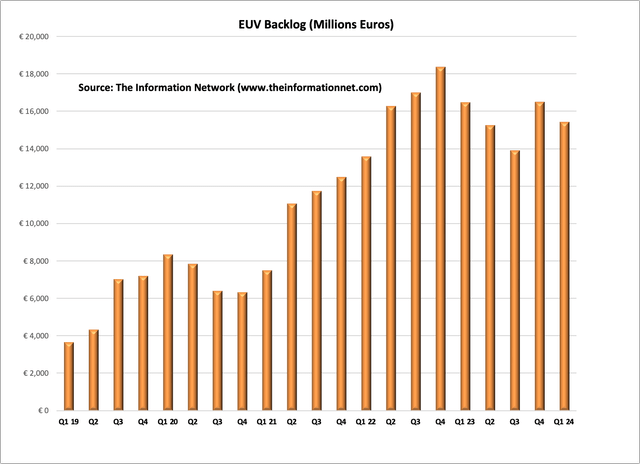
In Chart 3 I show the backlog of EUV systems by revenue, in Millions of Euros. Currently the backlog is about $15 billion Euros.
The Information Network
Chart 3
So for ASML to meet 2023 revenues of €27,559 million in 2024, and with revenues of €5,290 million already achieved in Q1, ASML needs to achieve revenues €22,269 million in the next three quarters.
Soon-to-be new ASML CEO Christophe Fouquet noted in the earnings call:
For EUV, we continue to expect revenue growth in 2024.
We expect our non-EUV business to be down in 2024.
I forecast that ASML will reach €8,476 million in EUV sales to hit €10,300 million for the total year 2024, which is above the €9,090 million in EUV revenues in 2023, concert with Fouquet’s comment.
Fouquet also noted in the earnings call:
It appears we are passing through the bottom of this specific cycle and we expect an industry recovery over the course of 2024.
His comment mirror’s one I made in a December 6, 2023 article to subscribers of my Investing Group entitled “Semiconductor Equipment Downturn Will Continue Through 1H 2024,” where I noted:
The macroeconomic outlook for 2024 suggests modest global growth and a potential overcapacity of equipment in the semiconductor market. I estimate the semiconductor equipment market will increase 1% in 2024. Growth will be negative in 1H followed by an uptick in 2H.
EUV Share of Revenues Dropping
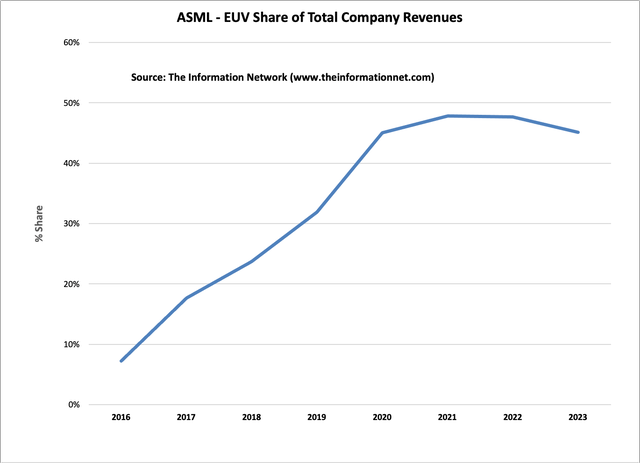
In Chart 4, I plot EUV revenue as a percentage of total ASML revenues. EUV share increased from 7.2% in 2016 to a peak of 47.8% in 2021.
EUV share dropped in 2023 to 45.1%, most likely due to ASML’s “fast shipments” in which EUV systems were dispatched to customers in 2023 without being completely finished and where customers agree to conduct final acceptance tests on-site rather than in the factory. Revenue wasn’t recorded until final testing, deferring recording the revenue from that sale until the machine was fully inspected and formally accepted at the customer site.
The Information Network
Chart 4
Investor Takeaway
Investing in ASML involves considering its unique position, technology, and the broader market dynamics. Here are several reasons why you might consider investing in ASML, which I discussed above.
ASML dominates in lithography machines. ASML is the only company in the world that manufactures EUV lithography machines, which are critical for producing the most advanced semiconductor chips. This monopoly-like status provides ASML with a significant competitive advantage and pricing power.
Of course, EUV is used only for nodes at 7nm and smaller for logic/foundry chips and for advanced DRAM nodes. But for larger nodes, DUV immersion is used, and here again, ASML stands out. That leaves competitors Nikon (OTCPK:NINOY) and Canon (OTCPK:CAJPY) viable for mainstream nodes, which will be helpful for them for sales in China which has been blocked at advanced nodes by U.S. sanctions.
The growing demand for advanced chips, driven by trends such as AI, digital transformation, 5G, autonomous vehicles and cloud computing translates directly into a need for more advanced chip manufacturing capabilities, benefiting ASML.
Finally, ASML has consistently demonstrated strong financial performance, with robust revenue growth, healthy profit margins, and a solid balance sheet. This financial resilience makes it an attractive investment for those looking for stable returns and potential growth.
As I noted in my February 13 article:
Amid sanctions in 2022 and 2023, ASML overtook Applied Materials as the top WFE (wafer front end) Semiconductor Equipment supplier in 2023. AMAT had flat semi equipment revenues CY 2023, losing its #1 Position it held for 20 years except for 2019 when ASML took over #1. Data for this article came from The Information Network’s report entitled Global Semiconductor Equipment: Markets, Market Shares and Market Forecasts.
I expect ASML will beat 2023 revenues in 2024 as management predicts, and the problems the company experienced in 2020-2022 will serendipitously enable ASML to meet its goals.
I rate ASML a Buy, particularly on the dip.
Credit: Source link