


















David Becker
Advanced Micro Devices, Inc. (NASDAQ:AMD) investors who chased its attempted breakout after Nvidia Corporation’s (NVDA) late May surge have been battered. Since my previous update, AMD has significantly underperformed the S&P 500 (SP500, SPX, SPY), as dip buyers likely took profit and rotated out.
It’s a timely reminder for investors to consider risk/reward and price action when assessing entry opportunities. The pullback started in mid-June, as AMD’s momentum was built into its highly anticipated AI event.
Wall Street analysts attempted to link the lack of a flagship customer for its newly-launched MI300 series AI chips to the selloff. However, AMD also assured investors that their AI accelerators are ready for sampling in Q3 before volume production in Q4. Hence, I assessed that the reasons cited likely aren’t sufficient enough to justify the pullback.
Instead, my readers should recall my previous update, where I cautioned investors to be patient as AMD’s valuation and price action were no longer constructive.
With the steep pullback as AMD fell nearly 20% from its mid-June highs, I believe it’s a reasonable time for me to provide an update on whether the current levels are attractive.
I assessed that AMD’s valuation is less aggressive than its frothy levels four weeks ago but still not undervalued. I gleaned that it seems, at best, fairly valued, which is also supported by Seeking Alpha Quant’s valuation rating of “C-.”
However, with industry-leading growth, profitability, and momentum grades of “A-,” some investors could consider the opportunity in AMD as reasonable, despite its fair valuation.
I believe there are sufficient reasons for investors to pay closer attention to AMD’s opportunities now. AMD highlighted that its AI chips are ready for ramp mode in Q4, suggesting that the company is confident of its roadmap in taking on market share leader Nvidia.
Moreover, supply chain sources also corroborate the confidence in CEO Dr. Lisa Su and her team as they are getting ready to support AMD’s growth inflection in the final quarter.
Foundry partner Taiwan Semiconductor Manufacturing (TSM), or TSMC, is reportedly preparing for more CoWoS advanced packaging capacity, which is critical for the fabrication of the AI accelerators. DIGITIMES reported that TSMC’s “monthly CoWoS capacity is expected to increase from 8,000 wafers to 11,000 wafers in the second half of 2023.” In addition, “Nvidia and AMD are projected to absorb 70-80% of the capacity.”
As such, TSMC’s focus on ramping up its advanced packaging capacity for its design partners is critical, as there were suggestions that TSMC could lack sufficient ability to meet near-term AI chip demand needs. As such, it’s possible that the elevated expectations over AMD and Nvidia’s growth inflection could have been overstated, leading to a steeper pullback if the market anticipates the earnings accretion might not pan out in the second half.
Despite that, AMD’s backend supply chain is reportedly optimistic about its ability to support AMD’s AI chips and its 4th Gen EPYC processors. It was reported that “AMD’s backend supply chain is scheduled to start working on the new chips in July,” which should align well with the company’s production cadence and revenue accretion as guided.
Therefore, I believe it likely all boils down to the market’s expectations of AMD’s execution prowess in the second half through 2024 on whether the company could gain a more solid foothold in the AI chips market. There are concerns that the server market could see much slower shipment growth in 2023 compared to FY22. In addition, higher-priced AI servers could also lead to lower shipments, requiring revenue accretion to be focused on ASPs increases.
While AMD reportedly launched superior AI chip hardware specifications than Nvidia’s H100, whether its open-source software ecosystem could compete effectively against Nvidia’s proprietary approach remains to be seen. For now, I assessed that these uncertainties would likely dampen further upward re-rating on AMD’s valuation. However, that also suggests that it could provide an attractive opportunity for high-conviction investors who have faith in AMD’s execution in working out these challenges and gaining share against Nvidia.
AMD price chart (weekly) (TradingView)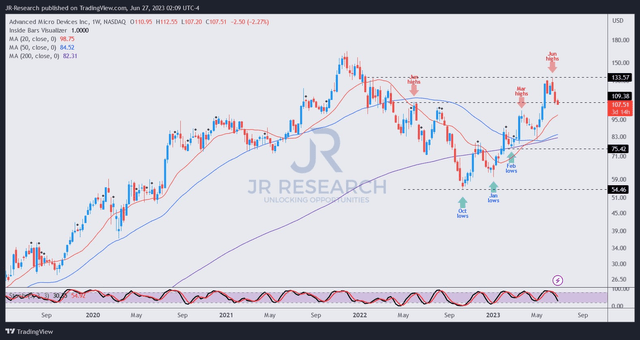
AMD has retraced closer to its 20-week moving average or MA (red line), close to the $100 entry zone.
I expect more buyers to return at those levels, which should help to underpin AMD’s buying sentiments. However, the aggressive buy zone could be lower if the tech rotation turns out to be more intense than expected. As such, investors should be prepared to average down further at lower levels.
Investors already with heavy/full exposure to AMD can consider adding at lower levels, while investors with little or no exposure should still find the $100 entry zone attractive.
With that, I upgrade my rating on AMD.
Rating: Buy (Revised from Hold).
Important note: Investors are reminded to do their own due diligence and not rely on the information provided as financial advice. The rating is also not intended to time a specific entry/exit at the point of writing unless otherwise specified.
We Want To Hear From You
Have additional commentary to improve our thesis? Spotted a critical gap in our thesis? Saw something important that we didn’t? Agree or disagree? Comment below and let us know why, and help everyone in the community to learn better!
Credit: Source link