

Justin Paget
Summary
Following my coverage of Altus Power (NYSE:AMPS) in Sep’23, for which I recommended a buy rating due to my expectation that AMPS can easily meet its 2H23 guidance, this post is to provide an update on my thoughts on the business and stock. After my post in Sep’23, the stock price rallied to a high of $7.28 (close to my previous share price target of $8.21), but fell horribly to $4.06. At the current valuation, I think there is another opportunity for investors to make upside returns. I still recommend a buy rating for AMPS, as I expect the business to continue benefiting from this tough macro-condition and growing demand for electricity in the coming decades.
Investment thesis
On 09/05/2024, AMPS released its 1Q24 earnings, which saw revenue of $40.7 million and pro-forma EBITDA of $19.7 million (implying a 48.5% EBITDA margin). The lower EBITDA margin relative to the AMPS typical range of high-50% should not be an alarming thing, as 1Q has lower revenue due to seasonality. In terms of assets, AMPS portfolio of operating assets reached 981 MW at the end of 1Q, up 85 MW sequentially and 303 MW over 1Q23, which implies 45% y/y growth. Driving the 85 MW increase is the contribution from the Vitol acquisition (which contributed 84 MW).
The market doesn’t seem to appreciate that AMPS benefits strongly from the current macroenvironmental dynamic in two ways. Firstly, the high interest rate and inflationary environment are putting a lot of pressure on consumers’ spending power; as such, every dollar of savings that they can achieve becomes more important, and this is where AMPS shines. AMPS’s business model takes advantage of underutilized rooftop solar space to access the community solar market, which benefits customers by reducing their utility bills. AMPS’s strategy is to sell the extra power it generates from its commercial and industrial customers’ rooftop solar panels to residential customers in the surrounding regions. For instance, an AMPS customer’s energy consumption may only necessitate a 5 MW system, even though the customer’s rooftop space is sufficient to support a 10 MW solar array. By constructing the additional 5 MW of capacity, AMPS will be able to sell excess electricity to the nearby community residents at a cheaper rate than what the residents would pay (i.e., cheaper than the prevailing rate). As such, I expect AMPS to continue to see a strong adoption rate, as the value proposition to consumers is huge. To give a sense of how strong the demand is, in 1Q24, AMPS grew the number of community solar customers by 20%, from 20,000 to 24,000.
We also now serve more than 24,000 community solar customers, an increase of 4,000 residential customers during the first quarter who are now subscribed to our solar facilities and receive the benefits of discounts on their local utility bills. 1Q24 earnings results call
Secondly, the high interest rate environment has pushed down asset prices, which makes it cheaper for AMPS to acquire. As a result of rising capital costs, which are limiting their capacity to build, several developers are pulling out of the market, and asset owners are selling off their commercial portfolios, as management pointed out during the most recent investor day. This benefits AMPS in two ways: (1) it provides more opportunities for AMPS to acquire assets, and (2) because asset owners are “forced” to exit because of the high rates environment, AMPS has strong negotiating power to ask for a cheaper valuation. Importantly, I believe AMPS has become a buyer of choice because they are informed of practically every possible portfolio transaction in the space. This implies that all sellers have sought out AMPS. Importantly, I believe AMPS has become a buyer of choice because they are informed of practically every possible portfolio transaction in the space. This implies that all sellers have sought out AMPS.
The reason AMPS has such a solid position in the M&A space is because of its significant partners, Blackstone and CBRE, who have extensive histories with AMPS. This partnership has strong strategic benefits. CBRE helps to “distribute” AMPS products to a large customer base by integrating AMPS into CBRE’s customer base and broader offering. Essentially, AMPS does not need to worry about getting customers because CBRE has a massive presence in the commercial markets. The main question is whether AMPS has sufficient financial capacity to conduct these M&As, and the answer is yes. The other partner, Blackstone, solidifies the AMPS balance sheet. Blackstone has invested approximately $1 billion in AMPS so far and plans to keep funding future growth, as they mentioned on investor day. As such, I view the backing and ongoing support from CBRE and Blackstone as a strong competitive advantage that AMPS has over peers of smaller scale.
AMPS AMPS
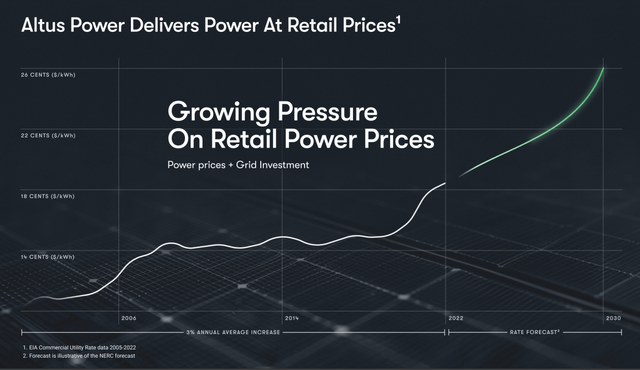
Lastly, I think we have reached an inflection point where electricity consumption is going to skyrocket in the coming years or decades due to drivers like AI adoption, demand for clean energy, etc. AMPS benefits from the increase in demand for electricity over the long term and the increase in utility prices in the near-to-medium term, as I expect the demand for electricity to outpace the increase in supply. Given the high fixed cost nature of AMPS, an increase in utility prices has a high incremental margin for AMP. According to AMPS, every 1% increase in power prices leads to a 0.4% increase in revenue, and I believe that 0.4% flows through at almost 100% down to the bottom line as there is almost no incremental cost associated.
AMPS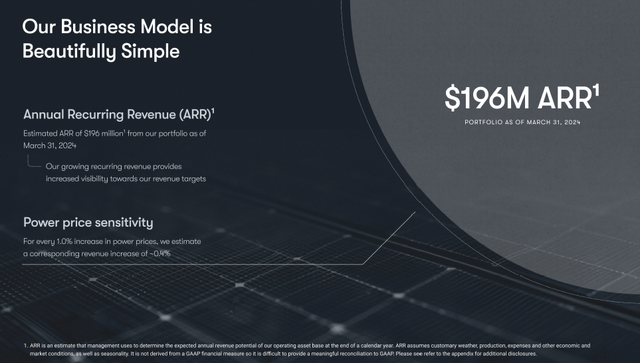
Valuation
Using the AMPS 3-year financial outlook (FY26), I believe AMPS is worth a lot more than what it is trading today.
The FY26 outlook expects AMPS to generate $288 million in revenue and $170 million in adj EBITDA. While this guidance was below my previous model expectations (I expected FY25 to generate $392 million in revenue and $239 million in adj. EBITDA), I think the growth rate is still amazing (23% CAGR) when compared to other power generation peers. For instance, Clearway Energy is expected to grow at low single-digit percentages, Constellation Energy growth is pretty muted, and FirstEnergy Corp. is expected to grow at mid-single-digit percentages.
Growth in EBITDA should translate to higher EPS growth, as AMPS has a quite a bit of financial leverage due to the debt it has. As of 1Q24, AMPS has a net debt position of around $1.13 billion (or 12x net debt to LTM adj EBITDA).
For valuation, I think AMPS deserves to trade at a premium to these peers (on average, the 3 peers I mentioned above trade at ~13x EBITDA). Assuming AMPS trades at a 1x premium, at 14x forward EBITDA (AMPS traded at this level 3 months ago), the business is worth an enterprise value of ~$2.38 billion, and that translates to a share price of $7.75 (vs. the current price of $4.06).
Risk
A further increase in interest rates may lead investors to assign a higher discount rate to AMPS, negatively impacting the stock’s valuation. Also, while AMPS has the backing of Blackstone, there may be times when AMPS needs to raise capital (suppose Blackstone decides to limit its funding), and this may negatively impact AMPS ability to grow, or existing investors may be diluted by new capital raises.
Conclusion
In conclusion, my rating for AMPS is a buy rating. AMPS benefits from strong tailwinds like rising electricity demand, and it offers a strong value proposition for consumers in the current macro backdrop. Notably, AMPS strategic partnerships with Blackstone and CBRE position them for future growth through accretive acquisitions. While the FY26 guidance is below my initial expectations, the expected growth is much better than that of industry peers. Hence, at the current valuation, I see significant upside opportunity.
Credit: Source link