

Mykola Sosiukin/iStock via Getty Images
Altimmune Inc. (NASDAQ:ALT) is completing a Phase 2 clinical trial of pemvidutide, an anti-obesity drug that appears to be able to bring important benefits to weight loss. The differentiating element compared to the competition seems to be the drug’s ability to attack 74.5% fat mass and, if confirmed in the next phase 2 and phase 3 steps, could create a competitive moat against already approved drugs that act on the same GLP-1 hormone. The market prospects appear to be very encouraging in terms of current and future growth, so much so that my hypothetical projection of the share price projects it well above $100 in 2030. To proceed on its path, however, Altimmune needs to find an important partnership that allows it to compete on par with the more renowned Novo Nordisk (NVO) and Eli Lilly (LLY) as well as other players. The potential of the drug, in my opinion, is very important, given the clinical results and market potential, and the chances of success should have a favorable wind. My rate is Buy.
Business Overview
Altimmune, Inc. is a clinical-stage biopharmaceutical company focused on one core product called Pemvidutide, designed and developed for the treatment of obesity and liver disease.
Pemvidutide is a GLP-1/glucagon dual receptor agonist and represents a relatively new and under-development drug category.
GLP-1 (Glucagon-like peptide-1) is a natural hormone that is released by the intestine after meals and on the one hand stimulates the production of insulin from the pancreas while on the other it reduces the production of glucagon (a hormone that increases blood sugar and stimulates glucose production in the liver)
A dual GLP-1/glucagon receptor agonist (such as Pemvidutide) acts on both of these hormones, stimulating beneficial effects, such as:
- Increases insulin secretion: Helps reduce blood sugar.
- Reduces glucagon secretion: Further contributes to keeping blood sugar under control.
- Slows gastric emptying: Increases the sense of satiety and reduces appetite, promoting weight control.
Regarding the Pemvidutide product, it should be underlined that in 2019 the company finalized the acquisition of Spitfire Pharma, Inc., a pharmaceutical company in the preclinical phase that had Pemvidutide as its main asset. It is therefore the development of a product coming from a relatively recent acquisition.
In terms of the regulatory process, the main steps inherent to product development can be summarized as follows:
- September 2021 – IND (Investigational New Drug) for MASH from the FDA followed by Phase 1b trial of pemvidutide in MASLD.
- January 2022, IND for obesity from the FDA followed by MOMENTUM Phase 2 trial of pemvidutide.
- October 2023 fast-track designation to pemvidutide (MASH) from the FDA.
Market Background
According to the World Health Organization, in 2019 around 5 million people died from non-communicable diseases caused by obesity and the trend is unfortunately continuously growing: in the last 30 years, the percentage of obese minors has quadrupled (from 2% to 8%) while the percentage of adults more than doubled (from 7% to 16%).
According to the Center for Disease Control and Prevention in the US, the costs related to medical care for patients with obesity are estimated at approximately $173B while companies are responsible for costs of absence from work due to illness of up to $6B.
According to Morgan Stanley, the global market for obesity treatments was $2.4B in 2022 but the most interesting thing is that exponential growth is expected up to $77B by 2030, of which $52B in the US alone. Goldman Sachs even estimates the market at $6B in 2023 and forecasts growth of up to $100B by 2030. It would therefore seem that the obesity treatment market could represent an excellent opportunity for any company able to offer effective drugs against this widespread form of disease in the coming years.
Going into more detail, according to the National Center for Biotechnology Information, the main risk factors or comorbidities of obesity include:
insulin resistance, glucose intolerance, diabetes mellitus, hypertension, dyslipidemia, sleep apnea, arthritis, hyperuricemia, gall bladder disease, and certain types of cancer. The independent association of obesity seems also clearly established for coronary artery disease, heart failure, cardiac arrhythmia, stroke, and menstrual irregularities.
Altimmune through Pemvidutide aims to intervene in a highly differentiated manner, apparently bringing significant improvements, both in weight loss and also in the main cardiovascular risk factors such as cholesterol, triglycerides, and hypertension.
Corporate Presentation – May 2024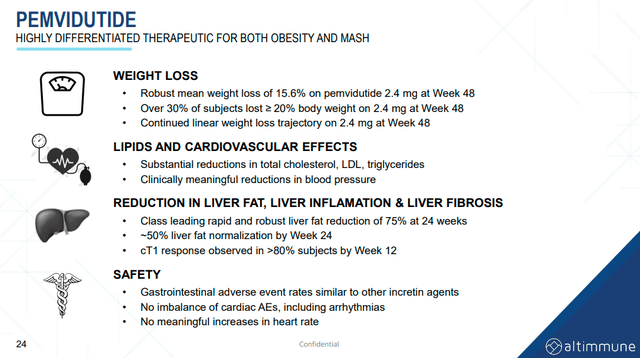
Investment Buy Thesis
My investment thesis in Altimmune is based on the findings of the phase 2 Momentum and Impact clinical studies, on the comparison with the market leader Novo Nordisk (NVO), and a projection of the possible future revenue and share price. All the items are analyzed below.
Clinical trial Phase 2 Momentum
Although this is still a phase 2 study which therefore requires further extensive checks before reaching the final regulatory phase, we can record some important signals that will most likely have a positive influence in some way on the ongoing activities with the FDA:
- Weight loss following the intake of Pemvidutide was recorded at 48 weeks with the predominant part of 74.5% in terms of body fat while the remaining part (25.5%) was associated with the loss of non-fat mass. This data, which the company believes to be comparable with the results obtained with diet and physical exercise, hypothetically places Pemvidutide as one of the possible best candidates (as a highly differentiating element) for the treatment of obesity against the regulator. Listening to the latest earnings call we can see that the company is also confident in a further improvement in the data in a period exceeding 48 weeks:
So if followed out over a longer time, that ratio should drop even further and put pemvidutide at the top of its class in terms of its preservation of lean mass. So, the number of trials, the selection of the population to maximize the value proposition, particularly the lipids, liver fat, the body composition, and the duration of treatment are all things that we aim to get an agreement with the agency when we meet with them.
- Mean Weight loss at 48 weeks was more than 10% with the minimum dose administered (1.2 mg) but more than 15% with the maximum dose administered (2.4 mg). This data represents another element of absolute importance and is statistically significant (p<0.001 vs placebo).
It has to be underlined that there are also other important results recorded in the clinical trial with the dosage of 2.4 mg which concern the percentage of subjects who achieved significant weight loss: more than 50% lost on average at least 15% of their weight while more than 30% lost on average more than 15%. Other positive effects of the treatment are attributable to improved blood pressure and reduced serum lipids.
Side effects were related to the presence of nausea and vomiting but with a mild to moderate incidence rate.
Corporate Presentation – May 2024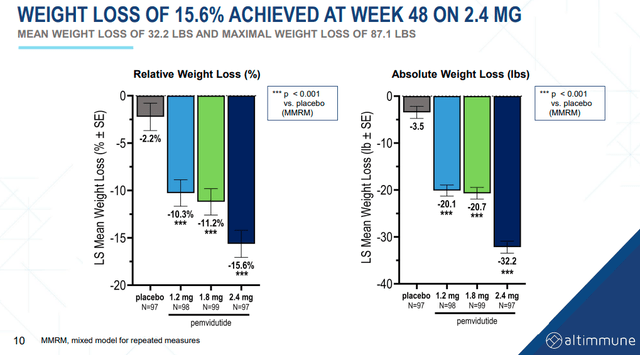
- The mean weight loss curve at 48 weeks with the maximum dose (2.4 mg) goes from a parabolic trend to a linear trend. This element, which might seem of little importance, actually lays the foundations for hypothesizing a possible very significant weight loss even in the period following 48 weeks and leaves the door open to define at a clinical level possible further improvements well beyond the 15% achieved to date.
Corporate Presentation – May 2024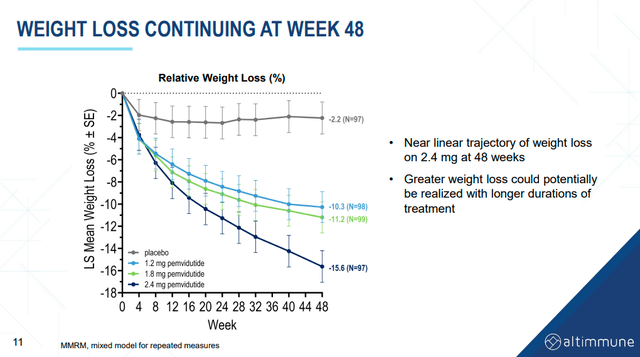
Novo Nordisk (NVO) has marketed the same GLP-1 agonist, named semaglutide, as an anti-obesity drug in 2021. The comparison between the two clinical results (same dose 2.4 mg) appears to be very similar in trend. At 48 weeks, the result of a weight loss close to 16% is almost identical for the two studies but, while the curve of semaglutide has a well-defined parabolic trend, that of Pemvidutide differs in the linearity of the trend. The linear trend, compared to the parabolic one, could indicate a much greater benefit in terms of weight loss. Semaglutide will then achieve a 16.9% weight loss over more than 68 weeks.
Novo Nordisk Investor Presentation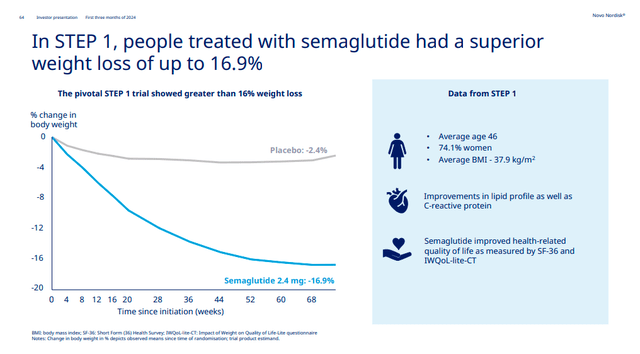
These results of Pemvidutide, in my opinion, should lay the foundations for a constructive review with the FDA for the discussion regarding the end of phase 2 (expected in Q3-24) and subsequently for the possible registration for the subsequent phase 3.
IMPACT trial Phase 2b
Regarding MASH (metabolic dysfunction-associated steatohepatitis) the company is completing the phase 2 study which should be finalized in terms of top-line results in Q1 – 25. This is a clinical trial based on biopsy with the administration of two doses (1.2 and 1.8 mg or placebo) with a double endpoint at 24 weeks on both MASH and fibrosis. This study should position Pemvidutide as an early candidate for incretin-based therapy with a 24-week endpoint.
In summary, the next company steps concern Q3 – 24 where the finalization of Phase 2 MOMENTUM with the FDA should take place, and Q1 – 25 where the top-line data for Phase 2b IMPACT MASH will be defined.
Competition
Competition in the GLP-1/glucagon dual agonist market for the treatment of obesity is relatively recent but highly competitive, the main competitors can be identified as:
Novo Nordisk (NVO) which has developed and marketed a GLP-1 agonist (semaglutide) under the Wegovy brand since the end of 2021
Eli Lilly (LLY) has developed a drug capable of activating both the hormone GLP-1 (glucagon-like peptide-1) and GIP (glucose-dependent insulinotropic polypeptide). This anti-obesity drug, tripeptide or Zepbound, was approved in late 2023
We are therefore in the presence of highly structured companies with drugs already approved for the same treatment and which are becoming (NVO already is as we will see in the next paragraph) undisputed leaders in the treatment of obesity with GLP-1. This, which might seem like a large barrier to entry, in reality, if seen from another perspective, can represent an excellent opportunity to enter a new market that, although highly competitive, has enormous margins for growth and therefore, potentially, many free spaces to fill.
Precisely to be able to compete in the best possible way on the market, it is known that Altimmune is actively looking for a long-term partner for Pemvidutide (last earnings call):
As you are all aware, our long-term goal remains to partner pemvidutide and we are firmly committed to finding a partner with the ability to maximize the near and long-term value of the program for Altimmune and our shareholders. And to recognizes the significant potential of our candidates in obesity and MASH as well as other potential indications.
In my opinion, this represents an important and probably binding turning point for the company’s future success. As a possible investor in ALT, I will need to carefully monitor future developments in terms of MA or partnership to define the real growth potential of the company.
While waiting to evaluate a future partnership, we can, to date, delve deeper into what the market leader is doing today and consequently hypothesize a possible future scenario.
Market and price share evaluation
Novo Nordisk Investor Presentation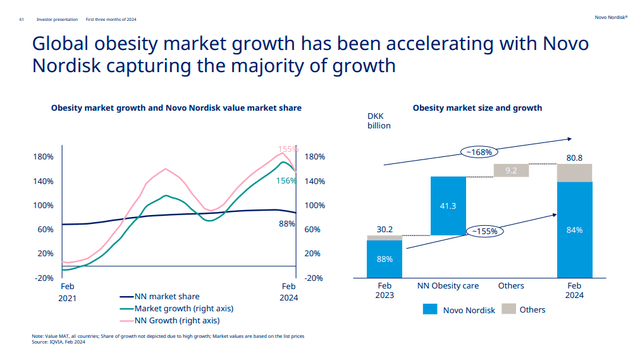
According to Novo Nordisk as of February 2024 the global obesity market is worth DKK 80.8 billion which, translated at the current exchange rate, is equivalent to $12.12B. Of these, 84% – equal to $10.18B are borne by NVO (undisputed leader) while the remaining part equal to $1.94B is borne by all the other competitors (including Eli Lilly).
I have no reason to believe that these data are misleading, as 84% of them are declared in the financial statements and the remaining part seems to be a more than reliable estimate.
Two factors should be noted: the market growth of 168% Y/Y and the loss of 4 percentage points of market share by NVO (from 88% to 84%) which is probably starting to be affected by the approval of tirzepatide which occurred just at the end of 2023.
These market growth data (168% Y/Y) confirm the growth projections estimated by Morgan Stanley and Goldman Sachs (see second paragraph of this article) which predict a total market value in 2030 between $77B and $100B.
At this point, assuming the most conservative scenario, i.e. a global market equal to $77B in 2030 and assuming that, by that date, Pemvidutide could have been approved and widely marketed, we could hypothesize a minimum market share of 3% for Pemvidutide. Under these assumptions, Altimmune could have an estimated revenue of around $2.3B ($77B X 3 %). In my opinion, this could be a conservative estimate of the possible Pemvidutide sales in 6 years.
Now if we assume a P/Sales equal to 3.55 (the benchmark for the biotechnology industry) Altimmune with a revenue of $2.3B could reach a stock market capitalization of $8.1B equal to 15.7 times the current market capitalization ($519M). Continuing the forecast, the current share price could grow by approximately 15.7, reaching $115 with a 4-digit return on investment in 6 years.
Financials
Assuming that the costs incurred in Q1-24 (Form 10-Q) can identify the expenses that will be incurred in the next quarters, we can hypothesize a hypothetical period of business continuity.
In Q1-24 R&D costs were $21.5M while General and administrative expenses were $5.3M. The total expenses are equal to $26.8M which on an annual basis can be estimated at $107.2M.
At the end of Q1-24, the company had $182.1M in cash and equivalents and could be sufficient funds to cover expenses for approximately 20 months. I therefore believe that the funds can allow the company to continue the business until the end of 2025. By that date, we should certainly have evidence on the future developments of the clinical trials, and we will be able to develop new hypotheses on the business future.
Risks
I think that the process with the FDA could represent an element of risk but not that great (at the moment) given the developments of the clinical trials in Phase 2, the data seems to be very encouraging and can lay the foundations for constructive discussions and analyzes for a positive continuation of the process with the regulator in the coming months.
What in my opinion represents an element of high risk is the market competition and more specifically the fact that large competitors such as NVO and LLY are already in a phase of marketing the competing product with clear competitive advantages (at least in terms of timing) on the rest of the actors (including Altimmune). The reference market is indeed in a phase of high growth and this should guarantee space for everyone, it is also true that the means and tools that giants such as NVO and LLY have at their disposal to conquer market shares are much larger than those that a company like Altimmune has available. This opens the way to the next point:
Another element of risk is the company’s need to identify a reliable partner to take maximum advantage of the possible commercialization of Pemvidutide. To date, this process has not yet been defined by the company and therefore remains an open question whose answer could potentially represent a high risk to business continuity.
Conclusion
Altimmune is moving the clinical trial aimed at marketing Pemvidutide into phase 3. The results relating to phase 2 demonstrated an excellent response in weight loss (completely similar, if not even better) compared to NVO’s semaglutide product. All this lays the foundations for a positive continuation of the process with the regulator. The market for obesity treatments is growing and forecasts for the next 6 years seem to project a possible global reference market that could reach $100B which leaves open a good opportunity for commercial growth for Pemvidutide. The hypotheses to support the investment thesis would project a possible share price of $115 for 2030 with an excellent potential return on investment which, in my opinion, is worth pursuing today.
Credit: Source link