

















Gary Yeowell
So far, there have been no summer doldrums for stocks – the US market posted a stronger-than-average June and enjoyed one of its better first halves of the past 20 years.
That said, high valuations in a handful of stocks seem driven by a single AI theme while the possibility of an earnings recession and Fed hawkishness have continued to raise questions in some minds about the viability of the rally.
While those challenges are real and a legitimate reason for caution – pullbacks and corrections are inevitable, after all – they don’t mean investors should turn their backs on stocks. They simply underscore the need to diversify in a way that properly reflects their investment goals and risk tolerance.
The good news: The benefits of branching out into other asset classes – especially fixed income, where yields are more attractive than they’ve been in years – have rarely been more apparent. But before looking at additional ways to adjust portfolios as we head into the final six months of the year, let’s take a look at how the markets performed in June.
US Equities
Stocks finished last month on a high note, with the S&P 500 posting its second-strongest June (+6.6%) since 1985. The Russell 2000 small cap index led the market with an 8.1% rally, while the tech-centric Nasdaq Composite gained 6.7%:
FactSet Research Systems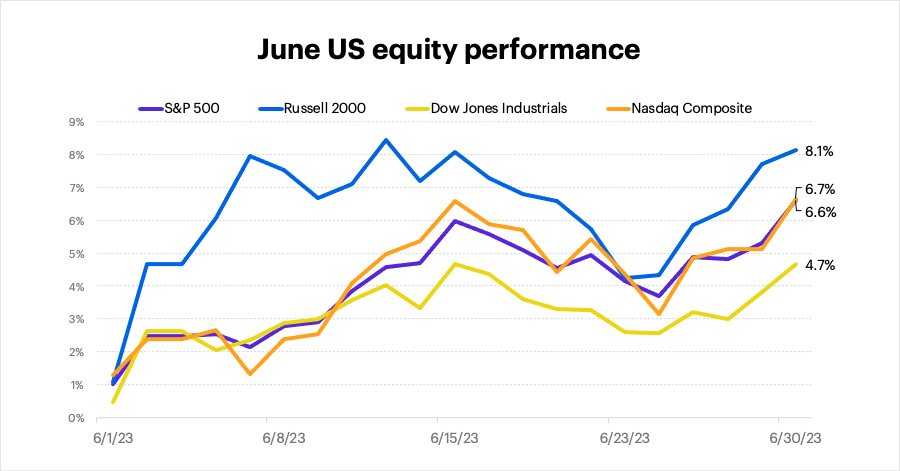
FactSet Research Systems. (It is not possible to invest in an index.)
Sectors
All S&P 500 sectors were positive in June, but three – consumer discretionary, industrials, and materials – ran far ahead of the pack. And while the tech sector had a very solid return, it trailed its May return by nearly three percentage points:
FactSet Research Systems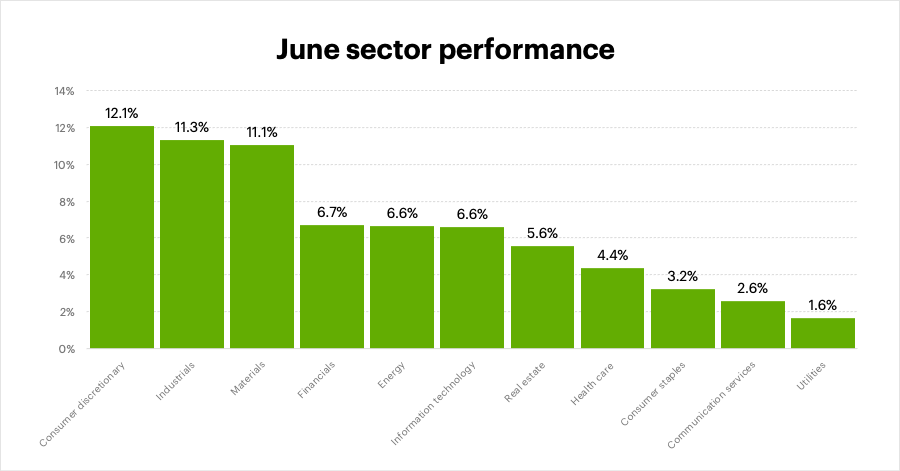
International Equities
International stocks slightly underperformed the US in June. The MSCI EAFE Index of developed markets rallied 4.6%, while the MSCI EM Index of emerging markets gained 3.8% (Latin America was especially strong):
FactSet Research Systems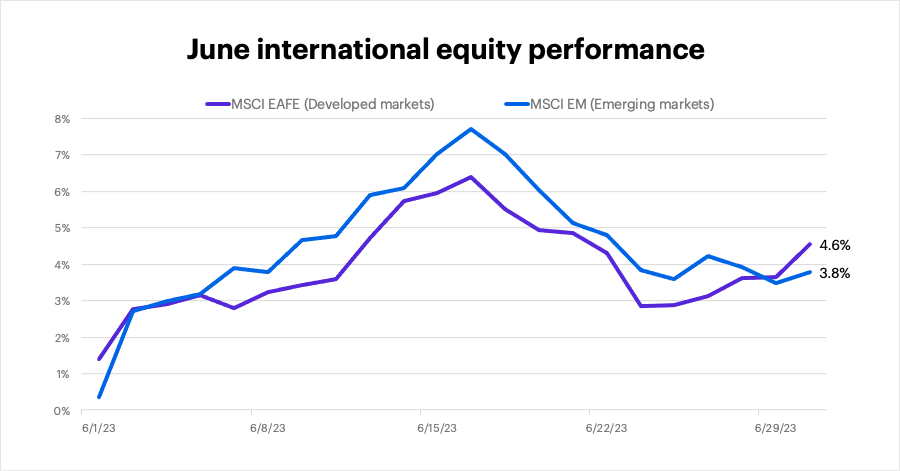
FactSet Research Systems (It is not possible to invest in an index.)
Fixed Income
Bond prices moved sideways for most of June. The shortest-term yields were flat to slightly lower from May, while intermediate to longer-term yields rose modestly. The benchmark 10-year Treasury yield ended June at 3.81%, up from 3.64% at the end of May:
FactSet Research Systems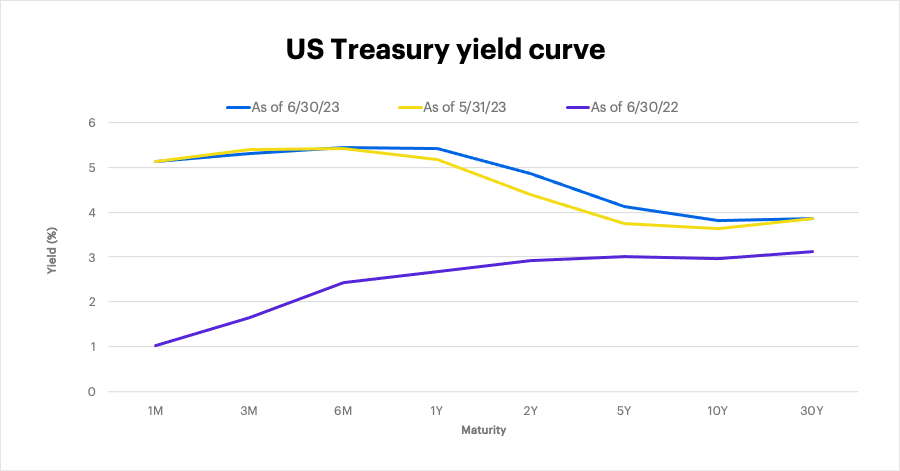
Looking Ahead
Here are a few ideas to focus on as we kick off the second half of 2023:
- Don’t fight the Fed. Continued strong economic data supports the idea the Fed will follow through on raising interest rates further, including later this month. Inflation has moderated, but it’s still above Fed target levels, and the labor market is still tight. As we’ve noted a few times in recent months, all signs point to the Fed staying hawkish for longer, and that pushes back the timeline for “stock-friendly” rate cuts.
- Beware the narrow market. The tech/AI rally may have slowed a bit last month, but the valuations of a handful of stocks at the forefront of the move have reached potentially extreme levels. While these names can certainly continue to run, history shows such elevated valuations tend to lead to lower returns. The innovation in the AI space is legitimate, but translating it into durable businesses and sustained earnings takes time – and it’s never a given.
- Stay in the game, but stay diversified. Investors who find themselves overly concentrated in the market’s narrow leadership may consider diversifying away from those names and into other areas of the market like fixed income, but also ETFs that track equal weighted indices, international equities, and small caps. Such simple steps can keep you in the game while reducing your exposure to a potentially overheated area of the market.
On any given day, seemingly unique events – the latest surprise economic number or bout of geopolitical turmoil, for example – can make investors feel like they’re in uncharted market territory. It’s only in retrospect that we realize that’s almost never the case. As always, stay disciplined, diversified, and focused on the long term. Doing so helps create “all-weather” portfolios that can keep you on course regardless of which way the wind is blowing at a given moment.
Credit: Source link