


Robert Way
Introduction
The last time we discussed Alibaba (NYSE:BABA) already dates back to February of this year. We rated the stock as a Strong Buy as we believed in the company’s long-term potential. Since then, the stock returned a measly 4%, while the S&P 500 (SPY) returned close to 12.50%. Since its all-time high in 2020, the stock is down over 75%.
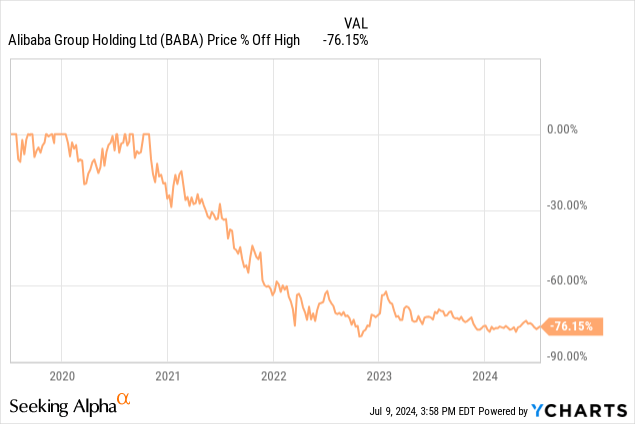
Ycharts
The question arises: “Is Alibaba really that bad of an investment?”. In this article, we will revisit some of our key points on why we believe Alibaba remains a strong buy and what is needed for the stock to finally start appreciating as we believe it will.
The Current State
Before we dive deeper into the macroeconomic factors and overall sentiment that impact Alibaba. Let us take a look at the underlying fundamentals of Alibaba and how they compare.
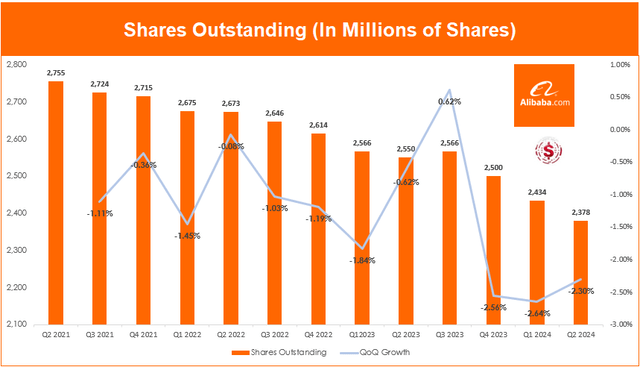
Let’s start by looking at the shares outstanding. As the stock became cheaper and cheaper the share buybacks became a larger focus point for investors.
In addition, Alibaba isn’t planning on stopping these share repurchases anytime soon. As things currently stand, Alibaba’s board authorized an additional $26.1B through March of 2027.
Stock Info
Alibaba remains a cash printing machine even when the recent stock performance might not seem like it. As such, it isn’t an unreasonable assumption that Alibaba’s board of directors might decide to authorize an even larger budget for share repurchases as long as the stock remains in the gutter.
In addition, the share repurchases aren’t the only thing Alibaba has done to give back to investors. Since our last write-up on Alibaba, they decided to issue a dividend.
Currently, Alibaba has a 2.72% dividend yield, which makes it an interesting dividend growth stock, as the stock currently only has a payout ratio of 11.62%. While we personally prefer share repurchases over dividends as a means of capital allocation. This small cash flow might help investors to stay patient while they wait for price appreciation to come.
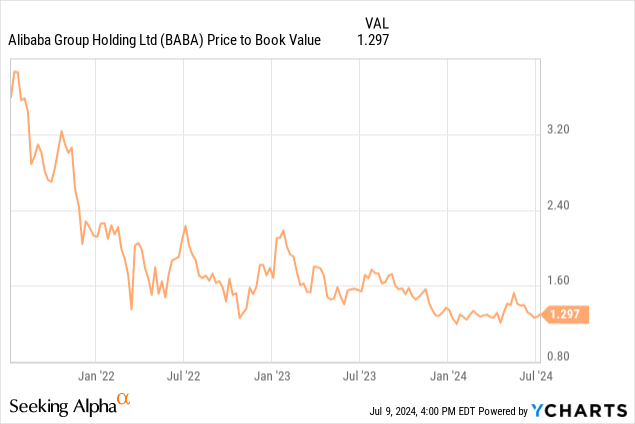
You might ask yourself, what makes Alibaba a cash flow machine? Well, at the current market cap of $164.64B, the company is able to generate a free cash flow of $24.772B, which means Alibaba currently sits at an FCF yield of a little over 15%. This means that the company would be able to buy itself back in less than 7 years if they would spend all their free cash flow on repurchasing stock (if the market cap would remain the same). This is massive and shows the value proposition Alibaba currently brings to the table. Let’s take a look at a few other metrics. Starting out with the Price to Book value. As you can see, Alibaba is trading close to its historical lows.
Ycharts
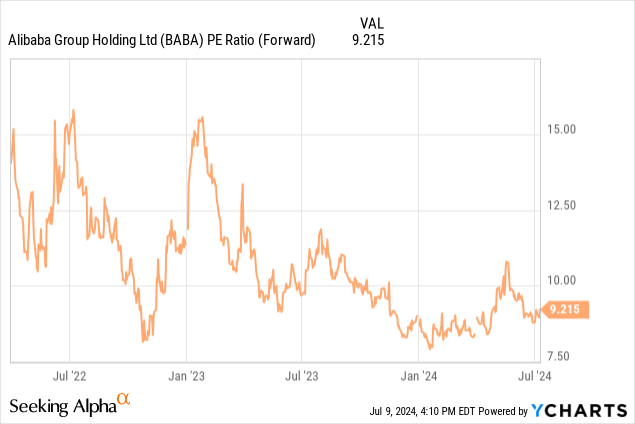
Forward PE ratio? Also close to ATL’s.
Ycharts
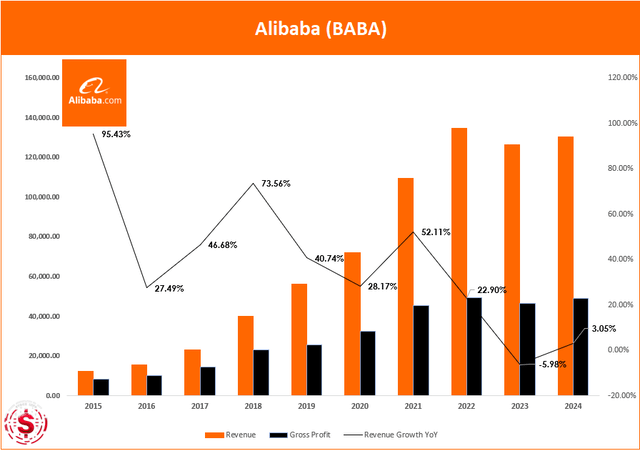
Sure, while this all sounds great, I’m not going to beat around the bush. Revenue growth has slowed quite significantly. This is a concern and definitely warrants a lower multiple than Alibaba deserved in 2020. But, at the same time, we believe Mr. Market is now undervaluing Alibaba and as such it has now become a very interesting value stock, which could generate significant alpha in the coming years with very limited downside.
Stock Info
Why is the Sentiment Bad?
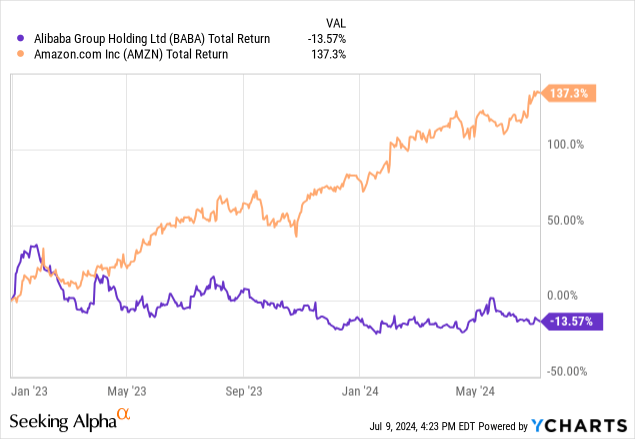
Let’s start by looking at its well-known competitor in the United States, Amazon (AMZN). Since January 1st 2023, Amazon returned over 137.3% to its investors, while Alibaba provided them with a negative 13.57% return, quite a significant difference.
Ycharts
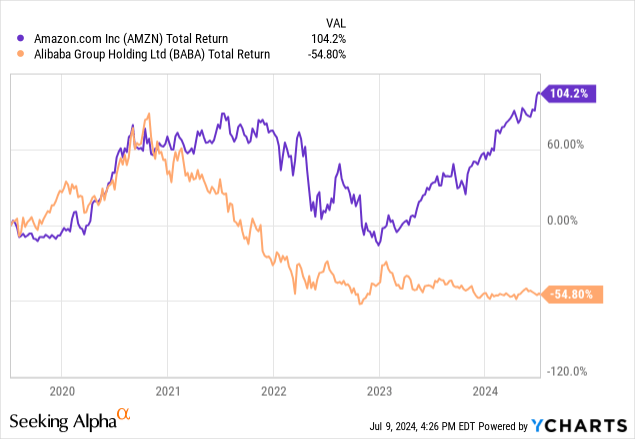
What does this look like on a 5-year basis? It looks even worse for Alibaba…
Over a 5-year period, Amazon gained over 104%, compared to Alibaba’s -54.80%. Why this comparison you might ask? Well, this shows that this isn’t a sector issue as Amazon has performed very well. To be clear, Amazon is a fabulous business and is executing better than Alibaba in our opinion. Nevertheless, Alibaba provides a much more enticing opportunity for value investors with a much larger margin of safety.
Ycharts
Where do the Problems Lie?
As we mentioned in our previous article, the biggest issue remains the negative sentiment around China and Alibaba’s stock as a whole. This is understandable, as an investor you aren’t happy when your position is underwater.
Last time, we mentioned that the Chinese economy was slow. But, the situation is improving. China announced that it is working on new capital market policies, which should be beneficial for the Chinese economy and as such should have a positive impact on large companies like Alibaba. In addition, China is trying to stabilize the real estate sector and the Chinese government recently experienced higher than expected GDP growth with Q1 numbers coming in at 5.3%, which exceeded the market’s expectations of 5.0%.
All in all, these are signs that China is slowly getting out of the woods again. But, it is crucial to continue watching how this develops further as the real estate market remains in a peculiar difficult situation.
Revenues by Segment
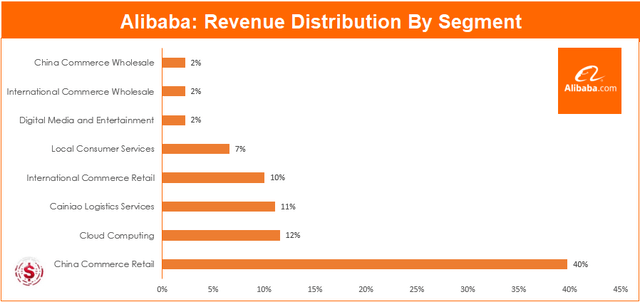
When we take a look at Alibaba’s revenue by segment, we can see that China Commerce Retail remains by far the biggest revenue driver with close to 40% of its revenue coming from this segment.
Stock Info with company filings
Last time we mentioned the following:
What is interesting to note is that Alibaba seems to have focused more on profitability over the last year. Of the 6 largest revenue drivers, all are posting a positive EBITDA this quarter. This is in stark contrast to the same quarter last year, where 4 out of 6 still posted negative EBITDA numbers.
What is interesting to see is that Alibaba’s revenue has now become a bit more diversified compared to when we last wrote about it, this is a positive sign. Nevertheless, China Commerce Retail remains the one to watch, China Commerce Retail includes Taobao and Tmall, the national eCommerce platforms.
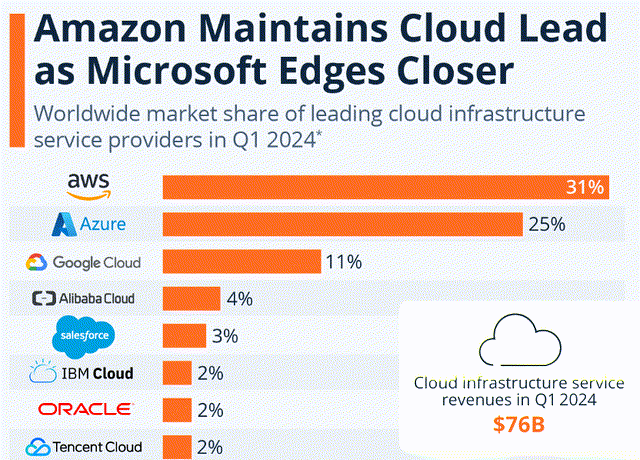
This trend has continued and Alibaba continues to diversify its revenue streams. Furthermore, the cloud market continues to grow, and Microsoft’s (MSFT) Azure and Amazon’s AWS are the clear leaders. Nonetheless, we expect Alibaba Cloud will continue to grow as the Chinese cloud sector is expected to grow to $90B by 2025, according to Mckinsey, important to note is that this report is already from 2022, and the cloud market is rapidly evolving. In addition, Alibaba Cloud has 39% of the market share, this shows the tremendous opportunity that lies ahead.
Statista
Furthermore, Alibaba has been focusing more and more on AI and it is reasonable to assume that Alibaba will become one, if not the leader in the Chinese AI market. China is also rapidly investing in its chips sector and in equipment needed to make sure they remain competitive on a global scale in regards to AI. This move from China is also meant as a means to become less reliable on the United States for its high-end chips and equipment.
If Alibaba is able to successfully integrate artificial intelligence into its cloud services, this could give a substantial boost to Alibaba’s revenue
Valuation
Now that we have discussed some of the metrics, let’s take a quick look at some possible valuation scenarios for the next few years. While a DCF remains the most accurate way to value a company, it still has quite a decent amount of flaws. Normally, a reverse DCF would be my preferred method to look at companies, but in this case, a P/FCF valuation model should be quite interesting as a big point of the thesis regards the sentiment, which would translate into higher multiples.
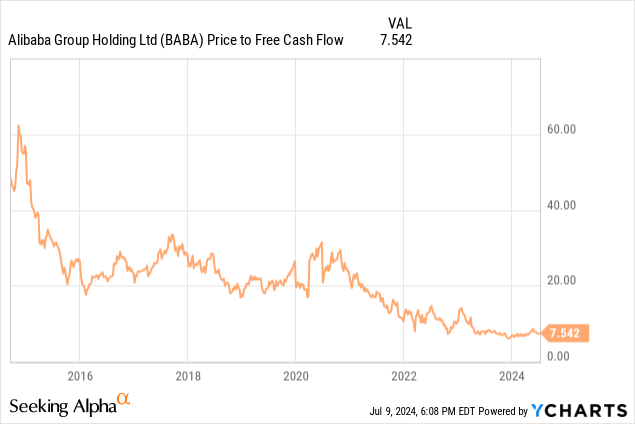
Currently, Alibaba is trading at a P/FCF of 7.54, according to Seeking Alpha.
Ycharts
As we believe the downside is currently fairly limited, the bear case is calculated at a 6.5x P/FCF. Further assumptions are a decrease of 2.50% per year in shares outstanding (they are currently doing this each quarter). Furthermore, we put in FCF growth at an increase of just 2% each year. Again, very conservative.
It is pretty clear that improving multiples are what is needed for investors to make money. But, the assumptions we made in this model should be very doable. But, as you can see, apart from the bull and super bull cases, the return really isn’t all that great through 2030. Sure, if we would reach a super bull case by 2026, this would be a great investment.

Stock Info
Nevertheless, let us take a look at a model with everything else remaining the same, but with FCF growth at 6%. This would result in the following chart, now even with the multiple only slightly increasing to our bull case in the next 2 years, would give a solid return. For some more ambitious targets, check out the previous article, where a base case of P/FCF of 12 was used. But, for this model I wanted to be on the more conservative side.

Stock Info
Conclusion
In conclusion, we could say that Alibaba remains highly undervalued in our opinion. Long-term investors should be able to generate a solid return with a fairly large margin of safety.
The newly introduced dividend might attract some potential new investors, who would have otherwise ignored the stock. The low payout ratio leaves plenty of potential for further increases in the future, but at the current share price, the money would have been better used on share repurchases.
The large share repurchase program demonstrates that Alibaba believes the market is currently undervaluing the company. The company continues to generate a significant amount of free cash flow in addition to the potential revenue increases that might come from its artificial intelligence initiatives and further expansion of its cloud computing business. As such, an increase in revenue growth could quickly improve the sentiment around Alibaba’s stock and propel the stock higher.
Nevertheless, its large dependency on the CCP and the Chinese economy is a serious risk that is associated with investing in Alibaba or any other Chinese stock for that matter. Nonetheless, taking everything into consideration Alibaba does provide an enticing value proposition with limited downside.
Editor’s Note: This article discusses one or more securities that do not trade on a major U.S. exchange. Please be aware of the risks associated with these stocks.
Credit: Source link