
Robert Way
In my last article on Alibaba (NYSE:BABA) I had mentioned the intentionality of management to initiate a new buyback program that could support the price per share. In the last few days there has been important news in this regard, and the potential of the buyback could in my opinion permanently change sentiment toward this company. In fact, the number of shares bought back in the last quarter is the second highest ever, and both EPS and dividends will get a big boost from it. Investors cannot ignore forever a company that remunerates its shareholders in this way. In addition, the Chinese economy is gradually recovering, which could fuel Alibaba’s domestic sales.
As for the rating, just as in my previous articles, I believe Alibaba is currently one of the best opportunity, which is why I reaffirm the rating of strong buy.
An unwritten rule
Buyback is a common practice used by companies to arouse investors’ interest. After all, if a company buys back its own shares, it means it thinks it is a good investment and therefore believes it is undervalued.
An interesting study conducted by S&P Global showed that U.S. companies that authorize and announce share buyback programs have historically shown statistically and economically significant outperformance after the announcements.
In other words, a buyback is a strong signal given to the market, and typically investors react positively. In fact, with fewer shares outstanding, both EPS and dividend per share increase without necessarily increasing earnings/dividends. U.S. big tech companies have used it extensively in recent years and the results in terms of capital gains are evident.
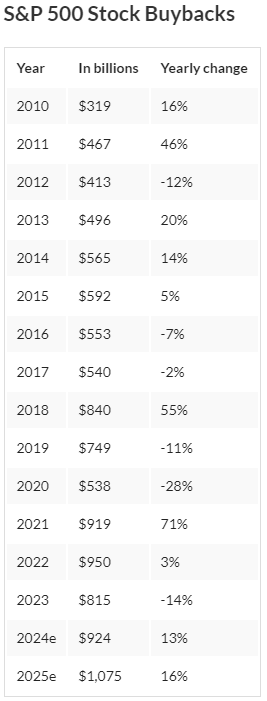
S&P500 buyback, 2024,2025 Goldman Sachs forecasts
The companies that make up the S&P500 can no longer do without it, and by 2025 the total amount is expected to exceed $1 trillion. It would seem that sentiment is positive about the future prospects of the market.
However, there is one aspect that puzzles me, a kind of unwritten rule. In fact, when the buyback is conducted by a U.S. company the market reacts positively, as for example happened with Meta when it announced that it would buy back $50 billion worth of its own shares. In contrast, when it is a Chinese company that announces a multi-billion-dollar buyback, investors do not care as much. Yet the effect on EPS and dividend per share follows exactly the same principle.
TradingView
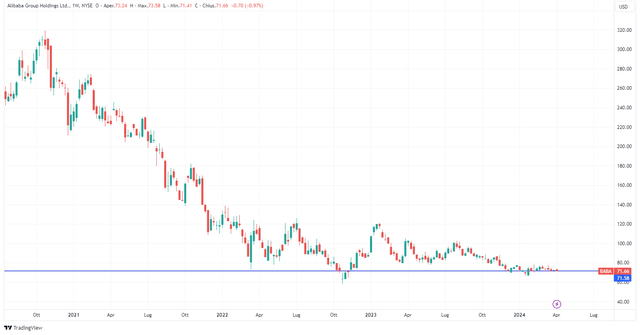
On February 7, Alibaba announced a $25 billion buyback increase, and that day the price per share rose 4.70%. However, in the following days the price per share collapsed again and as of today the stock seems to be in a perennial stalemate that began 2 years ago. At least for now the buyback has not achieved the desired results but nevertheless I remain positive and in this article I will explain why.
The inevitable effects of the buyback
There is still too much pessimism about Chinese stock market, which is why even a multi-billion-dollar buyback plan has not generated enthusiasm. However, not fully analyzing its potential is in my opinion a mistake, since the effects related to it will be important. Let me show you some figures to make you realize what I am talking about.

Alibaba FORM 6-K
- From June 30, 2022 to March 31, 2024, Alibaba spent $23.30 billion to buy back its own shares.
- In the fiscal year ended March 31, 2023, the net reduction in shares outstanding was 3.90% from the previous year. In the following fiscal year, it was 5.10%.
- In the last quarter alone, Alibaba spent $4.80 billion in buyback and reduced total shares outstanding by 2.60%. Such a figure had not been seen in the past two years.
Based on this data, it is clear that management’s intention is to reduce outstanding shares more and more. What is surprising, however, is that the figures used for this practice are getting larger and larger.
The company has another $31.90 billion available to purchase its own shares, but frankly I would not be surprised if it decided to devolve more capital into it. The reasons that lead me to think this are mainly twofold:
- Alibaba has never been cheaper and the buyback has better effectiveness in these times. We are talking about a leading company in China in several sectors, with domestic and international growth prospects, and which has an NTM Market Cap / Free Cash Flow of only 7.50x.
- Alibaba has a net debt of -$58.59 billion and has generated $22.02 billion in free cash flow in the past 12 months. It certainly does not lack cash.
Assuming the price per share remains at $70 over the next two years and all $31.90 billion is used, the total shares outstanding would become 1.978 million, or a reduction of about 19% from current level. This means that with the same amount of profits generated and distributed, just with the effect of the buyback, EPS and dividend per share would increase by about 23% in two years.
So, Alibaba does not even need to increase earnings-which it will probably do-but the reduction in shares outstanding will be enough to trigger a change in sentiment: the price per share of any company depends over the long term on EPS and nothing else. Investors may continue to avoid Alibaba, but sooner or later when faced with objective data they will give in.
In the above assumptions I considered a stagnant price per share, but the argument does not change much should there be an increase of 20 to 30%: at these prices the buyback is highly effective. As a shareholder, I hope they can increase it further.
Even in the face of such data, many people will still have an extremely negative opinion of this company, and in a way I do not blame them. After all, it is not easy to buy a company that has to undergo a political orientation so different from ours, where the government can decide its fate overnight. In any case, I wonder what the government’s incentive could be to destroy one of its best companies, which by the way is expanding rapidly all over the world. In my opinion, there is no reason to do so, and that reassures me.
Finally, for the pessimists who do not even believe in the veracity of the financial statements, I invite you to prove their bad faith. If you are better than the supervisors, then this is the time to do it. As for me, I can assure you that in January I received my dividend in my account, and it was not monopoly money.
In 2024 the total amount of dividends issued will be $2.50 billion, which is 9 times less than the free cash flow of the last 12 months. The dividend has ample room to increase, and together with the buyback, they will be two key drivers of dividend per share growth. Currently the dividend yield is only 1.40%, but I would not be surprised by dividend per share growth of 20% per year over the next 5 years. At that point, buying Alibaba at the current price, the dividend yield on cost would be 3.60%. Basically, it would become a dividend company for you.
China’s economic recovery and missed IPOs
China has never gone into recession since GDP continues to grow rather fast, albeit at a slower pace than in the past. Anyway, since the bursting of the real estate bubble due to the bankruptcy of the country’s largest builders – Evergrande above all – it is undeniable that the whole country has faced an economic slowdown.
Consumption has dropped, and this is evidenced by the fact that China is struggling with deflation rather than inflation. We are in an entirely different macroeconomic scenario from the Western world, where interest rates are high and the labor market remains strong. In the case of China, interest rates have experienced a decline to stimulate economic activity, and the first fiscal stimulus has already been allocated recently. After all, the country estimates GDP growth of 5% this year and will do everything possible to achieve it.
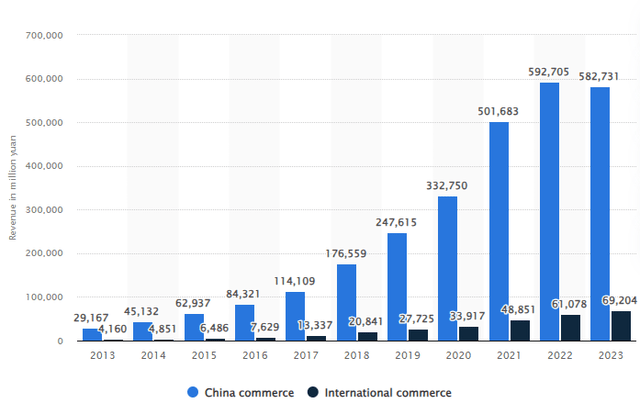
Based on what has just been said, the reason behind Alibaba’s slow domestic revenue growth seems obvious; simply the whole country has been facing a complicated period since 2022 but today the government is trying to turn things around.
Statista
This situation also emerges from the company’s financial results; in fact, international sales are growing strongly while domestic sales have stalled.
With due differences, it is as if China is facing its 2008, and from this point on, the situation is more likely to improve rather than deteriorate further. Alibaba’s price today discounts worst-case scenarios; in fact, it collapsed until late 2022 and then stabilized at current levels. Moreover, I find surprising the low volatility of the stock, now around $70-80 per share since early 2024. After years of declines my impression is that it is now difficult to go lower than that.
China’s economic recovery will not be easy, but the government has the tools to succeed. We all know that the business cycle is not a linear trend and the best time to invest is in the downturn. Fiscal stimulus combined with a gradual recovery in the real estate market will restore the country’s economic growth.
tradingeconomics.com
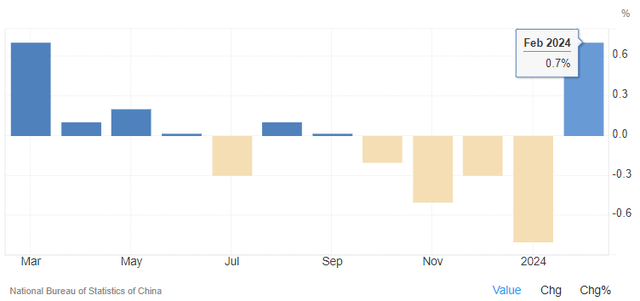
The first signs of recovery seem to be there, in fact after 4 negative months the CPI has turned positive again. This is an early indication that consumption is recovering, but the result may have been influenced by the Lunar New Year on Feb. 10. In a holiday season, people tend to spend more.
Finally, I would like to touch briefly on what is happening with IPOs as it is causing panic among investors.
Alibaba was planning to separately list both the Cloud segment and Cainiao, which is the logistics company. However, in both cases the management decided to suspend the IPOs and the market did not take this news well. Personally, I find this reaction unjustified, since it would have made no sense to list these two business branches at such a difficult time for the Chinese stock market: the goal of the IPO is to receive capital and not to sell off the companies.
A Cloud that is not growing certainly would not have been valued as much; Cainiao is growing but would have had a valuation below fair value. Management has correctly preferred to postpone IPOs until there are better times to do so. Moreover, since Alibaba owns 64% of Cainiao, it is intent on investing $3.75 billion to get 100% of the company. This is yet another proper choice: instead of selling off Cainiao, it preferred to acquire full ownership given the depressed prices. In short, there is little to complain about such impeccable management, yet the market thinks otherwise.
Conclusion
Alibaba is a company whose earnings potential cannot be questioned; however, the strong mistrust toward the Chinese stock market is such that it puts any positives on the back burner. The buyback program may be decisive in order to significantly increase both EPS and dividend per share, which could finally change the sentiment toward this company. In addition, the country’s economic growth may get a boost as a result of the fiscal stimulus just as happened in the West a few years ago.
As of today, the company is so depressed that in my opinion any valuation model is superfluous. Suffice it to say that if the free cash flow of the past 12 months remained unchanged in the future, hypothetically Alibaba could buy all the outstanding shares in a little more than 5 years. To make a comparison to a company that everyone would like to have in their portfolio, it is as if Nvidia were trading at $59.44 per share.
Credit: Source link