
Photofex
Airbus (OTCPK:EADSF) enjoyed a very strong 2023 booking of more than 2,000 airplane orders valued over $163 billion at market value. With Boeing being plagued by continued issues on its key commercial airplane programs, it’s interesting to see how customers react. Are we seeing shifts in customer orders or not?
Moreover, we will be watching the number of commercial airplane deliveries, as those could provide an indication that supply chains are gaining strength and production rates are becoming more stable at their targeted rates. Any absence of such stabilization could ultimately weaken appetite amongst airplane lessors and airlines to purchase additional airplanes and instead wait and see when their purchased airplanes are being delivered.
In this report, I will be discussing the April 2024 airplane orders and deliveries for Airbus.
Airbus A320 Orders Lead The Way In April
Airbus
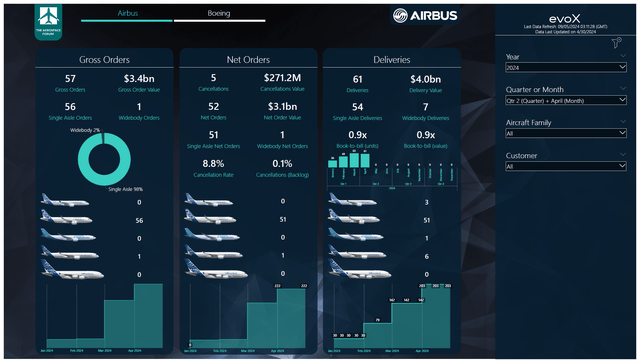
In April, Airbus booked 57 orders valued $3.4 billion. The orders included one wide body airplane and 56 single aisle airplanes:
- British Airways (OTCPK:ICAGY) ordered three Airbus A320neo and two Airbus A321neo airplanes.
- An undisclosed customer ordered 51 Airbus A321neo airplanes.
- Japan Airlines (JAPSY, JPNRF) ordered one Airbus A350-900.
During the month, the following order book changes and mutations took place:
- Air Canada (AC:CA) was identified as the customer for five Airbus A321neo airplanes.
- Chengdu Airlines was identified as the customer for two Airbus A321neo airplanes and one Airbus A320neo.
- Transavia (OTCPK:AFRAF) was identified as the customer for one Airbus A321neo.
- An unidentified customer swapped orders for 16 Airbus A320neo aircraft to 16 A321neos.
- CDB Leasing converted orders for two A321neo airplanes to orders for two Airbus A320neo airplanes.
- Cebu Pacific converted an order for one A320neo to one A321neo.
- Indigo converted an order for six A321neos to six A320neos.
- International Airlines Group (OTCPK:ICAGY) cancelled orders for two A321neos and three A320neos.
April orders were not spectacular for Airbus. The order from British Airways offset a cancellation from the parent company, while the order from Japan Airlines likely was driven by the Airbus A350 hull loss earlier this year. After subtracting five cancellations from the 57 gross orders, we are left with 52 net orders valued $3.1 billion. In the same month last year, Airbus booked five orders and three cancellations, bringing the net order value to $157.8 million. So, we’re seeing a significant jump, driven by the undisclosed customer order for 51 Airbus A321neo airplanes. Year-to-date, Airbus has booked 222 net orders valued $20.9 billion, compared to 144 net orders valued $12.7 billion last year. So, we’re seeing a significant increase in the net orders and associated value. The higher net order tally is driven by the order for 51 Airbus airplanes as well as lower cancellations, while the mix is driving the value higher next to volume.
Airbus Airplane Deliveries Are Ramping Up

Airbus
Airbus delivered a total of 61 airplanes in January, valued $4 billion:
- Three Airbus A220 airplanes were delivered.
- A total of 51 Airbus A320neo airplanes were delivered, including 22 Airbus A320neo airplanes and 29 Airbus A321neo airplanes.
- Airbus delivered one Airbus A330-900neo airplane.
- There are six Airbus A350 airplane deliveries, all for the baseline -900 model.
During the same month last year, Airbus delivered 54 airplanes valued at $3.4 billion. Year-over-year, we saw deliveries increase by seven units or 13%. So, it does seem like we’re seeing more stability in the supply chain. Higher deliveries were driven by the Airbus A320neo and Airbus A350 programs, partially offset by lower deliveries on the Airbus A330 and Airbus A220 programs.
Year-to-date, Airbus has delivered 203 airplanes valued $12.8 billion, compared to 181 deliveries valued $11.1 billion a year ago. The increase was again driven by the Airbus A320neo and Airbus A350 program.
The book-to-bill ratio was 0.9x in terms of value as well as units while year-to-date, the book-to-bill ratio in terms of units is 1.1x and 1.6x in terms of value. The difference between the value-based book-to-bill ratio and the unit book-to-bill ratio is driven by high order inflow. While book-to-bill ratios above one tend to signal strong demand, for commercial aerospace they are currently also driven by airplane production still being below 2019 levels.
Conclusion: Airbus Stock Is A Buy On Higher Airplane Production Ramp Up
April orders showed continued strength in Airbus orders, and I expect that momentum to last this year. The bigger question is the pace at which production ramp ups can be achieved. Currently, demand for airplanes is stronger than commercial airplane manufacturers can supply jets, so the key item to value generation will be the stability and ramp up ability of the supply chain. Airbus will be increasing production on its A350 program to 12 per month by 2028, so I would say visibility in the supply chain is also improving.
Additionally, Airbus could be gaining orders at the expense of Boeing but with outsold slots for years to come that is not something I’m feathering into my buy rating for the stock as I believe Airbus commercial airplane portfolio and backlogs are strong enough regardless of what happens with Boeing’s production and delivery rates.
Editor’s Note: This article discusses one or more securities that do not trade on a major U.S. exchange. Please be aware of the risks associated with these stocks.
Credit: Source link