
• bitcoinBitcoin(BTC)$84,862.001.65%
  • ethereumEthereum(ETH)$2,724.912.95%
  • tetherTether(USDT)$1.000.01%
  • binancecoinBNB(BNB)$779.761.34%
  • rippleXRP(XRP)$1.587.69%
  • usd-coinUSDC(USDC)$1.000.01%
  • solanaSolana(SOL)$120.956.79%
  • tronTRON(TRX)$0.337047-0.63%
  • zcashZcash(ZEC)$1,603.507.99%
  • Figure HelocFigure Heloc(FIGR_HELOC)$1.030.00%
  • HyperliquidHyperliquid(HYPE)$93.642.95%
  • dogecoinDogecoin(DOGE)$0.0980405.78%
  • moneroMonero(XMR)$568.444.13%
  • chainlinkChainlink(LINK)$14.0114.60%
  • whitebitWhiteBIT Coin(WBT)$84.681.37%
  • USDSUSDS(USDS)$1.000.00%
  • cardanoCardano(ADA)$0.2558668.41%
  • RainRain(RAIN)$0.011931-0.45%
  • leo-tokenLEO Token(LEO)$8.83-0.91%
  • stellarStellar(XLM)$0.22288311.81%
  • bitcoin-cashBitcoin Cash(BCH)$337.010.97%
  • nearNEAR Protocol(NEAR)$5.0518.76%
  • uniswapUniswap(UNI)$9.586.02%
  • litecoinLitecoin(LTC)$70.566.28%
  • Ethena USDeEthena USDe(USDE)$1.000.00%
  • CantonCanton(CC)$0.12198813.00%
  • avalanche-2Avalanche(AVAX)$10.614.36%
  • suiSui(SUI)$1.1419.57%
  • daiDai(DAI)$1.000.00%
  • USD1USD1(USD1)$1.000.02%
  • hedera-hashgraphHedera(HBAR)$0.0959457.05%
  • the-open-networkGram (prev. Toncoin)(GRAM)$1.431.48%
  • shiba-inuShiba Inu(SHIB)$0.0000066.28%
  • BittensorBittensor(TAO)$307.949.29%
  • crypto-com-chainCronos(CRO)$0.0660058.48%
  • Global DollarGlobal Dollar(USDG)$1.000.00%
  • BitwayBitway(BTW)$1.108.43%
  • MemeCoreMemeCore(M)$1.20-2.91%
  • paypal-usdPayPal USD(PYUSD)$1.000.01%
  • OndoOndo(ONDO)$0.5528.99%
  • tether-goldTether Gold(XAUT)$4,301.090.86%
  • okbOKB(OKB)$120.742.03%
  • EthenaEthena(ENA)$0.24211918.53%
  • Circle USYCCircle USYC(USYC)$1.140.01%
  • Ripple USDRipple USD(RLUSD)$1.000.00%
  • BlackRock USD Institutional Digital Liquidity FundBlackRock USD Institutional Digital Liquidity Fund(BUIDL)$1.000.00%
  • aaveAave(AAVE)$148.198.25%
  • Ondo US Dollar YieldOndo US Dollar Yield(USDY)$1.150.03%
  • mantleMantle(MNT)$0.681.50%
  • MorphoMorpho(MORPHO)$2.917.47%
TradePoint.io
  • Main
  • AI & Technology
  • Stock Charts
  • Market & News
  • Business
  • Finance Tips
  • Trade Tube
  • Blog
  • Shop
No Result
View All Result
TradePoint.io
No Result
View All Result

AI Interview Series #4: Explain KV Caching

December 21, 2025
in AI & Technology
Reading Time: 4 mins read
A A
AI Interview Series #4: Explain KV Caching
ShareShareShareShareShare

Question:

You’re deploying an LLM in production. Generating the first few tokens is fast, but as the sequence grows, each additional token takes progressively longer to generate—even though the model architecture and hardware remain the same.

If compute isn’t the primary bottleneck, what inefficiency is causing this slowdown, and how would you redesign the inference process to make token generation significantly faster?

YOU MAY ALSO LIKE

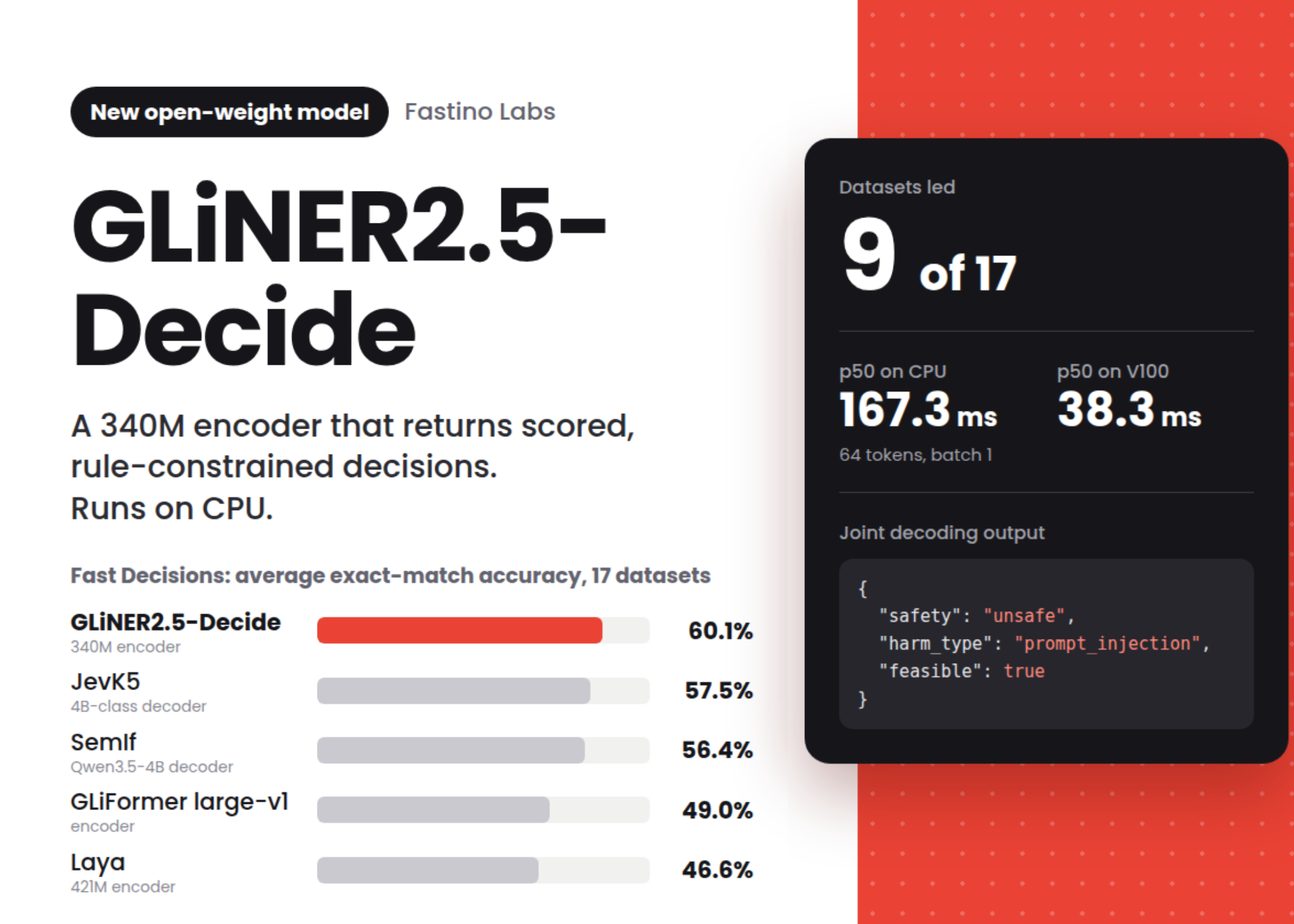
Fastino Releases GLiNER2.5-Decide: A 340M Open-Weight Decision Model That Runs on CPU

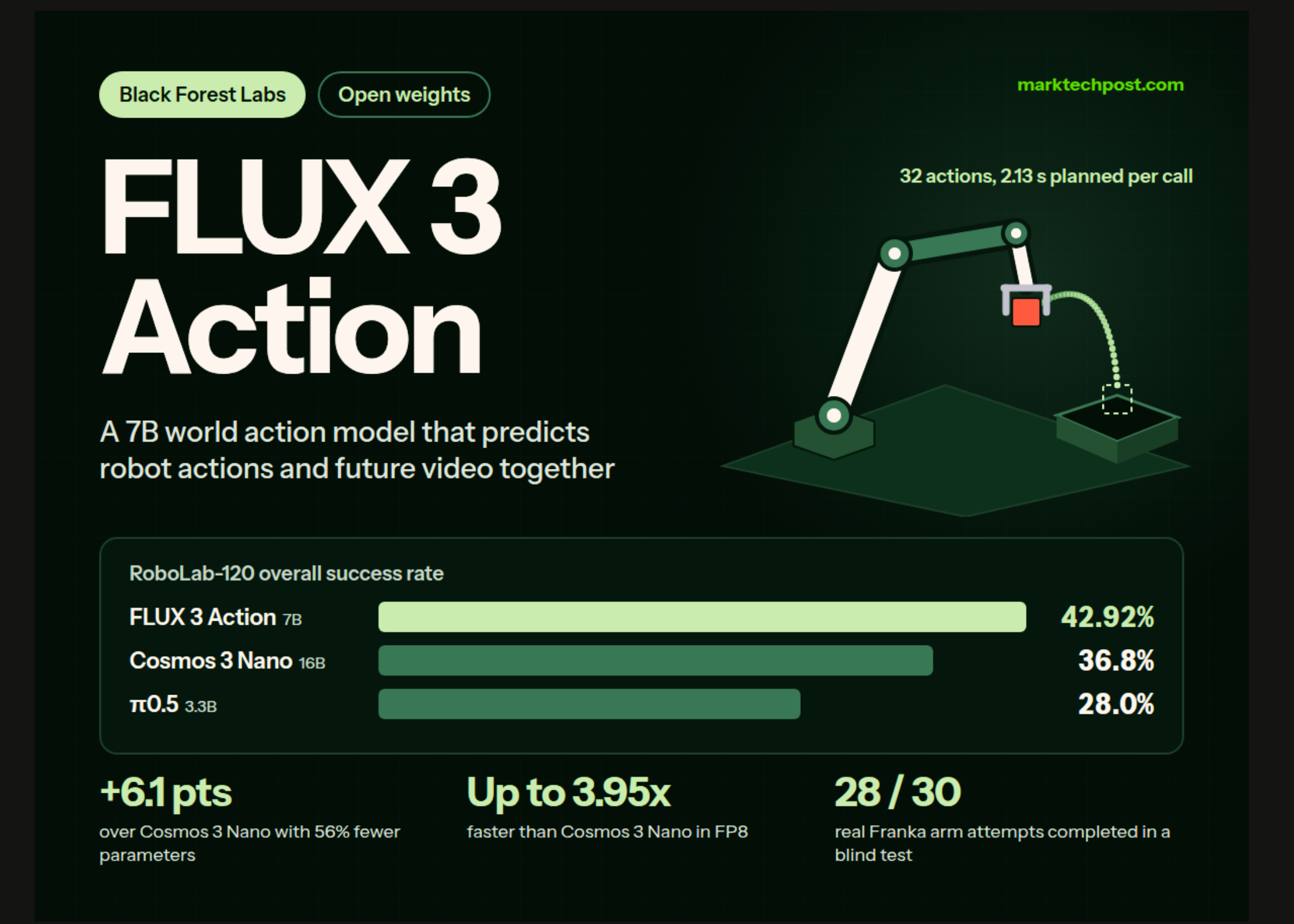
Black Forest Labs Releases FLUX 3 Action: A 7B Open-Weights World Action Model That Tops RoboLab-120

What is KV Caching and how does it make token generation faster?

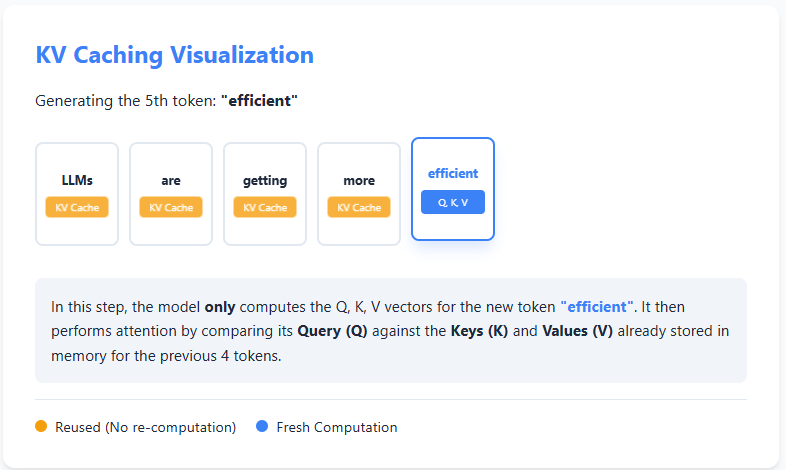
KV caching is an optimization technique used during text generation in large language models to avoid redundant computation. In autoregressive generation, the model produces text one token at a time, and at each step it normally recomputes attention over all previous tokens. However, the keys (K) and values (V) computed for earlier tokens never change.

With KV caching, the model stores these keys and values the first time they are computed. When generating the next token, it reuses the cached K and V instead of recomputing them from scratch, and only computes the query (Q), key, and value for the new token. Attention is then calculated using the cached information plus the new token.

This reuse of past computations significantly reduces redundant work, making inference faster and more efficient—especially for long sequences—at the cost of additional memory to store the cache. Check out the Practice Notebook here

Evaluating the Impact of KV Caching on Inference Speed

In this code, we benchmark the impact of KV caching during autoregressive text generation. We run the same prompt through the model multiple times, once with KV caching enabled and once without it, and measure the average generation time. By keeping the model, prompt, and generation length constant, this experiment isolates how reusing cached keys and values significantly reduces redundant attention computation and speeds up inference. Check out the Practice Notebook here

Copy CodeCopiedUse a different Browser
import numpy as np
import time
import torch
from transformers import AutoModelForCausalLM, AutoTokenizer

device = "cuda" if torch.cuda.is_available() else "cpu"

model_name = "gpt2-medium"  
tokenizer = AutoTokenizer.from_pretrained(model_name)
model = AutoModelForCausalLM.from_pretrained(model_name).to(device)

prompt = "Explain KV caching in transformers."

inputs = tokenizer(prompt, return_tensors="pt").to(device)

for use_cache in (True, False):
    times = []
    for _ in range(5):  
        start = time.time()
        model.generate(
            **inputs,
            use_cache=use_cache,
            max_new_tokens=1000
        )
        times.append(time.time() - start)

    print(
        f"{'with' if use_cache else 'without'} KV caching: "
        f"{round(np.mean(times), 3)} ± {round(np.std(times), 3)} seconds"
    )
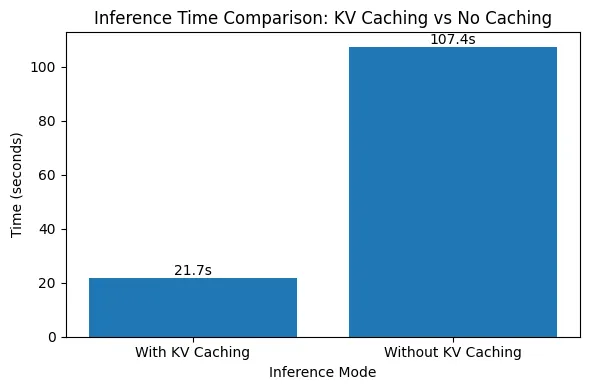
The results clearly demonstrate the impact of KV caching on inference speed. With KV caching enabled, generating 1000 tokens takes around 21.7 seconds, whereas disabling KV caching increases the generation time to over 107 seconds—nearly a 5× slowdown. This sharp difference occurs because, without KV caching, the model recomputes attention over all previously generated tokens at every step, leading to quadratic growth in computation. Check out the Practice Notebook here

With KV caching, past keys and values are reused, eliminating redundant work and keeping generation time nearly linear as the sequence grows. This experiment highlights why KV caching is essential for efficient, real-world deployment of autoregressive language models.

Check out the Practice Notebook here


AI Interview Series #3: Explain Federated Learning

The post AI Interview Series #4: Explain KV Caching appeared first on MarkTechPost.

Credit: Source link

ShareTweetSendSharePin

Related Posts

Fastino Releases GLiNER2.5-Decide: A 340M Open-Weight Decision Model That Runs on CPU
AI & Technology

Fastino Releases GLiNER2.5-Decide: A 340M Open-Weight Decision Model That Runs on CPU

September 25, 2026
Black Forest Labs Releases FLUX 3 Action: A 7B Open-Weights World Action Model That Tops RoboLab-120
AI & Technology

Black Forest Labs Releases FLUX 3 Action: A 7B Open-Weights World Action Model That Tops RoboLab-120

September 25, 2026
Warzone Is Adding A Button To Hide All The Goofy Skins
AI & Technology

Warzone Is Adding A Button To Hide All The Goofy Skins

September 24, 2026
How These AI Glasses Compare
AI & Technology

How These AI Glasses Compare

September 24, 2026
Next Post
Morning News NOW Full Episode – Dec. 4

Morning News NOW Full Episode – Dec. 4

Leave a Reply Cancel reply

Your email address will not be published. Required fields are marked *

Search

No Result
View All Result
Congressman Calls for National Data Center Strategy

Congressman Calls for National Data Center Strategy

September 24, 2026
Multiple Pullbacks Ahead — Kevin Mahn On What’s Worth Buying

Multiple Pullbacks Ahead — Kevin Mahn On What’s Worth Buying

September 23, 2026
Mark Ruffalo rips Gavin Newsom after Paramount settlement reached

Mark Ruffalo rips Gavin Newsom after Paramount settlement reached

September 21, 2026

About

Learn more

Our Services

Legal

Privacy Policy

Terms of Use

Bloggers

Learn more

Article Links

Contact

Advertise

Ask us anything

©2020- TradePoint.io - All rights reserved!

Tradepoint.io, being just a publishing and technology platform, is not a registered broker-dealer or investment adviser. So we do not provide investment advice. Rather, brokerage services are provided to clients of Tradepoint.io by independent SEC-registered broker-dealers and members of FINRA/SIPC. Every form of investing carries some risk and past performance is not a guarantee of future results. “Tradepoint.io“, “Instant Investing” and “My Trading Tools” are registered trademarks of Apperbuild, LLC.

This website is operated by Apperbuild, LLC. We have no link to any brokerage firm and we do not provide investment advice. Every information and resource we provide is solely for the education of our readers. © 2020 Apperbuild, LLC. All rights reserved.

No Result
View All Result
  • Main
  • AI & Technology
  • Stock Charts
  • Market & News
  • Business
  • Finance Tips
  • Trade Tube
  • Blog
  • Shop

© 2023 - TradePoint.io - All Rights Reserved!