


• bitcoinBitcoin(BTC)$84,412.000.44%
  • ethereumEthereum(ETH)$2,694.700.13%
  • tetherTether(USDT)$1.000.00%
  • binancecoinBNB(BNB)$773.13-0.47%
  • rippleXRP(XRP)$1.53-2.62%
  • usd-coinUSDC(USDC)$1.00-0.01%
  • solanaSolana(SOL)$121.39-0.52%
  • tronTRON(TRX)$0.334370-1.13%
  • zcashZcash(ZEC)$1,649.856.09%
  • Figure HelocFigure Heloc(FIGR_HELOC)$1.063.00%
  • HyperliquidHyperliquid(HYPE)$92.440.06%
  • dogecoinDogecoin(DOGE)$0.096751-2.29%
  • chainlinkChainlink(LINK)$14.151.67%
  • moneroMonero(XMR)$559.830.41%
  • whitebitWhiteBIT Coin(WBT)$84.180.30%
  • USDSUSDS(USDS)$1.000.00%
  • cardanoCardano(ADA)$0.254291-1.65%
  • RainRain(RAIN)$0.01288812.55%
  • leo-tokenLEO Token(LEO)$8.961.78%
  • stellarStellar(XLM)$0.216650-1.63%
  • bitcoin-cashBitcoin Cash(BCH)$335.70-2.13%
  • nearNEAR Protocol(NEAR)$5.021.22%
  • uniswapUniswap(UNI)$9.690.64%
  • litecoinLitecoin(LTC)$72.640.43%
  • CantonCanton(CC)$0.1357304.58%
  • Ethena USDeEthena USDe(USDE)$1.00-0.02%
  • avalanche-2Avalanche(AVAX)$10.872.00%
  • suiSui(SUI)$1.16-2.57%
  • daiDai(DAI)$1.000.00%
  • the-open-networkGram (prev. Toncoin)(GRAM)$1.6110.17%
  • USD1USD1(USD1)$1.000.01%
  • hedera-hashgraphHedera(HBAR)$0.093699-1.87%
  • BittensorBittensor(TAO)$321.871.13%
  • shiba-inuShiba Inu(SHIB)$0.000006-0.36%
  • crypto-com-chainCronos(CRO)$0.0683082.31%
  • Global DollarGlobal Dollar(USDG)$1.00-0.01%
  • MemeCoreMemeCore(M)$1.220.83%
  • paypal-usdPayPal USD(PYUSD)$1.00-0.01%
  • EthenaEthena(ENA)$0.2696870.60%
  • BitwayBitway(BTW)$0.99-24.77%
  • tether-goldTether Gold(XAUT)$4,280.13-0.11%
  • OndoOndo(ONDO)$0.54-1.93%
  • okbOKB(OKB)$120.91-0.10%
  • Ripple USDRipple USD(RLUSD)$1.00-0.01%
  • Circle USYCCircle USYC(USYC)$1.140.00%
  • aaveAave(AAVE)$155.661.31%
  • mantleMantle(MNT)$0.693.36%
  • BlackRock USD Institutional Digital Liquidity FundBlackRock USD Institutional Digital Liquidity Fund(BUIDL)$1.000.00%
  • Ondo US Dollar YieldOndo US Dollar Yield(USDY)$1.150.00%
  • quant-networkQuant(QNT)$153.3755.65%
TradePoint.io
  • Main
  • AI & Technology
  • Stock Charts
  • Market & News
  • Business
  • Finance Tips
  • Trade Tube
  • Blog
  • Shop
No Result
View All Result
TradePoint.io
No Result
View All Result

AI Interview Series #3: Explain Federated Learning

November 24, 2025
in AI & Technology
Reading Time: 4 mins read
A A
AI Interview Series #3: Explain Federated Learning
ShareShareShareShareShare

Question:

“You’re an ML engineer at a fitness company like Fitbit or Apple Health.

Millions of users generate sensitive sensor data every day — heart rate, sleep cycles, step counts, workout patterns, etc.

YOU MAY ALSO LIKE

Your Old GPU Could Be Worth More Than You Think

Sarvam AI Releases Saaras V4: A Speech-to-Text Model for All 22 Indian Languages and Global English

You want to build a model that predicts health risk or recommends personalized workouts.

But due to privacy laws (GDPR, HIPAA), none of this raw data can ever leave the user’s device.

How would you train such a model?“

Training a model in this scenario seems impossible at first—after all, you can’t collect or centralize any of the user’s sensor data. But the trick is this: instead of bringing the data to the model, you bring the model to the data.

Using techniques like federated learning, the model is sent to each user’s device, trained locally on their private data, and only the model updates (not the raw data) are sent back. These updates are then securely aggregated to improve the global model while keeping every user’s data fully private.

This approach allows you to leverage massive, real-world datasets without ever violating privacy laws.

What is Federated Learning

Federated Learning is a technique for training machine learning models without ever collecting user data centrally. Instead of uploading private data (like heart rate, sleep cycles, or workout logs), the model is sent to each device, trained locally, and only the model updates are returned. These updates are securely aggregated to improve the global model—ensuring privacy and compliance with laws like GDPR and HIPAA.

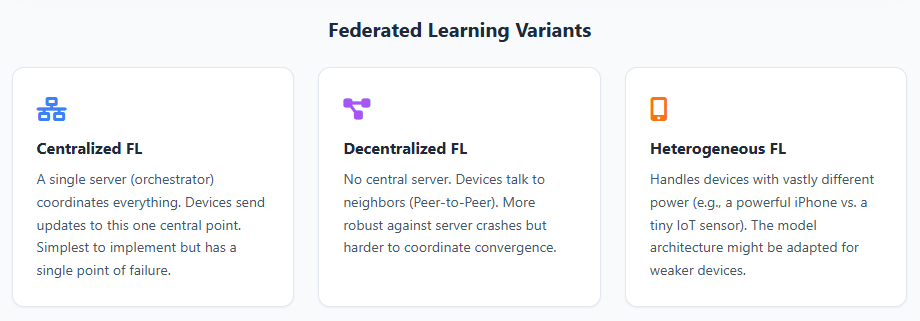
There are multiple variants:

  • Centralized FL: A central server coordinates training and aggregates updates.
  • Decentralized FL: Devices share updates with each other directly—no single point of failure.
  • Heterogeneous FL: Designed for devices with different compute capabilities (phones, watches, IoT sensors).

The workflow is simple:

  • A global model is sent to user devices.
  • Each device trains on its private data (e.g., a user’s fitness and health metrics).
  • Only the model updates—not the data—are encrypted and sent back.
  • The server aggregates all updates into a new global model.

Challenges in Federated Learning

Device Constraints: User devices (phones, smartwatches, fitness trackers) have limited CPU/GPU power, small RAM, and rely on battery. Training must be lightweight, energy-efficient, and scheduled intelligently so it doesn’t interfere with normal device usage.

Model Aggregation: Even after training locally on thousands or millions of devices, we still need to combine all these model updates into a single global model. Techniques like Federated Averaging (FedAvg) help, but updates can be delayed, incomplete, or inconsistent depending on device participation.

Skewed Local Data (Non-IID Data):

Each user’s fitness data reflects personal habits and lifestyle:

  • Some users run daily; others never run.
  • Some have high resting heart rates; others have low.
  • Sleep cycles vary drastically by age, culture, work pattern.
  • Workout types differ—yoga, strength training, cycling, HIIT, etc.

This leads to non-uniform, biased local datasets, making it harder for the global model to learn generalized patterns.

Intermittent Client Availability: Many devices may be offline, locked, low on battery, or not connected to Wi-Fi. Training must only happen under safe conditions (charging, idle, Wi-Fi), reducing the number of active participants at any moment.

Communication Efficiency: Sending model updates frequently can drain bandwidth and battery. Updates must be compressed, sparse, or limited to smaller subsets of parameters.

Security & Privacy Guarantees: Even though raw data never leaves the device, updates must be encrypted. Additional protections like differential privacy or secure aggregation may be required to prevent reconstructing sensitive patterns from gradients.


AI Interview Series #2: Explain Some of the Common Model Context Protocol (MCP) Security Vulnerabilities

The post AI Interview Series #3: Explain Federated Learning appeared first on MarkTechPost.

Credit: Source link

ShareTweetSendSharePin

Related Posts

Your Old GPU Could Be Worth More Than You Think
AI & Technology

Your Old GPU Could Be Worth More Than You Think

September 26, 2026
Sarvam AI Releases Saaras V4: A Speech-to-Text Model for All 22 Indian Languages and Global English
AI & Technology

Sarvam AI Releases Saaras V4: A Speech-to-Text Model for All 22 Indian Languages and Global English

September 26, 2026
Supersonic Labs Releases Julia 1: A 144.3M-Parameter Open Decision Model That Runs on a CPU
AI & Technology

Supersonic Labs Releases Julia 1: A 144.3M-Parameter Open Decision Model That Runs on a CPU

September 26, 2026
This External GPU Uses Wi-Fi To Transform Any Device Into A Gaming Rig
AI & Technology

This External GPU Uses Wi-Fi To Transform Any Device Into A Gaming Rig

September 26, 2026
Next Post
NVIDIA AI Releases Nemotron-Elastic-12B: A Single AI Model that Gives You 6B/9B/12B Variants without Extra Training Cost

NVIDIA AI Releases Nemotron-Elastic-12B: A Single AI Model that Gives You 6B/9B/12B Variants without Extra Training Cost

Leave a Reply Cancel reply

Your email address will not be published. Required fields are marked *

Search

No Result
View All Result
Hegseth considering presidential run, sources tell NBC News

Hegseth considering presidential run, sources tell NBC News

September 21, 2026
XTN: Transportation Likely To Lag Into 2027 Amid Macro Pressures And Factor Weaknesses

XTN: Transportation Likely To Lag Into 2027 Amid Macro Pressures And Factor Weaknesses

September 22, 2026
How China Is Changing AI

How China Is Changing AI

September 20, 2026

About

Learn more

Our Services

Legal

Privacy Policy

Terms of Use

Bloggers

Learn more

Article Links

Contact

Advertise

Ask us anything

©2020- TradePoint.io - All rights reserved!

Tradepoint.io, being just a publishing and technology platform, is not a registered broker-dealer or investment adviser. So we do not provide investment advice. Rather, brokerage services are provided to clients of Tradepoint.io by independent SEC-registered broker-dealers and members of FINRA/SIPC. Every form of investing carries some risk and past performance is not a guarantee of future results. “Tradepoint.io“, “Instant Investing” and “My Trading Tools” are registered trademarks of Apperbuild, LLC.

This website is operated by Apperbuild, LLC. We have no link to any brokerage firm and we do not provide investment advice. Every information and resource we provide is solely for the education of our readers. © 2020 Apperbuild, LLC. All rights reserved.

No Result
View All Result
  • Main
  • AI & Technology
  • Stock Charts
  • Market & News
  • Business
  • Finance Tips
  • Trade Tube
  • Blog
  • Shop

© 2023 - TradePoint.io - All Rights Reserved!