

Eoneren
Introduction
The other day, I wrote an article on GE Aerospace (GE), which included my very bullish outlook on the commercial aerospace industry, supported by numbers from giants like Airbus (OTCPK:EADSF).
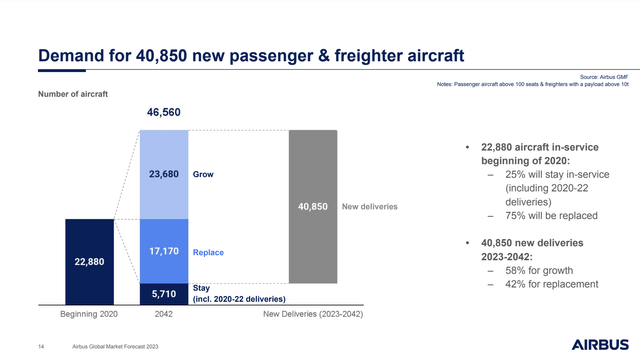
According to the European giant, demand for new passenger aircraft through 2024 could come in close to 41,000 units – with less than half of these planes replacing existing planes.
Airbus
On top of that, we’re seeing an acceleration in global traffic, as the post-pandemic recovery has gone from short-haul to long-haul flights, creating a better-than-expected demand environment.
As reported by Reuters on June 3 (emphasis added):
The International Air Transport Association (IATA) said it expected the worldwide industry to generate $30.5 billion of profit this year, higher than an upwardly revised $27.4 billion in 2023 as carriers keep a lid on underlying labour costs despite recent strikes.
That comes just four years after the industry collapsed to a $140 billion loss in 2020 as a result of the pandemic and is above the $25.7 billion forecast for 2024 issued in December.
“The environment is better than we had expected, particularly in Asia,” Director General Willie Walsh told Reuters on the sidelines of an annual meeting of IATA’s more than 300 members, which account for more than 80% of global air traffic.
This brings me to Honeywell International (NASDAQ:HON), the diversified industrial giant I started to cover more frequently last year. My most recent article was written on February 2, when I discussed its “Playbook For Double-Digit Growth And Returns.” Since then, shares are up 7%, slightly underperforming the S&P 500’s 9% return.
The good news is that the company, which returned 10.7% annually since January 2004, remains in a good spot to maintain elevated returns. On top of recovering aerospace demand, the company is focusing on strong secular growth, emphasizing innovation, and streamlining its business portfolio to reduce waste and improve overall results.
As we have a lot to unpack, let’s dive into the details!
A Path To 10-14% Annual Returns
One of Honeywell’s problems is its diversification. Since that may sound weird, let me elaborate. At the start of this article, I brought up GE Aerospace. That company was known as General Electric before it spun off its non-aerospace assets.
While conglomerates may have been a great way to offer investors diversification in the past, there’s no need to buy conglomerates anymore.
- Diversification often leads to poor valuations for advanced business units. For example, if a company has one high-margin business unit with fast growth and one business unit with poor growth and low margins, a spin-off makes sense to give the stronger business unit the valuation it deserves – instead of an average.
- Investors can diversify themselves. Due to low investment fees and the existence of cheap ETFs, investors can buy multiple companies, which reduces the need for companies to diversify. We can build our own conglomerates, so to speak.
While Honeywell never had the issues the “old” General Electric had, it was still hard for the company to get investors excited about a business that includes industrial automation, building automation, and energy solutions on top of its aerospace technologies business.
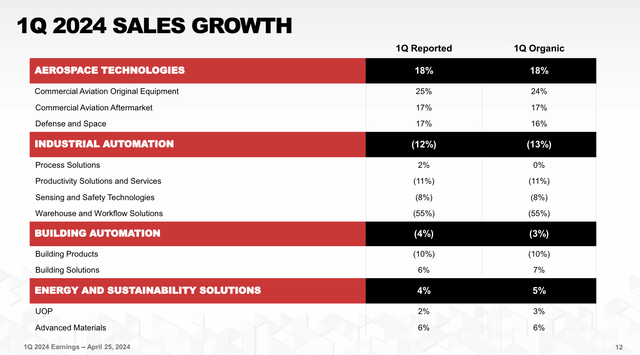
As we can see below, in 1Q24, the aerospace unit stood out with 18% organic growth, leaving the others in the dust. This segment also allowed the company to grow organic sales by 3%.
Honeywell International Inc.
Even better, the aerospace segment saw double-digit growth in both the commercial and defense sectors. This marks the 12th consecutive quarter of double-digit growth in the commercial aerospace business.
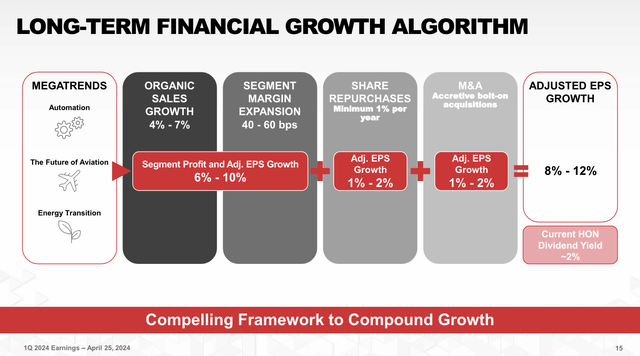
While non-aerospace business segments may be a drag on overall growth in this environment, the company is optimistic, as it targets long-term organic sales growth between 4-7% by focusing on innovation, sustainability, and software.
As we can see below, this is expected to lead to consistently higher margins, supporting 6-10% annual adjusted segment EPS growth. When adding between 1-2% growth from share repurchases and M&A, we get a total annual EPS growth outlook of 8-12%. Add its 2% dividend to that, and the company makes a compelling case for 10-14% annual returns, as total returns are capital gains in addition to dividends.
Capital gains consist of EPS growth and valuation changes. So, ignoring valuation changes, there’s a path to elevated annual double-digit returns – at least according to Honeywell.
Honeywell International Inc.
That would be above its 20-year average of 10.7%.
Growth is expected to come from a wide range of tailwinds, including aerospace, which continues to see strong demand and supply chain improvements. Moreover, the company’s long-cycle businesses, such as building solutions and process solutions, benefit from a strong backlog and sustained demand. The company is also poised for a recovery in short-cycle businesses, with sequential order growth in productivity solutions and services.
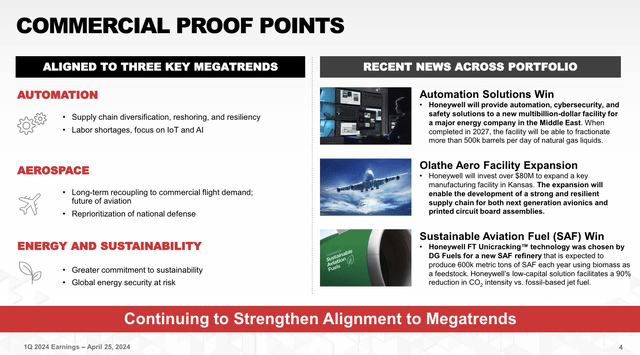
Based on this context, the company is focused on so-called “megatrends,” which I have highlighted in prior articles as well.
Honeywell International Inc.
- Automation is expected to require a major focus on the Internet of Things (“IoT”) and artificial intelligence (“AI”).
- Aerospace benefits from recovering commercial demand and a general reprioritization of defense – especially in light of the Ukraine war.
- Energy and sustainability focus on energy solutions and general sustainability.
With that in mind, Honeywell is investing $80 million to expand its Olathe plant in Kansas, which will support the production of next-generation avionics technology and create significant job opportunities.
Additionally, Honeywell’s advancements in sustainable aviation fuel (“SAF”) technology align with global efforts to reduce carbon emissions and support sustainable energy solutions.
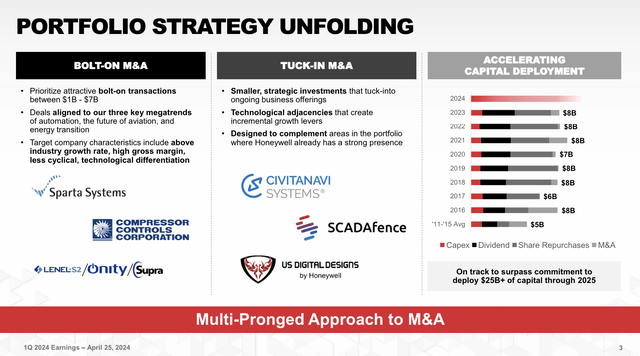
It is also using bolt-on and tuck-in acquisitions to boost its portfolio, including major deals to add megatrend capabilities. This includes businesses with above-average growth rates, elevated margins, and less cyclical demand characteristics.
Honeywell International Inc.
With regard to organic growth, during the Bank of America Transportation, Airlines, and Industrial Conference, the company explained that it allocates roughly 70% of its R&D budget to new products. Around 20% is dedicated to breakthrough initiatives, exploring the application of aerospace technologies in adjacent industries. The remaining 10% targets advanced technologies like autonomy, electrification, and fuel cell systems.
Plenty Of Shareholder Value
In addition to M&A, the company is not neglecting its shareholders.
Honeywell’s capital deployment strategy includes $1.6 billion allocated in the first quarter alone, with $700 million in dividends, $700 million in share repurchases, and $200 million in high-return capital expenditures.
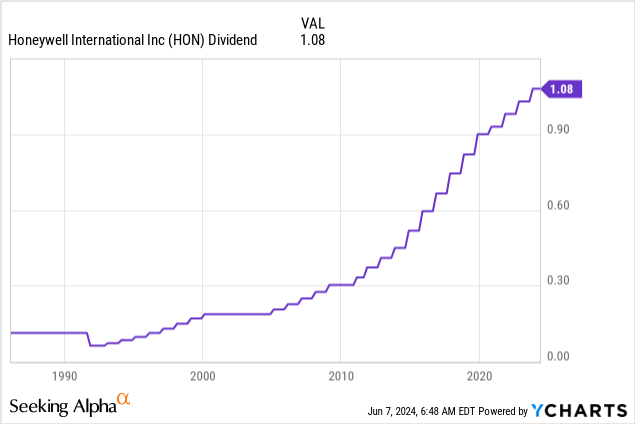
After hiking its dividend by 4.9% on September 29, Honeywell currently pays $1.08 per share per quarter, which translates to a 2.1% yield. This dividend is protected by a 45% payout ratio and adds to the company’s 10-14% annual return outlook, which I discussed in the second part of this article.
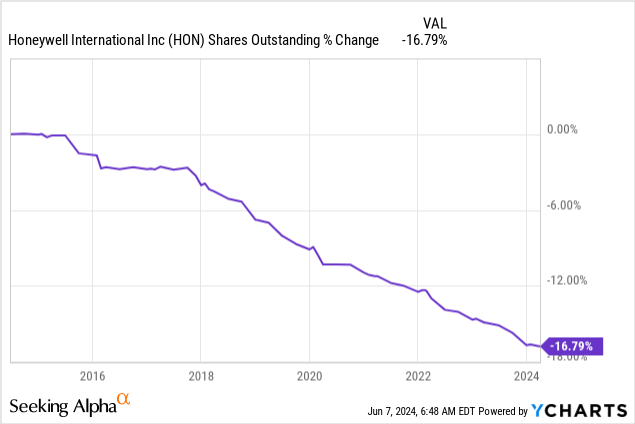
Moreover, the company, which enjoys an A-rated balance sheet, has bought back 17% of its shares over the past decade, which positively contributed to its favorable stock price performance.
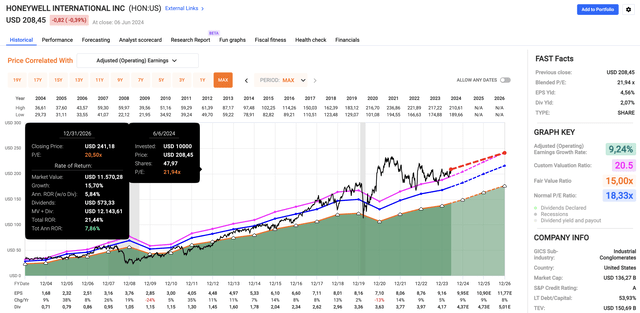
Valuation-wise, we need to keep a few things in mind. Earlier in this article, we discussed a potential annual return of 10-14%, based on elevated EPS growth and the company’s 2% dividend. However, there’s a valuation component the company cannot influence.
Using the FactSet data in the chart below, the company is expected to grow its EPS by roughly 9% annually, which is slightly below the midpoint of its long-term guidance. I expect that number to rise when cyclical tailwinds start to improve.
FAST Graphs
Adding to that, HON trades at a blended P/E ratio of 21.9x, which is above its two-decade normalized P/E ratio of 18.3x. That said, the 10-year average is 20.5x, which would imply an annual return between 7-8%.
In my prior article, I went with a 23.1x multiple, which is its five-year average and a number that better reflects long-term megatrend benefits and ambitious margin growth plans.
While this would imply a $272 price target (30% above the current price), I believe we need to see a path to stronger economic growth before investors are willing to apply a multiple that high.
Needless to say, I stick to a Buy rating. While short-term economic hiccups could cause volatility, I believe HON has found a way to turn a diversified conglomerate business model into a great foundation for elevated long-term growth and shareholder distributions.
Takeaway
Honeywell is well-positioned for long-term growth, driven by strong demand in its aerospace sector and strategic investments in innovation and sustainability.
Despite some short-term challenges, Honeywell’s focus on high-growth, high-margin segments, and megatrend opportunities like IoT and AI, positions it for 10-14% annual returns.
With a robust capital deployment strategy, including dividends and share buybacks, Honeywell continues to deliver value to shareholders.
While economic uncertainties may cause short-term volatility, the company’s long-term outlook remains promising, making it a compelling buy for investors who are looking for industrial exposure supported by megatrends.
Pros & Cons
Pros:
- Steady Aerospace Growth: Honeywell’s aerospace segment continues to outperform. I expect elevated long-term growth rates to last.
- Focus on Innovation/Megatrends: The company’s emphasis on innovation and sustainability positions it well for long-term growth, especially in light of megatrends.
- Shareholder-Friendly Policies: With consistent dividend growth and share buybacks, Investors remain in a good place.
Cons:
- Valuation: Although HON is far from overvalued, a higher multiple is needed to unlock elevated total returns in the years ahead.
- Diversification Challenges: While HON has figured out how to grow long-term, I believe pure-play aerospace companies may have an advantage as long as general cyclical growth remains subdued.
- Economic Growth: HON remains a cyclical company, which means potential economic downturns can have a negative impact on the company.
Credit: Source link