
• bitcoinBitcoin(BTC)$67,042.00-2.28%
  • ethereumEthereum(ETH)$1,899.52-1.08%
  • tetherTether(USDT)$1.000.00%
  • binancecoinBNB(BNB)$618.42-2.29%
  • usd-coinUSDC(USDC)$1.000.00%
  • rippleXRP(XRP)$0.99-1.61%
  • solanaSolana(SOL)$75.48-3.99%
  • tronTRON(TRX)$0.3122150.40%
  • Figure HelocFigure Heloc(FIGR_HELOC)$1.054.54%
  • HyperliquidHyperliquid(HYPE)$68.94-2.77%
  • zcashZcash(ZEC)$908.080.49%
  • dogecoinDogecoin(DOGE)$0.062961-1.11%
  • moneroMonero(XMR)$524.032.27%
  • leo-tokenLEO Token(LEO)$9.320.56%
  • USDSUSDS(USDS)$1.00-0.01%
  • whitebitWhiteBIT Coin(WBT)$65.31-1.40%
  • chainlinkChainlink(LINK)$9.64-0.64%
  • cardanoCardano(ADA)$0.164411-2.25%
  • stellarStellar(XLM)$0.1436240.70%
  • Ethena USDeEthena USDe(USDE)$1.00-0.02%
  • daiDai(DAI)$1.000.01%
  • nearNEAR Protocol(NEAR)$3.340.97%
  • bitcoin-cashBitcoin Cash(BCH)$216.150.12%
  • Quantix FinanceQuantix Finance(QFI)$999.150.00%
  • litecoinLitecoin(LTC)$48.811.32%
  • avalanche-2Avalanche(AVAX)$8.09-0.04%
  • CantonCanton(CC)$0.085430-1.41%
  • uniswapUniswap(UNI)$5.59-1.98%
  • suiSui(SUI)$0.780.45%
  • tether-goldTether Gold(XAUT)$3,861.03-1.16%
  • USD1USD1(USD1)$1.00-0.05%
  • the-open-networkGram (prev. Toncoin)(GRAM)$1.07-7.24%
  • Ripple USDRipple USD(RLUSD)$1.000.01%
  • hedera-hashgraphHedera(HBAR)$0.060085-2.00%
  • Global DollarGlobal Dollar(USDG)$1.00-0.01%
  • RainRain(RAIN)$0.003705-0.98%
  • paypal-usdPayPal USD(PYUSD)$1.00-0.01%
  • BittensorBittensor(TAO)$210.673.45%
  • shiba-inuShiba Inu(SHIB)$0.000004-0.36%
  • Ondo US Dollar YieldOndo US Dollar Yield(USDY)$1.150.04%
  • crypto-com-chainCronos(CRO)$0.046515-0.39%
  • quant-networkQuant(QNT)$156.75-0.60%
  • Circle USYCCircle USYC(USYC)$1.140.04%
  • Spiko Amundi Overnight Swap Fund (EUR)Spiko Amundi Overnight Swap Fund (EUR)(EURSAFO)$1.12-0.30%
  • okbOKB(OKB)$92.28-1.72%
  • MemeCoreMemeCore(M)$0.834.27%
  • pepePepe(PEPE)$0.000004-5.20%
  • EthenaEthena(ENA)$0.129900-2.96%
  • pax-goldPAX Gold(PAXG)$3,862.57-1.16%
  • Falcon USDFalcon USD(USDF)$0.99-0.02%
TradePoint.io
  • Main
  • AI & Technology
  • Stock Charts
  • Market & News
  • Business
  • Finance Tips
  • Trade Tube
  • Blog
  • Shop
No Result
View All Result
TradePoint.io
No Result
View All Result

A New AI Research from CMU and Meta Introduces PyNeRF: A Leap in Neural Radiance Fields with Scale-Aware, Grid-Based Rendering

December 8, 2023
in AI & Technology
Reading Time: 4 mins read
A A
A New AI Research from CMU and Meta Introduces PyNeRF: A Leap in Neural Radiance Fields with Scale-Aware, Grid-Based Rendering
ShareShareShareShareShare

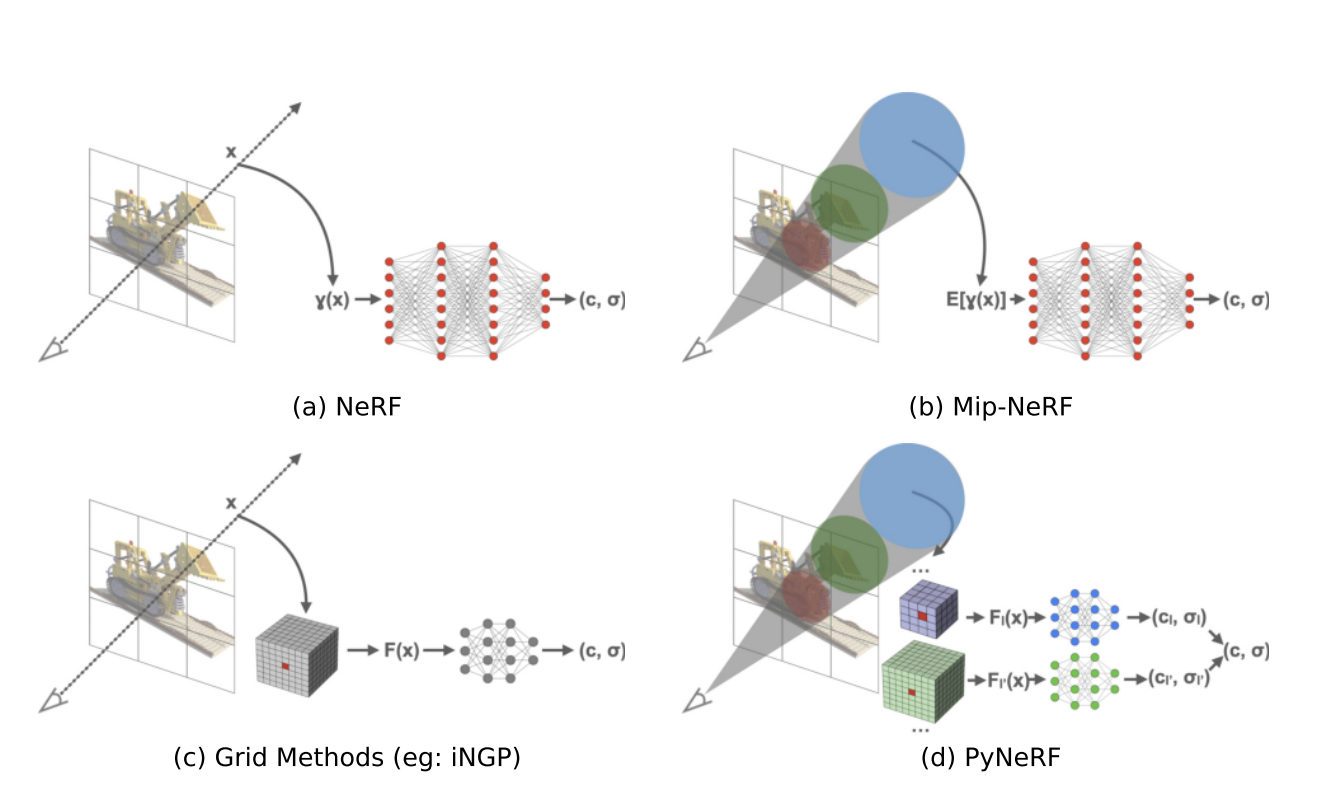
How can Neural Radiance Fields (NeRFs) be improved to handle scale variations and reduce aliasing artifacts in scene reconstruction? A new research paper from CMU and Meta addresses this issue by proposing PyNeRF (Pyramidal Neural Radiance Fields). It improves neural radiation fields (NeRFs) by training model heads at different spatial grid resolutions, which helps reduce the visual distortions that can occur when reconstructing scenes at various camera distances. PyNeRF achieves these improvements without significantly impacting performance, making it an effective solution for accelerating NeRFs while maintaining high-quality scene reconstruction.

Inspired by NeRF, the study explores grid-based methods (NSVF, Plenoxels, DVGO, TensoRF, K-Planes, Instant-NGP) aiming to enhance rendering speed and memory efficiency using voxel grids and tensor approximations. PyNeRF combines speed benefits with quality preservation across scales, surpassing other fast-rendering approaches like Instant-NGP, Nerfacto, and more in rendering quality and training speed. 

Recent advances in neural volumetric rendering, particularly NeRFs, offer progress in realistic view synthesis. However, NeRFs are slow due to their MLP representation and assumptions, leading to aliasing. Grid-based methods like Mip-NeRF accelerate training but lack compatibility with positional encodings—PyNeRF, inspired by divide-and-conquer NeRF extensions and classical techniques. PyNeRF’s pyramid of models, sampled along rays, and partitioning approach improve rendering quality while maintaining the speed of accelerated NeRF implementations, offering a versatile solution for efficient and high-quality novel view synthesis.

The research suggests modifying grid-based models and training model heads at different spatial grid resolutions for rendering larger volume samples. Using SUDS as the backbone model, they progressively train at higher resolutions. Various grid-based acceleration methods are discussed, storing learned features in structures like voxel grids or hash tables. The researchers evaluate their method against LaplacianPyNeRF and other interpolation approaches, examining the impact of reusing feature grids and using 2D-pixel areas. The primary contribution is a versatile partitioning method that enhances visual fidelity while preserving rendering speed in any existing grid-rendering approach.

PyNeRF significantly enhances rendering quality, lowering error rates by 20-90% in synthetic and real-world scenes with minimal performance impact. Compared to Mip-NeRF, it achieves a 20% error reduction while training over 60 times faster. PyNeRF converges to SUDS quality in 2 hours, outperforming baselines in various metrics, whereas SUDS takes 4 hours. Variant testing and evaluations against fast-rendering approaches demonstrate superior results on synthetic and Multiscale Blender datasets. Assessment of the Argoverse 2 Sensor dataset attests to PyNeRF’s high-quality reconstructions across numerous video frames.

In conclusion, PyNeRF has demonstrated impressive progress in enhancing anti-aliasing features in fast volumetric renderers, showcasing exceptional results across various datasets. The method advocates for sharing real-world captures to further research in neural volumetric rendering. Nonetheless, it acknowledges the potential security and privacy risks of proficiently constructing high-quality neural representations.

Future research could benefit from sharing additional real-world captures and exploring alternative mapping functions for assigning integration volume to hierarchy levels. A valuable investigation direction would be using semantic information for privacy filtering during model training. Interesting future avenues include further exploration of architectures to enhance visual fidelity while preserving rendering speed in fast NeRF approaches. Potential areas for future research involve applying the pyramidal approach to other accelerated NeRF implementations and assessing its performance.


Check out the Paper. All credit for this research goes to the researchers of this project. Also, don’t forget to join our 33k+ ML SubReddit, 41k+ Facebook Community, Discord Channel, and Email Newsletter, where we share the latest AI research news, cool AI projects, and more.

If you like our work, you will love our newsletter..


YOU MAY ALSO LIKE

Cursor Traces Breach to Access Key Exposed by Fireworks AI – Unite.AI

FAA Issues Nationwide Ground Stop After Communications Problems – Unite.AI

Hello, My name is Adnan Hassan. I am a consulting intern at Marktechpost and soon to be a management trainee at American Express. I am currently pursuing a dual degree at the Indian Institute of Technology, Kharagpur. I am passionate about technology and want to create new products that make a difference.


✅ [Featured AI Model] Check out LLMWare and It’s RAG- specialized 7B Parameter LLMs

Credit: Source link

ShareTweetSendSharePin

Related Posts

Cursor Traces Breach to Access Key Exposed by Fireworks AI – Unite.AI
AI & Technology

Cursor Traces Breach to Access Key Exposed by Fireworks AI – Unite.AI

November 14, 2026
FAA Issues Nationwide Ground Stop After Communications Problems – Unite.AI
AI & Technology

FAA Issues Nationwide Ground Stop After Communications Problems – Unite.AI

November 14, 2026
Some International Physical Copies Of GTA VI Can Allegedly Be Redeemed Without Opening The Box
AI & Technology

Some International Physical Copies Of GTA VI Can Allegedly Be Redeemed Without Opening The Box

November 13, 2026
Anthropic IPO Could Raise  Billion as Orders Reach Six Times – Unite.AI
AI & Technology

Anthropic IPO Could Raise $64 Billion as Orders Reach Six Times – Unite.AI

November 13, 2026
Next Post
Saltwater crisis impacting areas along Mississippi River

Saltwater crisis impacting areas along Mississippi River

Leave a Reply Cancel reply

Your email address will not be published. Required fields are marked *

Search

No Result
View All Result
RUM Group Inc. (RUM) Q3 2026 Earnings Call Transcript

RUM Group Inc. (RUM) Q3 2026 Earnings Call Transcript

November 11, 2026
Google Brings The Gemini App To Apple CarPlay

Google Brings The Gemini App To Apple CarPlay

November 11, 2026
Sweetgreen raises top store managers’ pay to over 0K

Sweetgreen raises top store managers’ pay to over $200K

November 10, 2026

About

Learn more

Our Services

Legal

Privacy Policy

Terms of Use

Bloggers

Learn more

Article Links

Contact

Advertise

Ask us anything

©2020- TradePoint.io - All rights reserved!

Tradepoint.io, being just a publishing and technology platform, is not a registered broker-dealer or investment adviser. So we do not provide investment advice. Rather, brokerage services are provided to clients of Tradepoint.io by independent SEC-registered broker-dealers and members of FINRA/SIPC. Every form of investing carries some risk and past performance is not a guarantee of future results. “Tradepoint.io“, “Instant Investing” and “My Trading Tools” are registered trademarks of Apperbuild, LLC.

This website is operated by Apperbuild, LLC. We have no link to any brokerage firm and we do not provide investment advice. Every information and resource we provide is solely for the education of our readers. © 2020 Apperbuild, LLC. All rights reserved.

No Result
View All Result
  • Main
  • AI & Technology
  • Stock Charts
  • Market & News
  • Business
  • Finance Tips
  • Trade Tube
  • Blog
  • Shop

© 2023 - TradePoint.io - All Rights Reserved!