






























ATOM announced the agreements on November 24, 2026, establishing borrowing limits totaling 4.5 billion yen with Mizuho Bank, Sumitomo Mitsui Banking Corp. and Mitsubishi UFJ Bank to build an on-premises GPU cluster and prepare its humanoid robots for volume production.
Sumitomo Mitsui’s facility is 2 billion yen, Mizuho’s is 1.5 billion yen and Mitsubishi UFJ’s is 1 billion yen. Each amount is a maximum borrowing limit under a separate agreement, not a loan already disbursed; drawdowns will follow the conditions of the relevant contract.
Mizuho’s facility replaces its August 2026 loan agreement under revised terms. Because the earlier Mizuho agreement was also 1.5 billion yen, the combined figure should not be interpreted as 4.5 billion yen of entirely new borrowing capacity.
GPU Cluster and Manufacturing Ramp
ATOM will build and operate the GPU cluster on its own premises, creating a dedicated computing environment to train and validate the physical AI models responsible for robot perception, decision-making and movement. The company’s stated aim in owning the training infrastructure is to accelerate model development and testing.
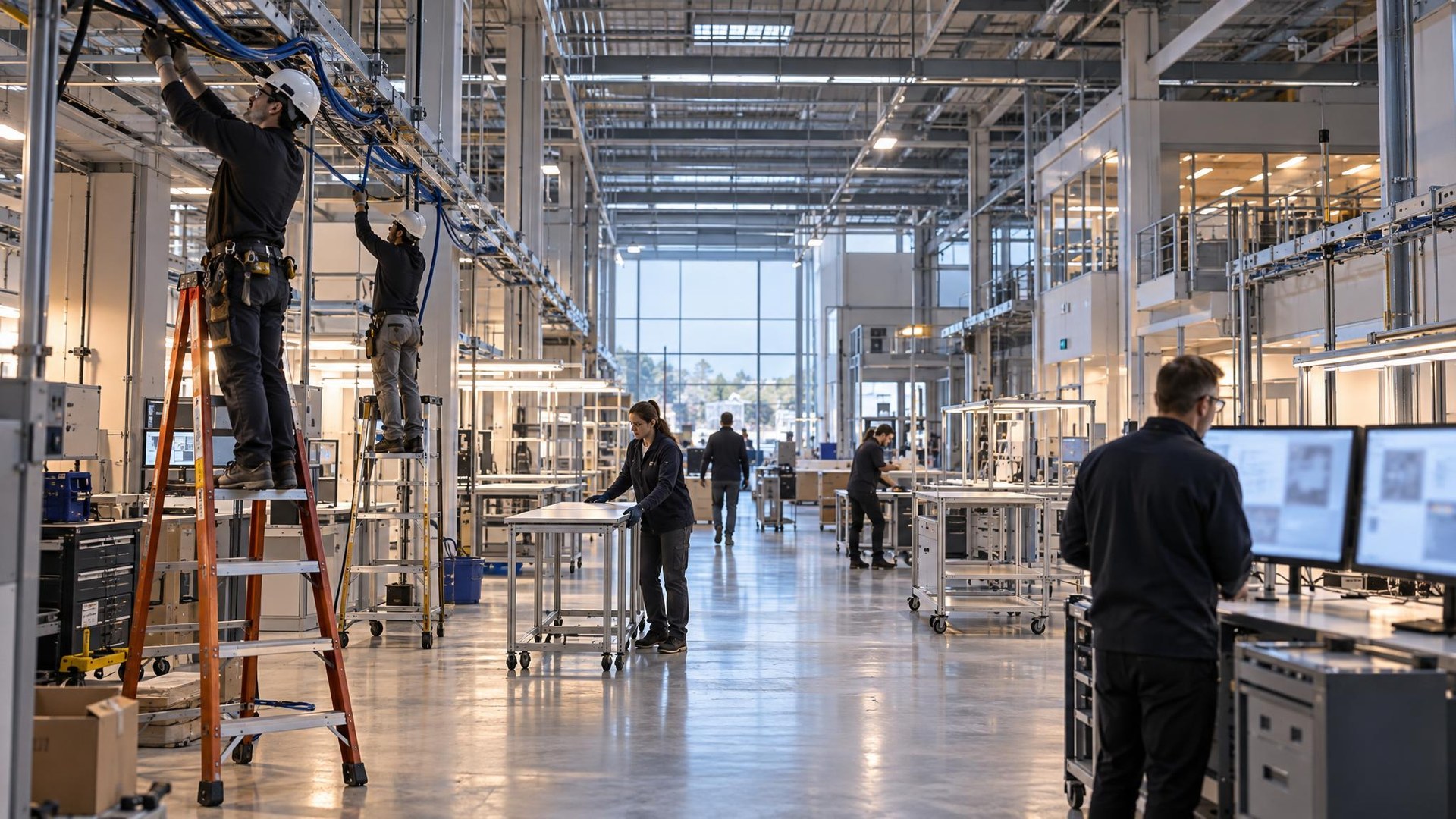
Manufacturing preparations will run alongside that computing buildout. ATOM plans to work with component manufacturers and manufacturing partners on design, procurement, assembly and inspection. The plan is to expand production and deliveries in stages while safety and quality requirements are checked at customer sites, with the goal of maintaining a continuing product supply.
ATOM is targeting annual deliveries of 200 humanoid robots in 2027 and 10,000 in 2030. Those are future company delivery targets rather than measures of current output.
President Shunsuke Aoki connected the financing plan to Japan’s component suppliers and expertise developed in manufacturing and logistics. He said ATOM wants to supply robots to workplaces facing labor shortages and connect robot installations with concrete results for customers.
Integrated Robots, Models and Data
Founded on November 11, 2025 and based in Tokyo’s Koto ward, ATOM develops both a dual-arm bipedal humanoid and the physical AI foundation model intended to control it. Its company profile describes vertical integration across hardware design and production, environmental recognition, decision-making and action generation.
The Physical AI Foundry handles the data side of that system. ATOM uses the Tokyo site to collect and generate real-machine training data, train and evaluate models, and improve the robot hardware. The company previously raised 3 billion yen in a May 2026 seed round; its earlier Mizuho loan agreement followed in August 2026.
ATOM’s official news index dates the foundry’s opening in Toyosu to August 2026 and describes roughly 1,700 square meters of development space, with goals of operating 200 robots continuously and producing 300,000 cumulative hours of training data by the end of 2027. A separate August 2026 memorandum with NSK covered joint validation of NSK actuators and joint collection of physical AI data at NSK manufacturing sites.
The facilities connect the two sides of ATOM’s plan: dedicated computing to train models on real-machine data, and a partner-based manufacturing process to deliver the robots those models are intended to control. The central execution question is whether ATOM can convert borrowing capacity into safe, repeatable customer deployments while expanding its data operation and production at the same time.
Credit: Source link