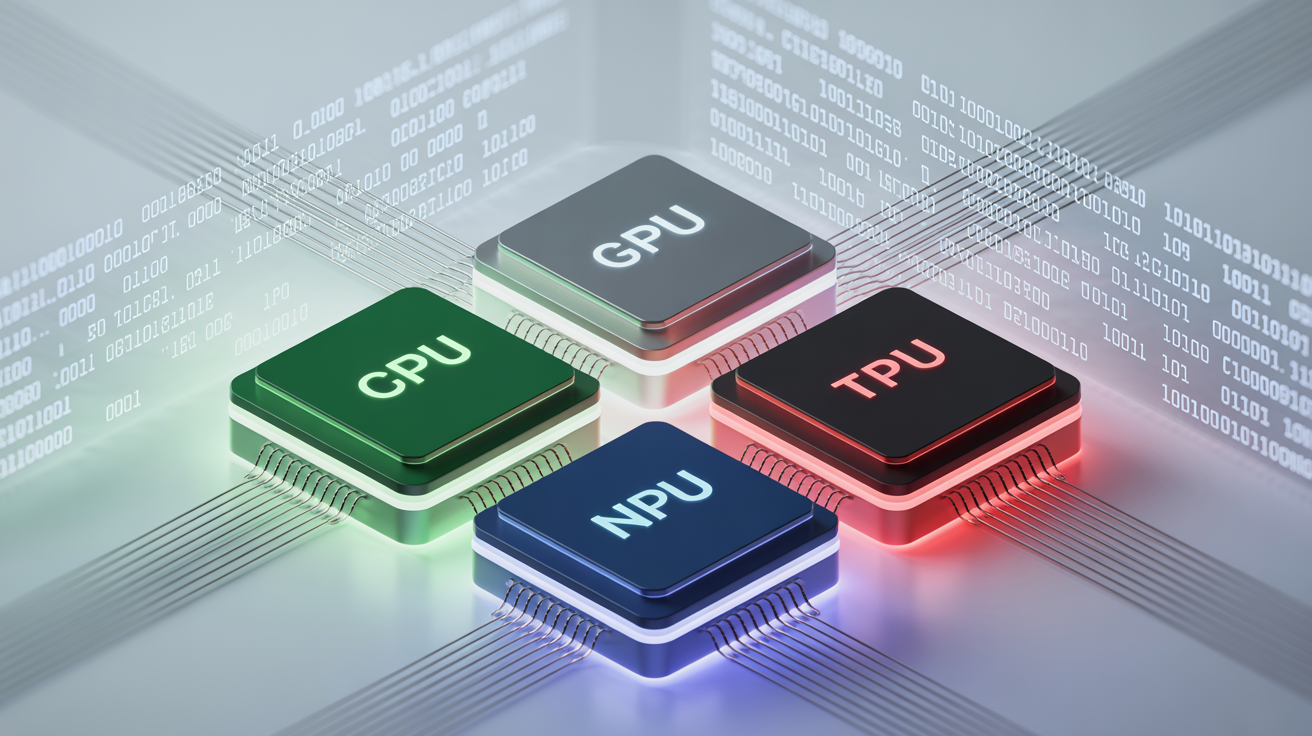

Artificial intelligence and machine learning workloads have fueled the evolution of specialized hardware to accelerate computation far beyond what traditional CPUs can offer. Each processing unit—CPU, GPU, NPU, TPU—plays a distinct role in the AI ecosystem, optimized for certain models, applications, or environments. Here’s a technical, data-driven breakdown of their core differences and best use cases.
CPU (Central Processing Unit): The Versatile Workhorse
- Design & Strengths: CPUs are general-purpose processors with a few powerful cores—ideal for single-threaded tasks and running diverse software, including operating systems, databases, and light AI/ML inference.
- AI/ML Role: CPUs can execute any kind of AI model, but lack the massive parallelism needed for efficient deep learning training or inference at scale.
- Best for:
- Classical ML algorithms (e.g., scikit-learn, XGBoost)
- Prototyping and model development
- Inference for small models or low-throughput requirements
Technical Note: For neural network operations, CPU throughput (typically measured in GFLOPS—billion floating point operations per second) lags far behind specialized accelerators.
GPU (Graphics Processing Unit): The Deep Learning Backbone
- Design & Strengths: Originally for graphics, modern GPUs feature thousands of parallel cores designed for matrix/multiple vector operations, making them highly efficient for training and inference of deep neural networks.
- Performance Examples:
- NVIDIA RTX 3090: 10,496 CUDA cores, up to 35.6 TFLOPS (teraFLOPS) FP32 compute.
- Recent NVIDIA GPUs include “Tensor Cores” for mixed precision, accelerating deep learning operations.
- Best for:
- Training and inferencing large-scale deep learning models (CNNs, RNNs, Transformers)
- Batch processing typical in datacenter and research environments
- Supported by all major AI frameworks (TensorFlow, PyTorch)
Benchmarks: A 4x RTX A5000 setup can surpass a single, far more expensive NVIDIA H100 in certain workloads, balancing acquisition cost and performance.
NPU (Neural Processing Unit): The On-device AI Specialist
- Design & Strengths: NPUs are ASICs (application-specific chips) crafted exclusively for neural network operations. They optimize parallel, low-precision computation for deep learning inference, often running at low power for edge and embedded devices.
- Use Cases & Applications:
- Mobile & Consumer: Powering features like face unlock, real-time image processing, language translation on devices like the Apple A-series, Samsung Exynos, Google Tensor chips.
- Edge & IoT: Low-latency vision and speech recognition, smart city cameras, AR/VR, and manufacturing sensors.
- Automotive: Real-time data from sensors for autonomous driving and advanced driver assistance.
- Performance Example: The Exynos 9820’s NPU is ~7x faster than its predecessor for AI tasks.
Efficiency: NPUs prioritize energy efficiency over raw throughput, extending battery life while supporting advanced AI features locally.
TPU (Tensor Processing Unit): Google’s AI Powerhouse
- Design & Strengths: TPUs are custom chips developed by Google specifically for large tensor computations, tuning hardware around the needs of frameworks like TensorFlow.
- Key Specifications:
- TPU v2: Up to 180 TFLOPS for neural network training and inference.
- TPU v4: Available in Google Cloud, up to 275 TFLOPS per chip, scalable to “pods” exceeding 100 petaFLOPS.
- Specialized matrix multiplication units (“MXU”) for enormous batch computations.
- Up to 30–80x better energy efficiency (TOPS/Watt) for inference compared to contemporary GPUs and CPUs.
- Best for:
- Training and serving massive models (BERT, GPT-2, EfficientNet) in cloud at scale
- High-throughput, low-latency AI for research and production pipelines
- Tight integration with TensorFlow and JAX; increasingly interfacing with PyTorch
Note: TPU architecture is less flexible than GPU—optimized for AI, not graphics or general-purpose tasks.
Which Models Run Where?
| Hardware | Best Supported Models | Typical Workloads |
|---|---|---|
| CPU | Classical ML, all deep learning models* | General software, prototyping, small AI |
| GPU | CNNs, RNNs, Transformers | Training and inference (cloud/workstation) |
| NPU | MobileNet, TinyBERT, custom edge models | On-device AI, real-time vision/speech |
| TPU | BERT/GPT-2/ResNet/EfficientNet, etc. | Large-scale model training/inference |
*CPUs support any model, but are not efficient for large-scale DNNs.
Data Processing Units (DPUs): The Data Movers
- Role: DPUs accelerate networking, storage, and data movement, offloading these tasks from CPUs/GPUs. They enable higher infrastructure efficiency in AI datacenters by ensuring compute resources focus on model execution, not I/O or data orchestration.
Summary Table: Technical Comparison
| Feature | CPU | GPU | NPU | TPU |
|---|---|---|---|---|
| Use Case | General Compute | Deep Learning | Edge/On-device AI | Google Cloud AI |
| Parallelism | Low–Moderate | Very High (~10,000+) | Moderate–High | Extremely High (Matrix Mult.) |
| Efficiency | Moderate | Power-hungry | Ultra-efficient | High for large models |
| Flexibility | Maximum | Very high (all FW) | Specialized | Specialized (TensorFlow/JAX) |
| Hardware | x86, ARM, etc. | NVIDIA, AMD | Apple, Samsung, ARM | Google (Cloud only) |
| Example | Intel Xeon | RTX 3090, A100, H100 | Apple Neural Engine | TPU v4, Edge TPU |
Key Takeaways
- CPUs are unmatched for general-purpose, flexible workloads.
- GPUs remain the workhorse for training and running neural networks across all frameworks and environments, especially outside Google Cloud.
- NPUs dominate real-time, privacy-preserving, and power-efficient AI for mobile and edge, unlocking local intelligence everywhere from your phone to self-driving cars.
- TPUs offer unmatched scale and speed for massive models—especially in Google’s ecosystem—pushing the frontiers of AI research and industrial deployment.
Choosing the right hardware depends on model size, compute demands, development environment, and desired deployment (cloud vs. edge/mobile). A robust AI stack often leverages a mix of these processors, each where it excels.
Michal Sutter is a data science professional with a Master of Science in Data Science from the University of Padova. With a solid foundation in statistical analysis, machine learning, and data engineering, Michal excels at transforming complex datasets into actionable insights.

Credit: Source link