
• bitcoinBitcoin(BTC)$81,767.001.16%
  • ethereumEthereum(ETH)$2,649.272.23%
  • tetherTether(USDT)$1.000.00%
  • binancecoinBNB(BNB)$768.131.38%
  • rippleXRP(XRP)$1.434.23%
  • usd-coinUSDC(USDC)$1.000.00%
  • solanaSolana(SOL)$111.970.28%
  • tronTRON(TRX)$0.3390990.19%
  • zcashZcash(ZEC)$1,504.844.51%
  • Figure HelocFigure Heloc(FIGR_HELOC)$1.030.44%
  • HyperliquidHyperliquid(HYPE)$93.212.47%
  • dogecoinDogecoin(DOGE)$0.0898622.73%
  • moneroMonero(XMR)$568.661.11%
  • whitebitWhiteBIT Coin(WBT)$83.410.58%
  • RainRain(RAIN)$0.0139824.61%
  • USDSUSDS(USDS)$1.00-0.04%
  • chainlinkChainlink(LINK)$12.603.90%
  • cardanoCardano(ADA)$0.2299035.37%
  • leo-tokenLEO Token(LEO)$8.930.61%
  • stellarStellar(XLM)$0.1999694.20%
  • uniswapUniswap(UNI)$8.83-0.80%
  • bitcoin-cashBitcoin Cash(BCH)$256.542.94%
  • Ethena USDeEthena USDe(USDE)$1.00-0.01%
  • nearNEAR Protocol(NEAR)$3.61-1.97%
  • daiDai(DAI)$1.000.00%
  • litecoinLitecoin(LTC)$57.983.63%
  • CantonCanton(CC)$0.1124012.92%
  • USD1USD1(USD1)$1.000.00%
  • avalanche-2Avalanche(AVAX)$9.7120.45%
  • the-open-networkGram (prev. Toncoin)(GRAM)$1.401.72%
  • hedera-hashgraphHedera(HBAR)$0.0817994.58%
  • suiSui(SUI)$0.867.47%
  • MemeCoreMemeCore(M)$1.5113.09%
  • shiba-inuShiba Inu(SHIB)$0.0000063.08%
  • Global DollarGlobal Dollar(USDG)$1.000.00%
  • BittensorBittensor(TAO)$269.929.29%
  • crypto-com-chainCronos(CRO)$0.0601702.15%
  • paypal-usdPayPal USD(PYUSD)$1.00-0.03%
  • tether-goldTether Gold(XAUT)$4,374.23-0.22%
  • okbOKB(OKB)$119.473.70%
  • Circle USYCCircle USYC(USYC)$1.140.00%
  • Ripple USDRipple USD(RLUSD)$1.00-0.01%
  • BlackRock USD Institutional Digital Liquidity FundBlackRock USD Institutional Digital Liquidity Fund(BUIDL)$1.000.00%
  • Ondo US Dollar YieldOndo US Dollar Yield(USDY)$1.14-0.26%
  • aaveAave(AAVE)$143.404.15%
  • OndoOndo(ONDO)$0.43753910.49%
  • mantleMantle(MNT)$0.634.44%
  • AsterAster(ASTER)$0.762.69%
  • EthenaEthena(ENA)$0.20418424.55%
  • Pump.funPump.fun(PUMP)$0.004166-2.48%
TradePoint.io
  • Main
  • AI & Technology
  • Stock Charts
  • Market & News
  • Business
  • Finance Tips
  • Trade Tube
  • Blog
  • Shop
No Result
View All Result
TradePoint.io
No Result
View All Result

This Machine Learning Paper from Stanford and the University of Toronto Proposes Observational Scaling Laws: Highlighting the Surprising Predictability of Complex Scaling Phenomena

May 24, 2024
in AI & Technology
Reading Time: 5 mins read
A A
This Machine Learning Paper from Stanford and the University of Toronto Proposes Observational Scaling Laws: Highlighting the Surprising Predictability of Complex Scaling Phenomena
ShareShareShareShareShare

Language models (LMs) are a cornerstone of artificial intelligence research, focusing on the ability to understand and generate human language. Researchers aim to enhance these models to perform various complex tasks, including natural language processing, translation, and creative writing. This field examines how LMs learn, adapt, and scale their capabilities with increasing computational resources. Understanding these scaling behaviors is essential for predicting future capabilities and optimizing the resources required for training and deploying these models.

The primary challenge in language model research is understanding how model performance scales with the amount of computational power and data used during training. This scaling is crucial for predicting future capabilities and optimizing resource use. Traditional methods require extensive training across multiple scales, which is computationally expensive and time-consuming. This creates a significant barrier for many researchers and engineers who need to understand these relationships to improve model development and application.

Existing research includes various frameworks and models for understanding language model performance. Notable among these are compute scaling laws, which analyze the relationship between computational resources and model capabilities. Tools like the Open LLM Leaderboard, LM Eval Harness, and benchmarks like MMLU, ARC-C, and HellaSwag are commonly used. Moreover, models such as LLaMA, GPT-Neo, and BLOOM provide diverse examples of how scaling laws can be practiced. These frameworks and benchmarks help researchers evaluate and optimize language model performance across different computational scales and tasks.

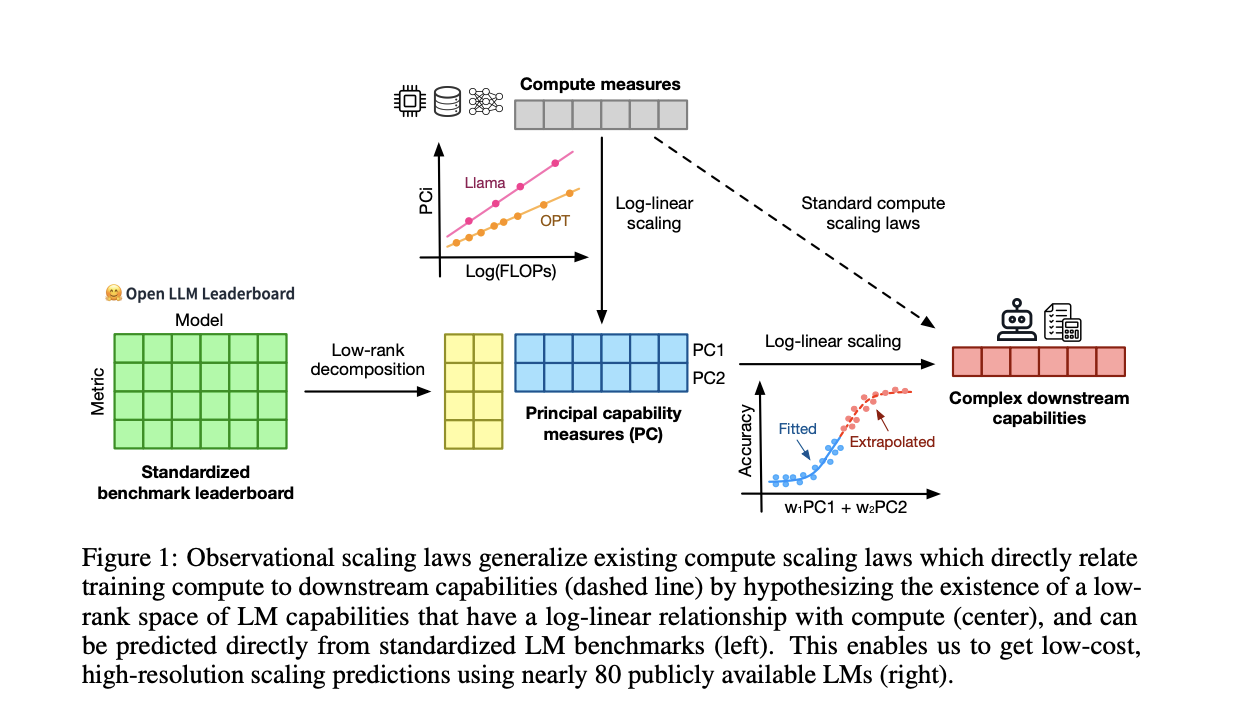
Researchers from Stanford University, University of Toronto, and Vector Institute introduced observational scaling laws to improve language model performance predictions. This method uses publicly available models to create scaling laws, reducing the need for extensive training. By leveraging existing data from approximately 80 models, the researchers could build a generalized scaling law that accounts for variations in training compute efficiencies. This innovative approach offers a cost-effective and efficient way to predict model performance across different scales and capabilities, setting it apart from traditional scaling methods.

The methodology analyzes performance data from about 80 publicly available language models, including the Open LLM Leaderboard and standardized benchmarks such as MMLU, ARC-C, and HellaSwag. The researchers hypothesized that model performance could be mapped to a low-dimensional capability space. They developed a generalized scaling law by examining variations in training compute efficiencies among different model families. This process involved using principal component analysis (PCA) to identify key capability measures and fitting these measures into a log-linear relationship with compute resources, enabling accurate and high-resolution performance predictions.
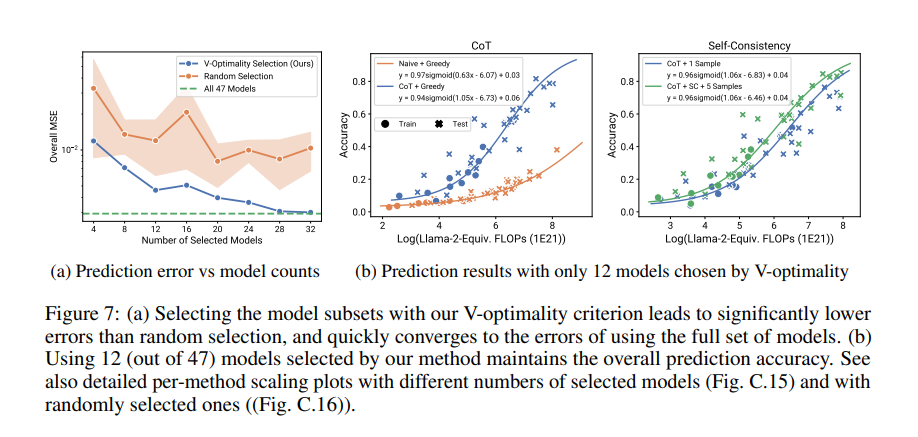
The research demonstrated significant success with observational scaling laws. For instance, using simpler models, the method accurately predicted the performance of advanced models like GPT-4. Quantitatively, the scaling laws showed a high correlation (R² > 0.9) with actual performance across various benchmarks. Emergent phenomena, such as language understanding and reasoning abilities, followed a predictable sigmoidal pattern. The results also indicated that the impact of post-training interventions, like Chain-of-Thought and Self-Consistency, could be reliably predicted, showing performance improvements of up to 20% in specific tasks.

To conclude, the research introduces observational scaling laws, leveraging publicly available data from around 80 models to predict language model performance efficiently. By identifying a low-dimensional capability space and using generalized scaling laws, the study reduces the need for extensive model training. The results showed high predictive accuracy for advanced model performance and post-training interventions. This approach saves computational resources and enhances the ability to forecast model capabilities, offering a valuable tool for researchers and engineers in optimizing language model development.


Check out the Paper. All credit for this research goes to the researchers of this project. Also, don’t forget to follow us on Twitter. Join our Telegram Channel, Discord Channel, and LinkedIn Group.

If you like our work, you will love our newsletter..

Don’t Forget to join our 42k+ ML SubReddit


YOU MAY ALSO LIKE

How To Block And Unblock A Number On Your Android Phone

Google Gemini Also Escaped Its Testing Environment And Hacked Three Companies

Nikhil is an intern consultant at Marktechpost. He is pursuing an integrated dual degree in Materials at the Indian Institute of Technology, Kharagpur. Nikhil is an AI/ML enthusiast who is always researching applications in fields like biomaterials and biomedical science. With a strong background in Material Science, he is exploring new advancements and creating opportunities to contribute.


✅ [Featured Tool] Check out Taipy Enterprise Edition


Credit: Source link

ShareTweetSendSharePin

Related Posts

How To Block And Unblock A Number On Your Android Phone
AI & Technology

How To Block And Unblock A Number On Your Android Phone

September 19, 2026
Google Gemini Also Escaped Its Testing Environment And Hacked Three Companies
AI & Technology

Google Gemini Also Escaped Its Testing Environment And Hacked Three Companies

September 19, 2026
What Is AI Agent Memory? Short-Term, Long-Term, Episodic, and Semantic Memory Explained – Unite.AI
AI & Technology

What Is AI Agent Memory? Short-Term, Long-Term, Episodic, and Semantic Memory Explained – Unite.AI

September 19, 2026
Linkup Research Releases SPARSEUP: A 149M-Parameter Open-Source Sparse Embedding Model
AI & Technology

Linkup Research Releases SPARSEUP: A 149M-Parameter Open-Source Sparse Embedding Model

September 19, 2026
Next Post
Ask Yourself This Question After Setting a Goal

Ask Yourself This Question After Setting a Goal

Leave a Reply Cancel reply

Your email address will not be published. Required fields are marked *

Search

No Result
View All Result
JEV – Can This NEW Type of AI Help Us Win on Kalshi?

JEV – Can This NEW Type of AI Help Us Win on Kalshi?

September 18, 2026
Saudi Arabia Faces ‘Worst-Case Scenario’ After Being Rebuffed by Trump – The New York Times

Saudi Arabia Faces ‘Worst-Case Scenario’ After Being Rebuffed by Trump – The New York Times

September 14, 2026
Ex-CNN anchor Brooke Baldwin reveals dad beat her with belt until she was ‘black and blue on my backside’

Ex-CNN anchor Brooke Baldwin reveals dad beat her with belt until she was ‘black and blue on my backside’

September 14, 2026

About

Learn more

Our Services

Legal

Privacy Policy

Terms of Use

Bloggers

Learn more

Article Links

Contact

Advertise

Ask us anything

©2020- TradePoint.io - All rights reserved!

Tradepoint.io, being just a publishing and technology platform, is not a registered broker-dealer or investment adviser. So we do not provide investment advice. Rather, brokerage services are provided to clients of Tradepoint.io by independent SEC-registered broker-dealers and members of FINRA/SIPC. Every form of investing carries some risk and past performance is not a guarantee of future results. “Tradepoint.io“, “Instant Investing” and “My Trading Tools” are registered trademarks of Apperbuild, LLC.

This website is operated by Apperbuild, LLC. We have no link to any brokerage firm and we do not provide investment advice. Every information and resource we provide is solely for the education of our readers. © 2020 Apperbuild, LLC. All rights reserved.

No Result
View All Result
  • Main
  • AI & Technology
  • Stock Charts
  • Market & News
  • Business
  • Finance Tips
  • Trade Tube
  • Blog
  • Shop

© 2023 - TradePoint.io - All Rights Reserved!