
grandriver
Vista Energy (NYSE:VIST) is one of Argentina’s largest oil producers and exporters and the only pure-play Vaca Muerta basin oil public company in the market.
I have been recommending Vista since October 2021 (the first analyst to recommend the name in Seeking Alpha), with a return of more than 400% since. My latest article from December 2023 analyzed the company’s growth plans and continued to recommend the name.
I reviewed Q423 results, earnings call, and FY24 guidance in this article and re-approached the valuation after a 40% appreciation since the December article. My conclusion is that the stock is still a buy, given the high capital returns at current oil prices, low breakeven prices, incremental investment opportunities, and undemanding valuation.
Operational improvement on all fronts
Vista’s FY23 showed improvements in almost every single front. The company’s operational excellence has been the pillar of its successful growth and consequent stock price appreciation.
Production grows 17%: When comparing FY22 to FY23 numbers, Vista production growth seems to have stalled. However, we must remember that the company divested its conventional assets in February. When adjusting for the divestment, unconventional production grew close to 20%, reaching an average of 52 thousand barrels per day for the year, with an exit rate in Q4 of 60 thousand barrels.
Cost improvement: The company’s lifting cost decreased, now reaching $4.3/boe, with drilling and completion costs per well of $14.3 million, representing D&A costs per barrel of $10 (IR presentation). Management commented on the call that cost reduction should plateau as most scale gains have been realized.
Still, this represents all-in opex (including SG&A and D&A) of $592 million pro-forma for the unconventional operations (Note 30 of financial statements, removing other operating income from FX gains), which divided by 19 million boe produced in the year yields a breakeven of $31 for the whole operations.
GOR improvement: The gas to total production ratio declined to 14.6% for FY23 compared to 16.5% for FY22. By 4Q23, the ratio dropped to 13.1%. Extracting mainly oil is essential as oil is easy to export, meaning its price is more stable. In contrast, gas has significant export capacity limits (Argentina has no LNG terminal and lacks sufficient pipeline connections with its neighbors), which easily leads to an oversaturated market.
Investing in high ROIC growth
According to Buffett, the best type of business is one that can earn high returns on capital and can reinvest in the business at those high returns.
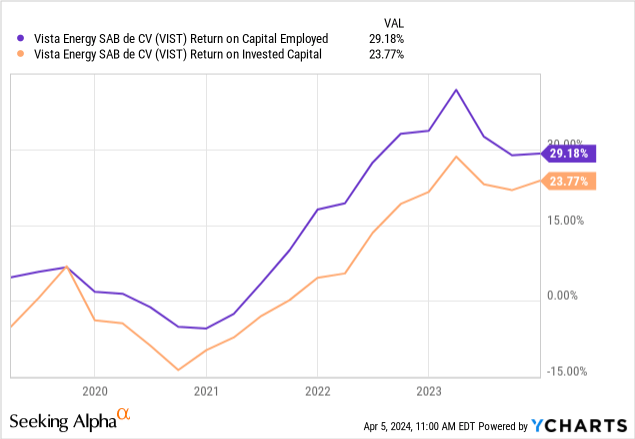
With such a low extraction cost and low all-in operating costs, Vista’s returns on capital are impressive. My favorite measure is ROCE because it does not include capital structure variations, but ROIC (equity returns) is also remarkable.
And the company has a lot of room for growth. Its P1 reserves of 320 million barrels represent 15 years of production at 60 thousand barrels per day. The current healthy inventory is about 1,200 wells, with the company planning to grow by about 50 wells per year. This inventory could expand as the company operates more in the Aguila Mora and Baja del Palo Este areas, where only a few wells have been drilled, and estimates must be more conservative.
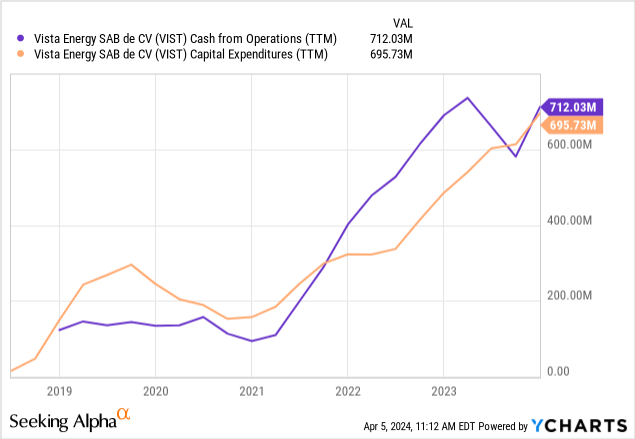
The company does not need to take debt to finance this expansion. It plans to spend about $900 million in CAPEX for the next few years to drill 46 wells annually ($150 million of that CAPEX goes to general infrastructure). At current oil prices of about $65 realized in Argentina, the company can generate well above $1 billion in CFO (Q4 CFO was $350 million) to self-sustain this level of investment. Compared with $350 million CFO in one quarter, Vista’s net debt is only $200 million. The company is almost completely self-financed.
Management also mentioned on the call that they would concentrate on the central development hub (Bajada del Palo Oeste, Este, and Coiron Amargo). BPO is the company’s main property, responsible for 40 thousand daily barrels. The company does not seem interested in acquiring properties from Exxon (XOM), which is divesting Vaca Muerta assets.
No growth valuation attractive at $65 Brent
Vista has many quality characteristics: long-tenured, operationally excellent management, low costs of production, high returns on capital, vast opportunities to deploy more capital, and negligible leverage.
However, even though the stock has appreciated more than 400% in the past three years, 100% in the past year, and 40% since December alone, it continues to be attractively priced even considering no further growth after FY24, and Brent prices moving to $65 per barrel.
In my previous article, I provided a table showing the net income for the company at different prices, accounting for the 10/15% discount from Brent that Argentinian exporters receive, all-in costs of $27 per boe, income taxes of 35%, and assuming production of 70 thousand boe per day, which is the company’s target for 2024. For this article, we can adjust all-in costs to $30 and interest costs of $10 million annually. The remodeled table is below.
Simple Vista profitability model at 70k boe/d (Author)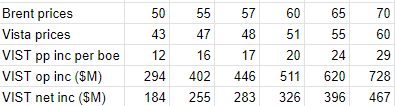
With the company currently valued at a market cap of about $4 billion, it can generate a 10% earnings yield on a $65 Brent barrel with FY24 production against the current $90 per barrel. The company could be considered fairly priced with an oil price of 30% lower and stagnant production.
This valuation leaves any upside potential from the unification of the Argentinian market, removal of 8% excise taxes on exports, and continued expansion of production (the company plans to reach 100 thousand barrels by 2026).
In my opinion, this is the definition of an undervalued security, even though the price has increased substantially already. The company is valued for a much worse oil scenario and without any expansion in production. However, the company can continue expanding at very high incremental returns and has a management team that has proved it can conduct such growth.
For that reason, despite the appreciation, I continue to consider Vista an opportunity, and maintain my Buy rating.
Credit: Source link