

Robert Way
Citigroup Inc.’s (NYSE:C) stock has enjoyed a scintillating twelve months, much to the relief of those who endured the ‘false-hope’ stages in late 2021 and 2022.
C Stock 5-Y Returns (Seeking Alpha)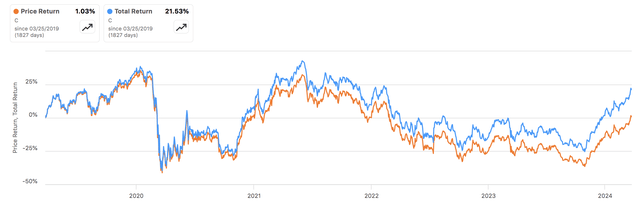
We last covered the stock in April last year, when we assigned it a buy rating. Our premise back then was that Citigroup’s stock would surge due to a turnaround in earnings momentum. Our outlook was successful as the stock has climbed by more than 35% ever since; however, a lot of time has elapsed, meaning revision is warranted.
Herewith are a few of our latest findings on Citigroup.
Our Previous C Stock Rating (Seeking Alpha)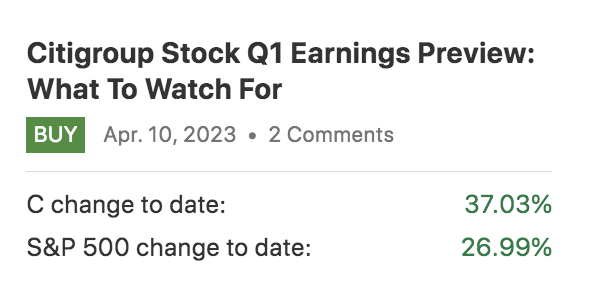
Fundamental Analysis
Supply of Funds
I wanted to start this analysis by discussing the supply of funds, as today’s volatile interest rate environment is pivotal in banks’ access to capital. The following diagram illustrates Citigroup’s funding sources, with a discussion following beneath the graph.
Citigroup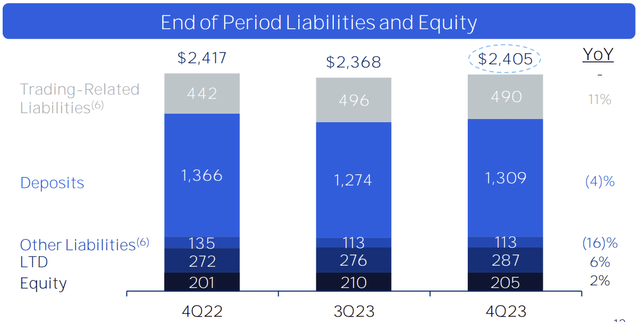
If you recall, bank deposits were a major concern this time last year amid a series of bank defaults in the United States and abroad. However, matters have calmed down. In fact, U.S. bank deposits ticked up by 1.1% in Q4 alone.
Citigroup’s deposits are down 4% year-over-year but up 2.75% quarterly, signaling a shift in momentum. An increase in deposits is fantastic news for the bank because short-term deposits are usually considered the most stable source of financing, as they possess little interest rate sensitivity and are low-cost.
Furthermore, long-term debt and trading liabilities both increased year-on-year but relaxed quarter-over-quarter. The bank’s trading liabilities are likely co-integrated with their asset positions (meaning they’re considered in tandem with asset positions when incurred). However, we are delighted to see lower long-term debt as it often introduces an expensive source of financing due to higher interest rate sensitivity and term premiums than short-term deposits.
In essence, we think the status of Citigroup’s supply of funds is improving.
Return on Investments
Citigroup’s asset performance paints an interesting picture. The following figure provides a summation of its last recorded asset base and as with the liabilities section, a discussion follows beneath.
Citigroup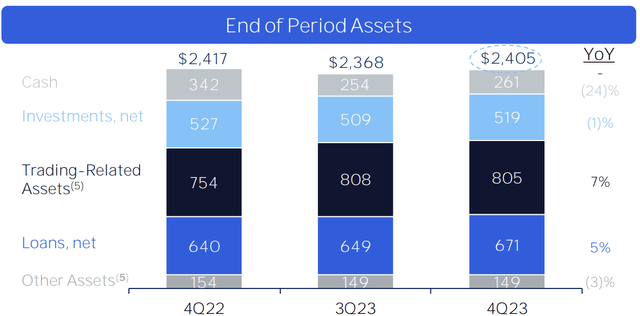
Most of Citigroup’s assets include trading-related assets and loans.
Loans and other NII
We think corporate loans will yield better results for the remainder of the year due to the declining yield curve. A lower curve may lead to reduced funding rates, but a countercyclical uptick in credit spreads is highly probable, providing latitude to Citigroup in the form of higher profit margins. Sure, such a scenario might not occur, but the bank’s current portfolio loan yield of 9.12% suggests current market factors are enough to proliferate the bank’s net interest income by themselves.
Consumer loans could follow a similar trajectory as corporate loans. However, we highlight the risk of negative interest rate duration related to the mortgage market. Mortgages often possess negative duration, which means that a lower yield curve (led by interest rates) may reduce their value.
Citigroup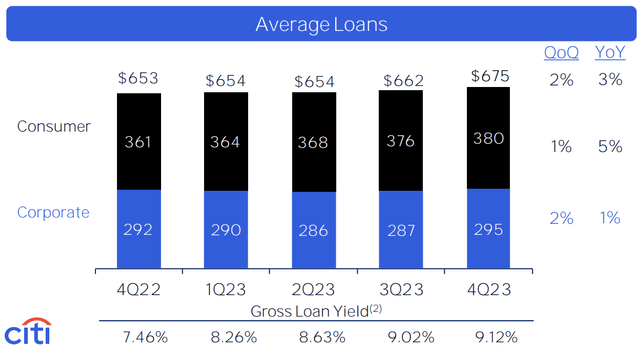
Furthermore, Citigroup’s trading securities are an interesting topic of conversation. The bank’s balance sheet is loaded with held-for-sale securities, which could result in unrealized gains/losses as time passes. The equity market’s outlook is tough to call; therefore, we’ll label it indeterminate for today’s discussion, but we think lower bond yields could spur on sovereign and corporate held-for-trading securities, ramping up Citigroup’s asset base and trading income alike.
Note: The discussion above is included in NII but also relates to the NI segment.
Balance Sheet (Citigroup)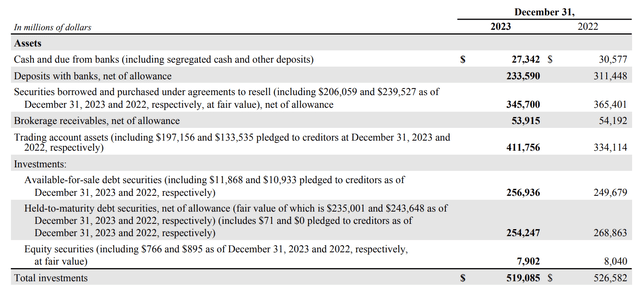
Citigroup’s fourth-quarter results communicated a 13% year-over-year increase in net interest income. As mentioned, we would not be surprised if this trend resumes throughout 2024. However, slower implied economic growth (GDPNow) could add risk to the segment going into the back end of 2024.
Citigroup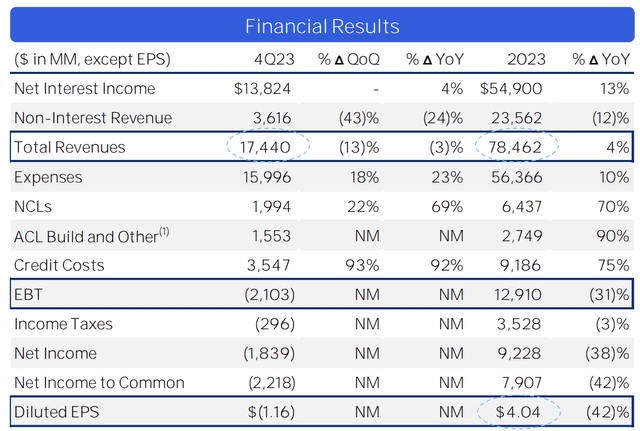
Non-Interest Income
Citigroup reported $555 million in services revenue during Q4, down by 20% year-over-year. Much of the decline resulted from devaluations driven by the firm’s operations in Argentina amid a slump in the Peso. We anticipate a strong rebound for the remainder of the year as cross-border flows continue to outpace GDP growth (23% in the past quarter), and the Argentina debacle is hopefully in arrears.
Furthermore, Citigroup’s markets segment could experience additional revenue expansion in the coming quarters. The segment delivered $3.41 billion in total Q4 revenue (including interest revenue). However, a sustained uptick in public equity and debt markets provides Citigroup with the latitude to engage in further primary and secondary intermediation, providing it with significant tailwinds.
Despite services and markets looking promising, we think it’s a bit too early for non-interest corporate finance activities to reach secular growth. Sure, Citigroup’s $669 million Q4 investment banking activities translate into a 27% year-over-year increase, but we think additional momentum is unlikely. Interest rates remain high, and general access to capital is scarce, therefore adding pressure to the merger and acquisition and IPO arenas.
Lastly, wealth management is worth mentioning. This segment is typically less cyclical than others, and we think it will continue to be that way. However, sustained demand for public equities and bonds could ramp up base fees via AUM growth. The segment generated $1.671 billion in Q4 revenue (interest and non-interest revenue combined), which could be matched in Citigroup’s Q1 earnings report next month.
Key Metrics – Risk and Earnings
Citigroup’s common equity tier 1 ratio of 13.3% is above regulatory requirements. We don’t see much change occurring here apart from enhanced tail risk on the bank’s loan book. Higher tail risk is a possibility because of a lower yield curve, slowing year-over-year inflation, and lower real economic factors (previously referenced via the GDPNow link in the “loans and other NII” section). These factors could coalesce, leading to higher credit spreads, aka higher expected losses on loans. Nevertheless, such effects will likely be infinitesimal and have little bearing on Citigroup’s broader risk profile.
Citigroup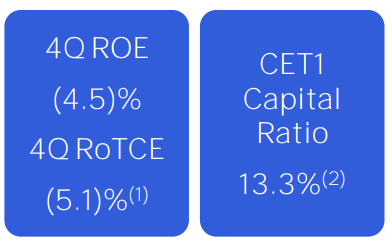
To those of you interested in earnings as an event, Citigroup is due to release its Q1 earnings report on April 12. It’s expected that Citigroup will reach earnings-per-share of $1.38 and revenue of $20.41 billion. However, the real reason I highlighted this matter is that Citigroup has surpassed its EPS target in nine of its last twelve quarters, suggesting a positively skewed event-driven trade may be en route.
Seeking Alpha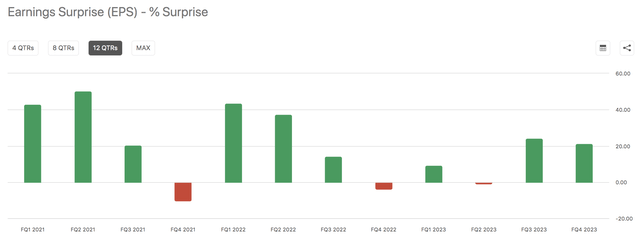
Valuation and Dividends
Residual Income Model
Output
We think a residual income valuation model is an appropriate valuation metric for Citigroup’s stock as it emphasizes a company’s book value, which is essential for a banking stock. The model’s output suggests Citigroup is undervalued (it traded at around $61 per share upon writing this article). Despite being purely theoretical, the RI model possesses validity and is used by many financial analysts.
Author’s Work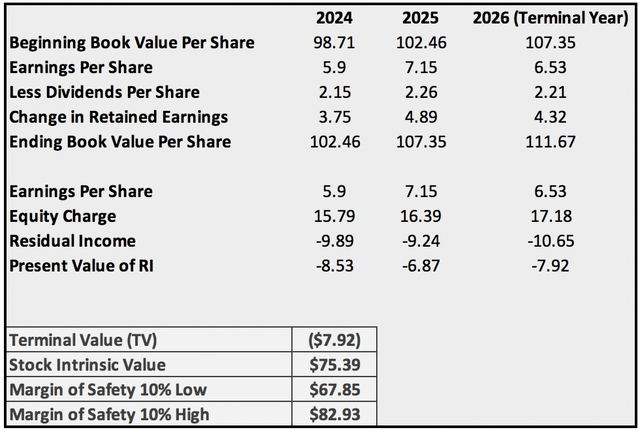
Input Variables
Herewith are the input variables used for the model.
- The book value was drawn from Citigroup’s Q4 earnings results.
- The earnings and dividend forecasts were extracted from Seeking Alpha’s database. However, note that the terminal year’s values were averaged out.
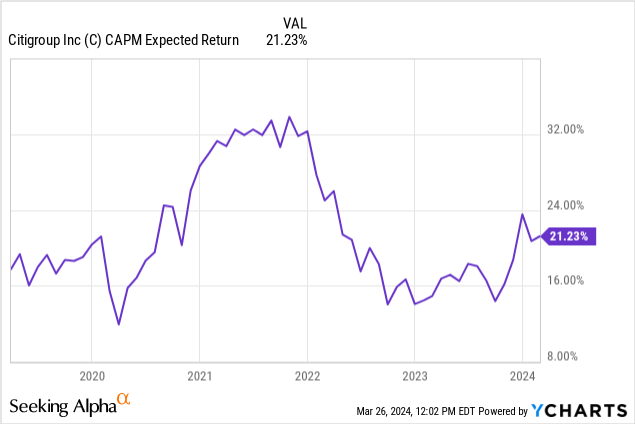
- The equity charge was assumed at 16%. The YCharts diagram below shows Citigroup’s historical cost of equity, which I compressed to phase out the latent risk of the COVID-19 pandemic and the 2023 banking crisis panic.
Dividends
If you scroll back up to the returns depiction at the top of the page, you’ll notice that most of Citigroup’s five-year returns stemmed from dividends. As such, it’s only fair to assume that its dividend will play a pivotal role in the next few years.
As illustrated below, Citigroup delivers a solid average yield. Moreover, the bank’s 11 consecutive years of dividend payments suggest it is a “through the cycle” dividend stock instead of a once-off dividend capture play. As such, we deem its income prospects robust.
Seeking Alpha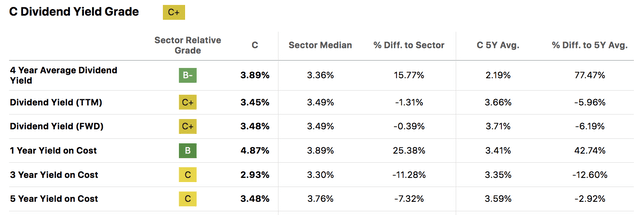
Risks
I already mentioned a few risks throughout the article. Nevertheless, I collated additional risks to balance the argument.
For those unaware, Citigroup has pivoted since Jane Fraser’s appointment. It has divested numerous retail entities and implemented geographical shifts, contemporaneously reducing its headcount. The expense reduction has seemingly started working, but it has yet to be established whether Citigroup’s restructuring costs will be worthwhile. Many investors might be playing a wait-and-see game due to the restructuring, which we consider an “overhang risk” for Citigroup’s stock.
Citigroup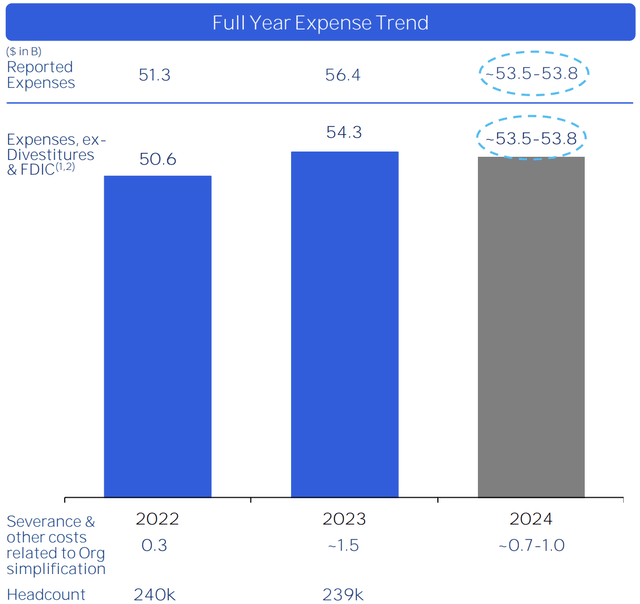
Furthermore, macroeconomic risks and their effect on Citigroup’s operations and stock price cannot be understated. The current economic outlook is highly uncertain, which isn’t ideal for financial sector stocks such as Citigroup because factors such as contagion and cyclical earnings risk could come into play. Moreover, as displayed in the diagram below, Citigroup’s monthly value at risk far exceeds the S&P 500’s, adding tail risk to investors’ portfolios in the event of a broad-based market drawdown.
Note: 15.23% Monthly VAR 5% means the stock loses at least 15.23% in 5% of its traded months.
Seeking Alpha; YCharts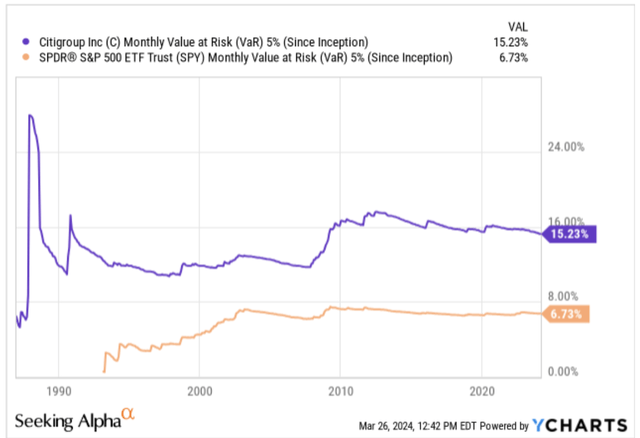
Final Word
Our analysis shows that Citigroup’s stock is aligned toward additional growth. The company’s recent change in fortunes could be sustained via systematic support attached to its loan book and held-for-trading asset base.
Furthermore, Citigroup’s services segment could rebound after a severe write-off in Q4. Although we think non-interest corporate finance activities will be stale, we expect Citigroup’s market-based activities to prosper for the rest of 2024.
Lastly, our residual income model suggests that Citigroup’s stock is undervalued, while historical data suggests its robust dividend profile.
Consensus: Buy Rating Maintained.
Credit: Source link