
• bitcoinBitcoin(BTC)$77,554.000.29%
  • ethereumEthereum(ETH)$2,257.330.42%
  • tetherTether(USDT)$1.000.03%
  • binancecoinBNB(BNB)$704.11-0.62%
  • rippleXRP(XRP)$1.25-0.45%
  • usd-coinUSDC(USDC)$1.000.01%
  • solanaSolana(SOL)$95.58-1.06%
  • tronTRON(TRX)$0.307047-5.30%
  • Figure HelocFigure Heloc(FIGR_HELOC)$1.063.50%
  • zcashZcash(ZEC)$1,254.67-2.14%
  • HyperliquidHyperliquid(HYPE)$88.12-1.87%
  • dogecoinDogecoin(DOGE)$0.075679-0.81%
  • moneroMonero(XMR)$604.591.32%
  • USDSUSDS(USDS)$1.000.01%
  • chainlinkChainlink(LINK)$11.66-0.46%
  • whitebitWhiteBIT Coin(WBT)$74.430.22%
  • leo-tokenLEO Token(LEO)$9.40-0.19%
  • cardanoCardano(ADA)$0.192872-1.80%
  • stellarStellar(XLM)$0.169384-1.05%
  • nearNEAR Protocol(NEAR)$4.432.01%
  • bitcoin-cashBitcoin Cash(BCH)$285.33-3.50%
  • daiDai(DAI)$1.000.05%
  • Ethena USDeEthena USDe(USDE)$1.000.03%
  • uniswapUniswap(UNI)$7.08-1.66%
  • RainRain(RAIN)$0.006182-1.66%
  • litecoinLitecoin(LTC)$55.74-0.13%
  • CantonCanton(CC)$0.097645-1.01%
  • USD1USD1(USD1)$1.000.01%
  • avalanche-2Avalanche(AVAX)$8.55-0.58%
  • suiSui(SUI)$0.90-1.39%
  • the-open-networkGram (prev. Toncoin)(GRAM)$1.212.51%
  • hedera-hashgraphHedera(HBAR)$0.072140-1.00%
  • tether-goldTether Gold(XAUT)$3,875.10-0.10%
  • Global DollarGlobal Dollar(USDG)$1.000.01%
  • quant-networkQuant(QNT)$200.313.86%
  • paypal-usdPayPal USD(PYUSD)$1.00-0.01%
  • shiba-inuShiba Inu(SHIB)$0.000005-2.60%
  • BittensorBittensor(TAO)$236.39-1.15%
  • crypto-com-chainCronos(CRO)$0.051482-0.92%
  • EthenaEthena(ENA)$0.188685-1.07%
  • Ripple USDRipple USD(RLUSD)$1.000.03%
  • Ondo US Dollar YieldOndo US Dollar Yield(USDY)$1.15-0.12%
  • Circle USYCCircle USYC(USYC)$1.140.00%
  • okbOKB(OKB)$110.52-1.23%
  • pepePepe(PEPE)$0.0000051.37%
  • MemeCoreMemeCore(M)$0.90-5.38%
  • aaveAave(AAVE)$133.891.99%
  • BlackRock USD Institutional Digital Liquidity FundBlackRock USD Institutional Digital Liquidity Fund(BUIDL)$1.000.00%
  • OndoOndo(ONDO)$0.410748-2.22%
  • Pump.funPump.fun(PUMP)$0.0042010.42%
TradePoint.io
  • Main
  • AI & Technology
  • Stock Charts
  • Market & News
  • Business
  • Finance Tips
  • Trade Tube
  • Blog
  • Shop
No Result
View All Result
TradePoint.io
No Result
View All Result

Do Language Models Know When They Are Hallucinating? This AI Research from Microsoft and Columbia University Explores Detecting Hallucinations with the Creation of Probes

January 1, 2024
in AI & Technology
Reading Time: 4 mins read
A A
Do Language Models Know When They Are Hallucinating? This AI Research from Microsoft and Columbia University Explores Detecting Hallucinations with the Creation of Probes
ShareShareShareShareShare

Large Language Models (LLMs), the latest innovation of Artificial Intelligence (AI), use deep learning techniques to produce human-like text and perform various Natural Language Processing (NLP) and Natural Language Generation (NLG) tasks. Trained on large amounts of textual data, these models perform various tasks, including generating meaningful responses to questions, text summarization, translations, text-to-text transformation, and code completion.

In recent research, a team of researchers has studied hallucination detection in grounded generation tasks with a special emphasis on language models, especially the decoder-only transformer models. Hallucination detection aims to ascertain whether the generated text is true to the input prompt or contains false information.

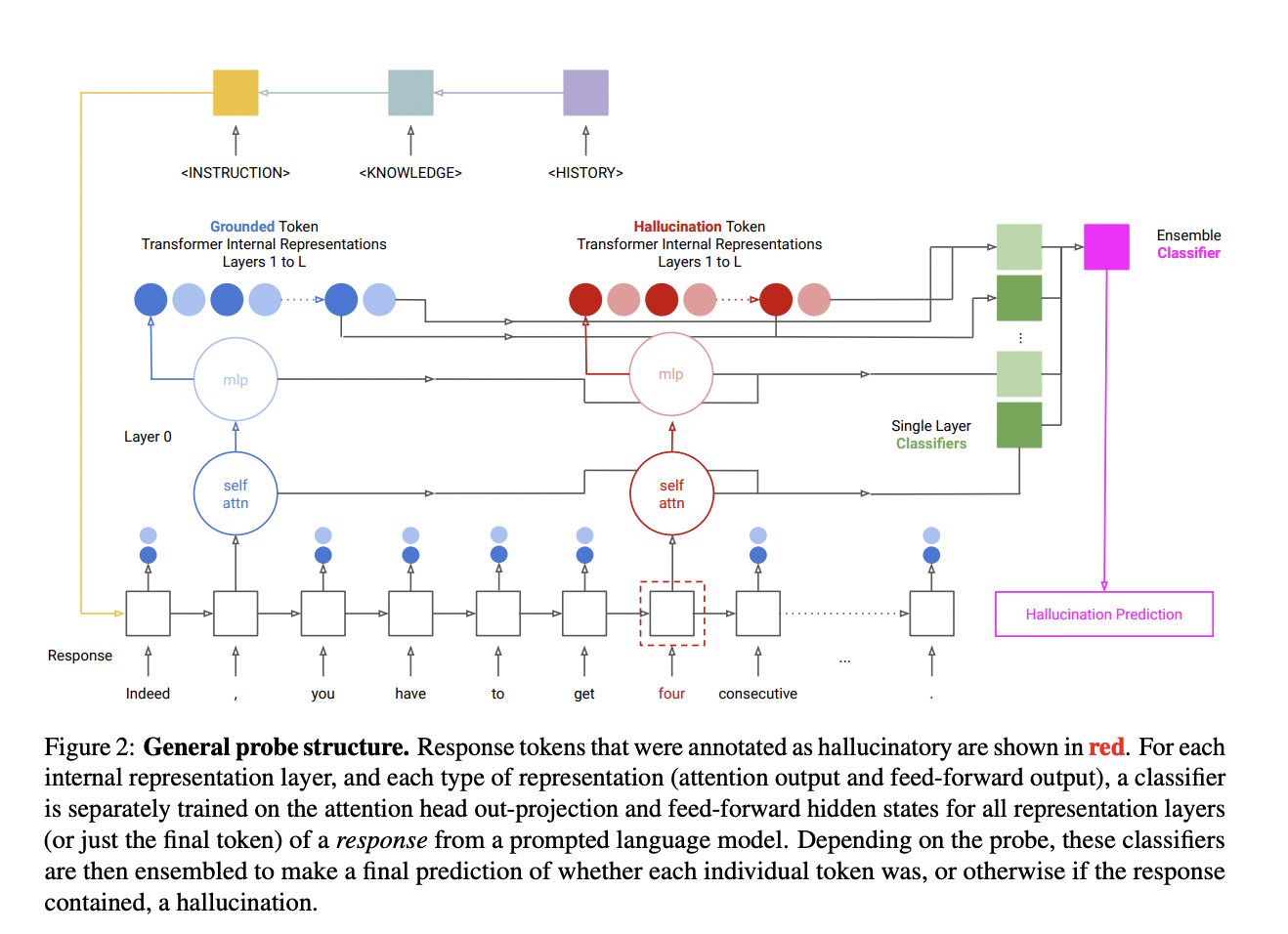
In recent research, a team of researchers from Microsoft and Columbia University has addressed the construction of probes for the model to anticipate a transformer language model’s hallucinatory behavior during in-context creation tasks. The main focus has been on using the model’s internal representations for the detection and a dataset with annotations for both synthetic and biological hallucinations.

Probes are basically the instruments or systems trained on the language model’s internal operations. Their job is to predict when the model might provide delusional material when doing tasks involving the development of contextually appropriate content. For training and assessing these probes, it is imperative to provide a span-annotated dataset containing examples of synthetic hallucinations, purposely induced disparities in reference inputs, and organic hallucinations derived from the model’s own outputs.

The research has shown that probes designed to identify force-decoded states of artificial hallucinations are not very effective at identifying biological hallucinations. This shows that when trained on modified or synthetic instances, the probes may not generalize well to real-world, naturally occurring hallucinations. The team has shared that the distribution properties and task-specific information impact the hallucination data in the model’s hidden states.

The team has analyzed the intricacy of intrinsic and extrinsic hallucination saliency across various tasks, hidden state kinds, and layers. The transformer’s internal representations emphasize extrinsic hallucinations- i.e., those connected to the outside world more. Two methods have been used to gather hallucinations which include using sampling replies produced by an LLM conditioned on inputs and introducing inconsistencies into reference inputs or outputs by editing. 

The outputs of the second technique have been reported to elicit a higher rate of hallucination annotations by human annotators; however, synthetic examples are considered less valuable because they do not match the test distribution.

The team has summarized their primary contributions as follows.

  1. A dataset with more than 15,000 utterances has been produced that have been tagged for hallucinations in both natural and artificial output texts. The dataset covers three grounded generation tasks.
  1. Three probe architectures have been presented for the efficient detection of hallucinations, which demonstrate improvements in efficiency and accuracy for detecting hallucinations over several current baselines.
  1. The study has explored the elements that affect the accuracy of the probe, such as the nature of the hallucinations, i.e., intrinsic vs. extrinsic, the size of the model, and the particular encoding components that are being probed. 

Check out the Paper. All credit for this research goes to the researchers of this project. Also, don’t forget to join our 35k+ ML SubReddit, 41k+ Facebook Community, Discord Channel, LinkedIn Group, and Email Newsletter, where we share the latest AI research news, cool AI projects, and more.

If you like our work, you will love our newsletter..


YOU MAY ALSO LIKE

4 Important Features You Should Know If You Use Microsoft Teams

Xbox Manager Says AI Is Already Being Used In Game Development

Tanya Malhotra is a final year undergrad from the University of Petroleum & Energy Studies, Dehradun, pursuing BTech in Computer Science Engineering with a specialization in Artificial Intelligence and Machine Learning.
She is a Data Science enthusiast with good analytical and critical thinking, along with an ardent interest in acquiring new skills, leading groups, and managing work in an organized manner.


🎯 Meet AImReply: Your New AI Email Writing Extension…. Try it free now!.

Credit: Source link

ShareTweetSendSharePin

Related Posts

4 Important Features You Should Know If You Use Microsoft Teams
AI & Technology

4 Important Features You Should Know If You Use Microsoft Teams

October 31, 2026
Xbox Manager Says AI Is Already Being Used In Game Development
AI & Technology

Xbox Manager Says AI Is Already Being Used In Game Development

October 31, 2026
4 Drawbacks You Should Know Before Buying A PlayStation 5
AI & Technology

4 Drawbacks You Should Know Before Buying A PlayStation 5

October 31, 2026
Cisco Talos Details VOLTA Infostealer’s LLM Victim-Ranking Stage – Unite.AI
AI & Technology

Cisco Talos Details VOLTA Infostealer’s LLM Victim-Ranking Stage – Unite.AI

October 31, 2026
Next Post
This Paper Explores AI-Driven Hedging Strategies in Finance: A Deep Dive into the Use of Recurrent Neural Networks and k-Armed Bandit Models for Efficient Market Simulation and Risk Management

This Paper Explores AI-Driven Hedging Strategies in Finance: A Deep Dive into the Use of Recurrent Neural Networks and k-Armed Bandit Models for Efficient Market Simulation and Risk Management

Leave a Reply Cancel reply

Your email address will not be published. Required fields are marked *

Search

No Result
View All Result
Pope Leo diagnosed with lung cancer

Pope Leo diagnosed with lung cancer

October 26, 2026
DOJ charges ex-FBI Director James Comey in new case – CNBC

DOJ charges ex-FBI Director James Comey in new case – CNBC

October 26, 2026
Their House Smells Like Sewage and They Can’t Afford To Fix It

Their House Smells Like Sewage and They Can’t Afford To Fix It

October 30, 2026

About

Learn more

Our Services

Legal

Privacy Policy

Terms of Use

Bloggers

Learn more

Article Links

Contact

Advertise

Ask us anything

©2020- TradePoint.io - All rights reserved!

Tradepoint.io, being just a publishing and technology platform, is not a registered broker-dealer or investment adviser. So we do not provide investment advice. Rather, brokerage services are provided to clients of Tradepoint.io by independent SEC-registered broker-dealers and members of FINRA/SIPC. Every form of investing carries some risk and past performance is not a guarantee of future results. “Tradepoint.io“, “Instant Investing” and “My Trading Tools” are registered trademarks of Apperbuild, LLC.

This website is operated by Apperbuild, LLC. We have no link to any brokerage firm and we do not provide investment advice. Every information and resource we provide is solely for the education of our readers. © 2020 Apperbuild, LLC. All rights reserved.

No Result
View All Result
  • Main
  • AI & Technology
  • Stock Charts
  • Market & News
  • Business
  • Finance Tips
  • Trade Tube
  • Blog
  • Shop

© 2023 - TradePoint.io - All Rights Reserved!