


















Uwe Krejci/DigitalVision via Getty Images
During the last few months, we’ve written articles on three of Rithm Capital’s (RITM) preferred shares on Seeking Alpha. We discussed:
-
RITM-D (RITM.PR.D) as one of our favorite fixed-to-reset preferred shares.
-
RITM-B (RITM.PR.B) when it dipped into our buy range with an attractive stripped yield.
-
RITM-A (RITM.PR.A) because of its high floating spread and stripped yield.
That Raises a Question
Why aren’t we talking about RITM-C (RITM.PR.C)?
The answer isn’t that RITM-C is a terrible preferred share. It simply has the habit of competing against three other preferred shares that usually offer investors a better deal. Those other three preferred shares all come from the same company.
Today, RITM-C is a good example of why relative valuation plays a major role in the preferred share space.
Current Valuation

The REIT Forum
Our current rating on RITM-C is a hold.
We don’t have any major concerns when it comes to Rithm Capital’s preferred shares. I think they’re a reasonable investment for many investors, if the price is right. If you’re not looking for securities that offer a big dividend yield, they’re probably not a great fit for you. If you’re looking for that kind of income, then I think any of these shares could work if the valuation is right. Consequently, we’re going to focus more on relative values than on evaluating the share by itself. If you’re looking for analysis of the underlying company, Seeking Alpha has many articles on RITM. Scott Kennedy also provides his research on RITM on The REIT Forum. The question is which Rithm preferred share has the best value. That’s an important distinction.
Too many investors become attached to a specific ticker or a specific yield threshold. We are attached to which preferred share offers the best relative value. The ticker doesn’t care if you like it. In the interest of transparency, I recently posted my latest 100 trades in preferred shares and baby bonds. I have placed a few more trades since then, but it gives you a clean look at our record with the securities.
As of writing this article, RITM-C trades at roughly 101.3% of our buy target, making it the most expensive preferred share from RITM in our view. That isn’t enough by itself to make RITM-C a poor choice. However, once you consider the other three preferred shares, RITM-C is a tiny bit behind.
Same Company, Different Yields
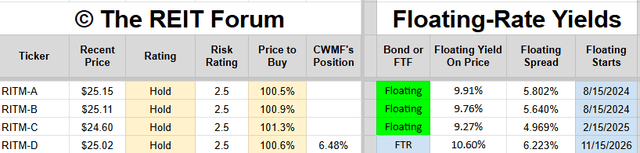
The REIT Forum
One of the nice things about covering preferred shares from the same company is that you don’t need to compare the issuers to each other. Credit quality is the same. Capital structure is the same. The management team is the same. With all those being the same, investors can focus more on pricing and the structure of the preferred share.
As of writing this article, RITM-C has:
Are those good yields? Yes.
However, there starts to be a valuation problem when RITM-B currently offers a stripped yield around 9.65% and RITM-A has a stripped yield around 9.8%. For RITM-A, the negative yield to call becomes a problem, but it’s still close to our buy range.
That’s roughly 50 basis points of additional income for the same underlying credit risk. RITM-A has a higher stripped yield at around 9.8%, but the negative yield to call is a problem. However, it’s still close to our buy range (closer than RITM-C).
Income investors frequently focus too much on whether or not the yield is “high.” We think it’s more useful to ask what risks come with the yield and what other preferred shares offer with a similar risk level. That’s where RITM-C has generally come up short.
Why Relative Valuation Matters
One of the biggest advantages individual investors have is the ability to look at valuation. Institutional investors often have certain rules they follow based on their index and liquidity requirements. We don’t. If two preferred shares are issued by the same company and one offers materially more yield while trading at a more attractive valuation, then we can jump on the opportunity.
We’ve spent a lot of time discussing relative value over the years. Sometimes the best investment decision isn’t finding a great company. Sometimes it’s simply buying the best preferred share issued by the same company.
Those little differences compound over time.
How We View The Other Preferred Shares
Readers who want to read about the other Rithm’s preferred shares can look at our previous articles.
We recently covered RITM-B, which remains one of the more attractive floating-rate preferred shares in the mortgage REIT sector despite being in our hold range.
For investors interested in the fixed-to-reset feature, RITM-D remains a decent choice because of its upcoming reset and high yield if shares remain outstanding after call protection ends.
Several months ago we discussed RITM-A, which has one of the stronger floating spreads among the mortgage REIT preferred shares we cover.
In those three articles, we discussed why the three preferred shares stood out. Today’s article is different.
RITM-C doesn’t stand out. That’s precisely why we’re discussing it.
Sometimes investors learn just as much from understanding why we don’t particularly like a preferred share as from reading about one of our favorites. We believe the additional yield on RITM-A and RITM-B is significant enough to offset the moderate call risk for those shares. However, if prices were to swing a little bit, the relative valuation proposition would change.
Is RITM-C Doomed?
Absolutely. Not. We don’t dislike RITM-C because it’s a bad preferred share. If the share price declined enough, our opinion would change. And that’s the great thing about investing in preferred shares. Unlike looking at the common stocks, we usually aren’t debating which preferred share has the best management team (though we do evaluate the risk of each individual company). Instead, we’re comparing very similar investments.
The market will give investors opportunities. Sometimes that happens because one preferred share is materially more attractive than another. If that happens with RITM-C, we would happily swap into RITM-C. Currently, we have an allocation to RITM-D.
Final Thoughts
RITM-C is a good preferred share. It just isn’t at a price we’d buy today. At current prices:
-
RITM-A: Closest to our buy range. While the annualized yield to call is negative, the actual dollar impact (based on prices recorded in our screenshot) would only be a few pennies.
-
RITM-B: Also close to our buy range while offering a materially higher stripped yield and floating yield than RITM-C.
-
RITM-C: A good preferred share, but currently the furthest above our buy target and therefore our least attractive choice today.
-
RITM-D: Also closer to our buy range than RITM-C and remains attractive because of its upcoming reset.
That leaves RITM-C in an awkward situation. There’s nothing fundamentally wrong with the preferred share. It’s simply too expensive relative to the other preferreds issued by RITM.
In my experience, that’s more likely to happen when a few criteria are met:
-
Many preferred shares are trading relatively close to call value.
-
The share being evaluated has a lower coupon rate than other shares from the same company.
-
The shares are all floating. This last one is less precise, but lately it’s been included each time.
So in this case, we see RITM-C has the thinner spread over short-term rates. The price is modestly lower than RITM-A and RITM-B, but the difference in the share price was too small to accept the smaller yield. In the event the market were to become more concerned about credit quality (such as a recession), we would expect that many preferred shares would trade moderately lower. In that scenario, the shares with thinner spreads typically decline further. Consequently, we would expect RITM-A and RITM-B to be slightly less exposed to a decline in valuations than RITM-C if recessionary concerns came up.
Credit: Source link