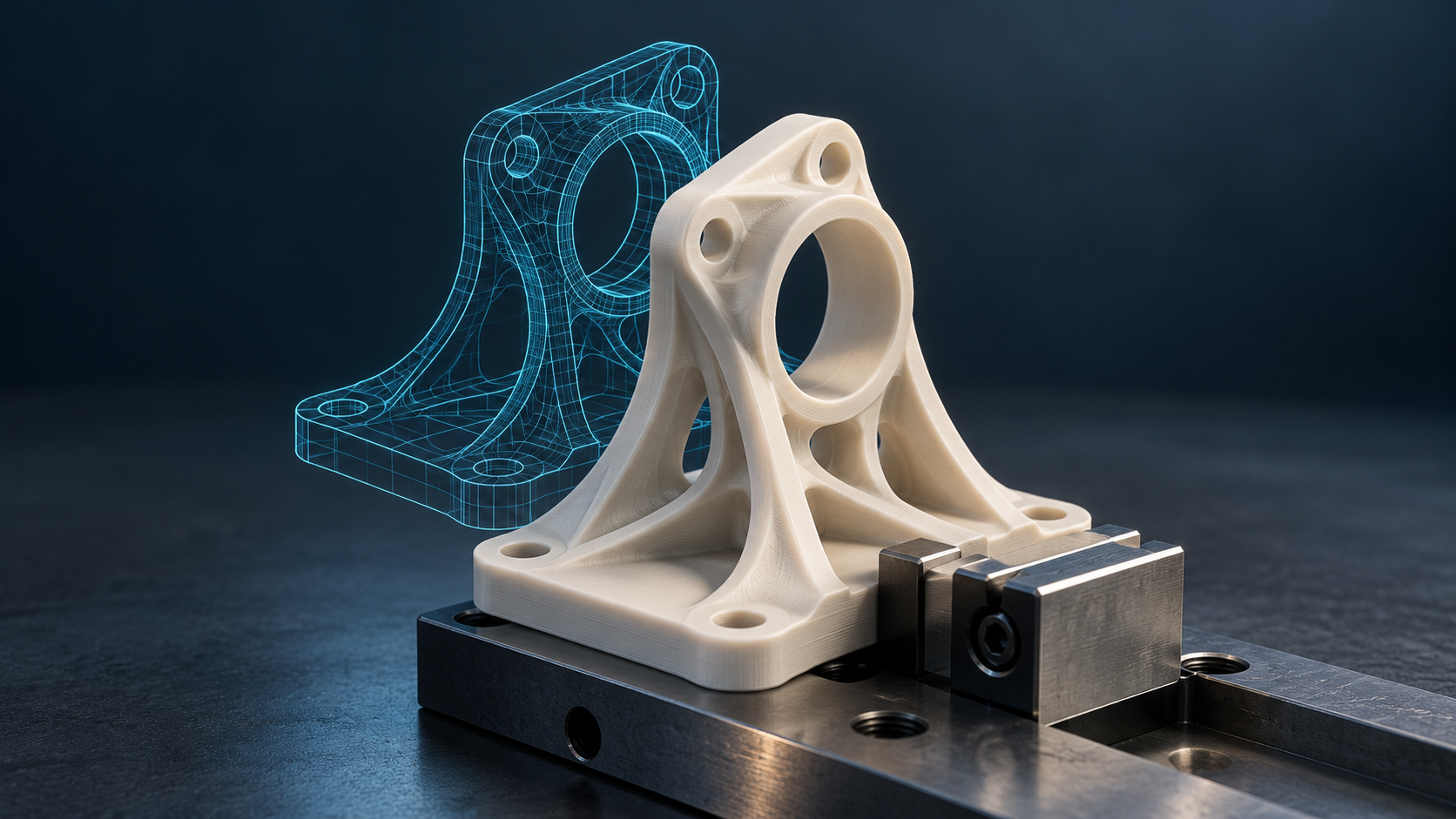

Between an idea and a physical test, hardware teams repeat the same chain. Someone sketches a change, someone turns it into CAD, the team checks the geometry, picks a material, reviews manufacturability, sends it to production, waits, gets a part, tests it, and starts again. The product may be new, but the cycle is familiar, and AI is starting to speed up parts of it.
AI use across business is now routine. The 2026 Stanford AI Index found that 88% of surveyed organizations used AI in at least one business function in 2025, and 70% used generative AI somewhere in the organization.
For hardware teams, the question is narrower. It comes down to how much time AI can cut between deciding to change a part and testing the new one. Working with robotics and hardware customers, I see why that matters. Across 30,000 3D-printed parts, more than 30% moved through a rush production schedule. At that pace, saving hours before production matters as much as saving time on the print itself.
Here are six places where AI can already help.
1. Turn a Rough Idea Into Something You Can Edit
For customers without CAD experience, the first barrier is often not manufacturing itself. It is creating a model that can be reviewed, changed, and eventually made. Not every hardware change ends in 3D printing, but for many early prototypes, enclosures, brackets, fixtures, covers, and replacement parts, 3D printing is often the fastest way to get a physical test part.
A founder with a good idea and no CAD training had to hire somebody before knowing whether the idea was worth pursuing. That is changing. We now receive AI-assisted models from people with no formal CAD background. The successful ones rarely start from a single prompt. People supply dimensions, photos, measurements, reference objects, a hand sketch, and the AI helps turn that input into a first model they can revise.
Research is heading the same way. At ICML 2025, CADFusion combined large language models with visual feedback to generate parametric CAD sequences from text. It is research, not a replacement for professional CAD, but it shows how fast tools that turn natural language into CAD are improving.
For a startup, the practical value is getting to a first editable draft 3D model sooner. A founder can write a prompt, “I need a cover for this enclosure. Here are the measurements, these four screws must stay accessible, and this surface cannot exceed this height.” The result may not be the final part, but it is far more useful than a blank CAD screen.
2. Explore More Versions Before Making One Prototype
Every physical version costs money in material, machine time and shipping. After production, a team may discover that a bracket does not fit the surrounding assembly, or that a mounting point needs to move. The earlier those questions are explored digitally, the fewer avoidable physical iterations the team may need.
AI can move more of that experimentation into the digital stage. A team can request alternative geometries, adjust dimensions, and compare candidates before deciding which versions are worth prototyping. That does not mean the goal is always to make only one physical version. Teams may still order several physical versions in different designs or materials. We already see customers submit multiple numbered versions of the same part, usually not because something went wrong, but because they are exploring more options before spending on production.
McKinsey estimates generative design tools could improve parts of automotive R&D by 10% to 20%, and one supplier reported productivity gains of up to 30% when engineers used generative AI in requirements development.
Those figures are not a universal promise for hardware development. The useful point is simpler. Digital experimentation is getting cheaper, and the cheaper it gets, the more selective teams can be about what they send to production.
3. Ask Manufacturing Questions Earlier
A 3D model is only half the job. The more practical questions follow. Can this geometry actually be manufactured? Which process fits? Which material? Is a wall too thin? Does a feature cause printing problems?
Give an AI tool the part’s intended function plus a render or basic 3D model, and it can often suggest technologies, materials and potential geometry issues before the file reaches production. It can also help engineers think through material tradeoffs earlier, for example whether a standard material, a carbon-fiber-filled option or a glass-fiber-filled option makes more sense for a specific model and use case.
This can help move some preventable questions earlier in the design process, before the team spends time and money on a physical iteration. It is a first pass, a screening tool, not an engineering sign-off. That distinction matters more as parts move from prototypes into functional assemblies.
4. Give AI the Context That the CAD File Does Not Contain
Geometry alone tells only part of the story. Ask AI to add four holes to your part and it will do exactly that. But the AI doesn’t know what those holes are for, so it can only guess their size, type and position. If you leave those details out of the prompt, they become assumptions.
We recently saw a design with multiple parts where components could be assembled, but holes that were supposed to line up across parts did not align as cleanly as an experienced engineer would have placed them. While the geometric features were present, the assembly logic wasn’t communicated effectively.
The rule for hardware teams is simple. Describe what the part has to do, not only what it has to look like. Explain how the part works in the real product: what it connects to, where the force goes, and which dimensions can’t change. Better context produces better geometry.
5. Automate Routine Steps Before Production
Once a team sends a CAD file for 3D printing or outside production, another workflow begins. Depending on the job, that can include a series of routine checks and coordination steps before production can begin. Small steps, but together they add hours or days before anything moves.
Basic tasks like pricing, intake and initial manufacturability screening can already be automated fairly reliably, and straightforward parts on standard materials can move further through the process without routine human intervention. Deloitte’s 2025 Smart Manufacturing Survey, covering 600 executives at large manufacturers with U.S. operations, found 24% had already deployed generative AI at facility or network level and another 38% were piloting it.
At Upside Parts, we are working on an internal system that uses multiple AI agents to review incoming orders against factors such as geometry, material, production profile and machine readiness. For eligible jobs, the goal is to move an approved order toward production within minutes instead of waiting for routine coordination, while still escalating unusual geometry, specialized materials, unclear requirements or higher-risk orders for human review. . The printer itself does not become instantaneous. A part may still take hours to print, but reducing the waiting time before production starts makes the full cycle faster.
6. Know When Human Review Still Matters
AI works best on simple parts with clear requirements and standard materials, where issues are easier to catch and correct. Complex parts are the opposite, and there, an error costs much more than a few minutes of review.
That is where human judgment is worth more. NIST’s 2026 roadmap for AI and machine learning in smart manufacturing points to the same boundary, identifying additive manufacturing, autonomous systems, robotics and digital twins as areas where AI is advancing, while calling for reliable, explainable, trustworthy operation in industrial environments.
We see it daily. An AI system can evaluate a routine part and solve the problem it was given. An experienced manufacturing engineer might look at a difficult one and decide it is the wrong problem.
A Shorter Path to the Next Test
Hardware will always have to deal with physics, so the physical test still matters. AI does not remove that step. It helps with the digital work that happens before it. Design revisions and manufacturability checks happen before any material becomes a part, and each of those steps is getting faster.
For a startup or small engineering team, that means more useful test cycles with the same headcount. The full path from prompt to finished part is not reliable for every production scenario yet. Too many materials and edge cases get in the way. But pieces of it already work, and once the waiting between them shrinks, hardware teams get to their next iteration sooner.
Credit: Source link