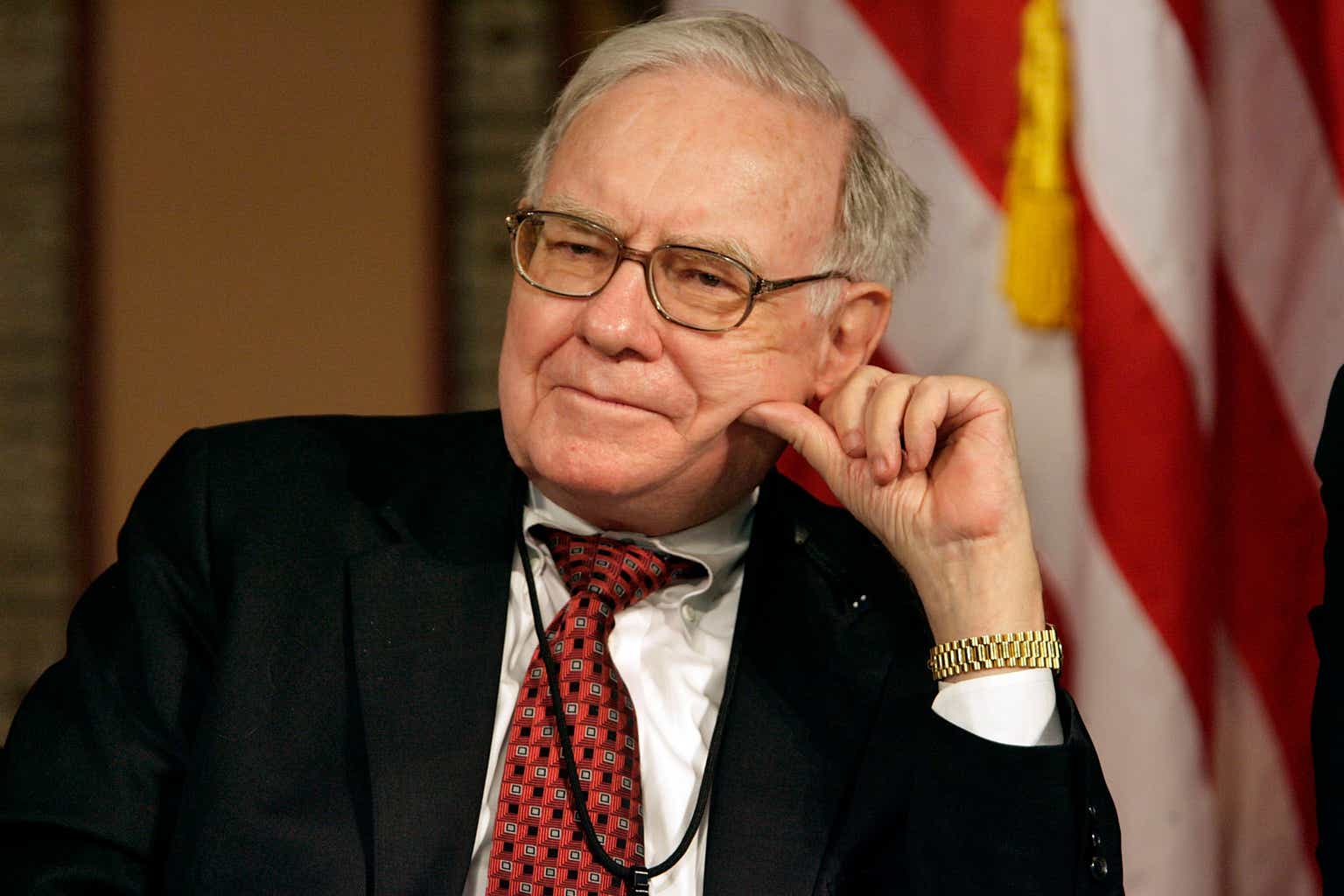

Chip Somodevilla
Coming into today, my expectation for the Berkshire Hathaway Inc. (NYSE:BRK.A) Letter to Shareholders has been to get a deep-dive lesson on the impact Charlie Munger has had on the company over so many years. Warren Buffett tends to use his letter to educate, and with the passing of his long-time business partner, I have been looking forward to hearing these personal sentiments.
In keeping with tradition, I will cover the three key takeaways from the Letter.
For reference, you can review my coverage of prior years here: 2014, 2015, 2017, 2018, 2019, 2020, 2021, and 2022.
Key Takeaway No. 1: Charlie Munger, the Architect
In last year’s letter, Buffett went to great lengths to highlight Munger’s wit and expansive knowledge, quoting him directly fifteen times. This year, in opening the Letter, readers are greeted with a full-page, bulletin-style tribute to Munger.
In it, Buffett credited Munger as the one who most indelibly shaped the vision and path that Berkshire would take.
In reality, Charlie was the “architect” of the present Berkshire, and I acted as the “general contractor” to carry out the day-by-day construction of his vision.
– Page 2
All-in-all, many readers will find some catharsis in Buffett’s approach to the letter this year, giving proper credit where it is due. Opening the Letter in such a way to pay homage was the proper approach.
What is Next for Berkshire?
Having noted the above, the Letter is, of course, designed to keep shareholders informed. So, while there is certainly room for the personal touches, many readers will also be looking for signs that the company remains on the proper track.
While it has been known that Greg Abel would be the CEO-successor of Berkshire, this was further confirmed:
Greg Abel, who runs all non-insurance operations for Berkshire – and in all respects is ready to be CEO of Berkshire tomorrow…
– Page 15
This was a step further than Buffett has taken in prior Letters, and I believe he felt it important to plainly reaffirm this given Munger’s passing.
Key Takeaway No. 2: Regulatory and political challenges are significant
While Buffett is known for being an eternal optimist, he did spend considerable time articulating the threats facing two key operating units:
- Railroad.
- Utilities and Energy.
While these are both foundational elements of a healthy economy, they are highly capital-intensive businesses by their very nature. They also attract the attention and sometimes direct involvement of the government.
Let’s briefly cover each.
Railroad
The operating earnings in the Railroad unit fell by $859M YOY:
| Year | Operating Earnings ($, millions) |
| 2022 | 5,946 |
| 2023 | 5,087 |
In terms of Berkshire’s poor performance with BNSF this year, Buffett stated:
Wage negotiations in the rail industry can end up in the hands of the President and Congress.
…
Last year BNSF’s earnings declined more than I expected, as revenues fell. Though fuel costs also fell, wage increases, promulgated in Washington, were far beyond the country’s inflation goals. This differential may recur in future negotiations.
– Page 13
While BNSF is a staple of the US economy, its operating earnings may prove difficult to reasonably predict in years to come. There are considerable pressures on wages – and even staffing – as the company operates in a difficult, high-risk environment, which can be influenced by many external forces.
Utilities and Energy
The Utilities and Energy operating earnings fell off the proverbial cliff this year, declining by $1,573M:
| Year | Operating Earnings ($, millions) |
| 2022 | 3,904 |
| 2023 | 2,331 |
Buffett was direct in calling out the challenging environment in which Berkshire Hathaway Energy does business:
Our second and even more severe earnings disappointment last year occurred at BHE. Most of its large electric-utility businesses, as well as its extensive gas pipelines, performed about as expected. But the regulatory climate in a few states has raised the specter of zero profitability or even bankruptcy… in such jurisdictions, it is difficult to project both earnings and asset values in what was once regarded as among the most stable industries in America.
– Page 13
He also went on to state:
It will be many years until we know the final tally from BHE’s forest fire losses and can intelligently make decisions about the desirability of future investments in vulnerable western states. It remains to be seen whether the regulatory environment will change elsewhere.
…
Berkshire can sustain financial surprises but we will not knowingly throw good money after bad.
– Page 14
While Buffett always emphasizes that the Letter is for shareholders, I believe it is exceptionally clear that he is here speaking to regulators. In my view, he is raising the smoke signal to let them know that while Berkshire is committed to doing its part to further advance the US economy and overall infrastructure, it will not invest blindly.
While it remains to be seen where this heads, it is evident that the utility and energy business will present no free lunch going forward.
Key Takeaway No. 3: Financial performance will be unremarkable
Using his sister Bertie as the proxy for the readership Buffett most wanted to address, he struck a colloquial tone in outlining the upsides and potential downsides to owning Berkshire.
All in all, we have no possibility of eye-popping performance.
…
[W]ith our present mix of businesses, Berkshire should do a bit better than the average American corporation and, more importantly, should also operate with materially less risk of permanent loss of capital. Anything beyond “slightly better,” though, is wishful thinking.
– Pages 6-7
Buffett indicated that Berkshire’s opportunities for investment would remain primarily in the U.S., with no viable opportunities for huge capital deployment externally – although he did seem amenable to joint ventures with the five Japanese companies of Itochu, Marubeni, Mitsubishi, Mitsui, and Sumitomo.
So Why Own Berkshire Hathaway?
It is always interesting when Buffett goes to great lengths to indicate Berkshire has limited opportunity to outperform given its considerable size. While on the one hand, he welcomes investors to join for the long-term, on the other he warns against any exuberance.
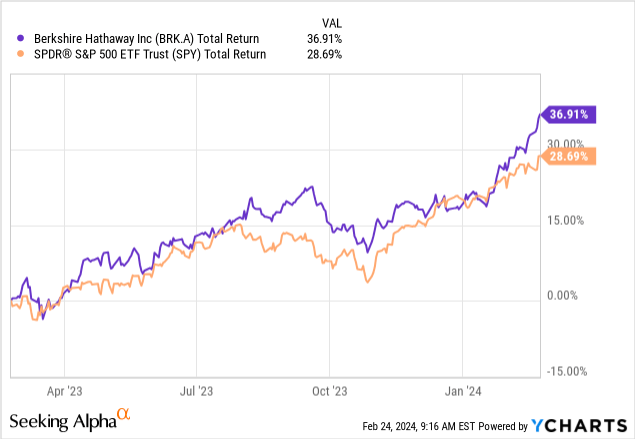
Despite his cautioning, it is worth noting the 1-year and 5-year performance of Berkshire, both of which demonstrate the company has not been slacking.
Here’s the 1-year:
And here’s the 5-year:
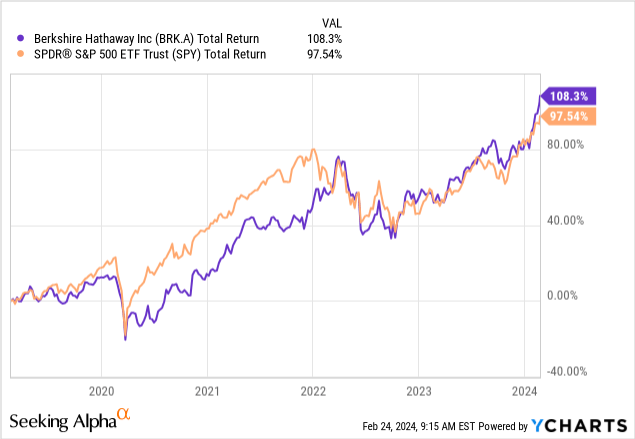
In other words, even if Buffett is warning of softer performance than has been experienced historically, there’s still something to be said for outpacing the market.
The bottom line is that Berkshire remains a solid investment opportunity for investors going in with their eyes wide open, and who believe America still has plenty of growth runway ahead of it.
My favorite reasons for owning the company are simple:
- A proven management team focused on reliable, core values.
- No fees.
You get a top-notch leadership group in a rock-solid company, all with no management expense fee eating at your capital. That’s a tough combination to beat.
Final Thoughts
Buffett struck a great balance between a look back to Munger’s contributions to Berkshire, along with outlining the current strengths and challenges faced by the company. As always plenty of focus was firmly fixed on affirming the company’s bedrock of financial strength, underpinning its value as a long-term investment vehicle for investors both large and small.
While some operating units struggled in 2023, the insurance operation was a great shining star, again underlining the importance of Berkshire having such a diversified business line.
Perhaps the biggest takeaway from this year’s letter ought to be that there will only ever be one Charlie Munger. He was truly one of a kind, and Berkshire investors owe him thanks.
In closing, I would like to share one of my favorite Munger quotes, as this simple concept is what drives me to continue investing for the future:
A great company keeps working after you are not; a mediocre company won’t do that.
Berkshire has proven to be just such a company.
Thank you for reading.
Credit: Source link