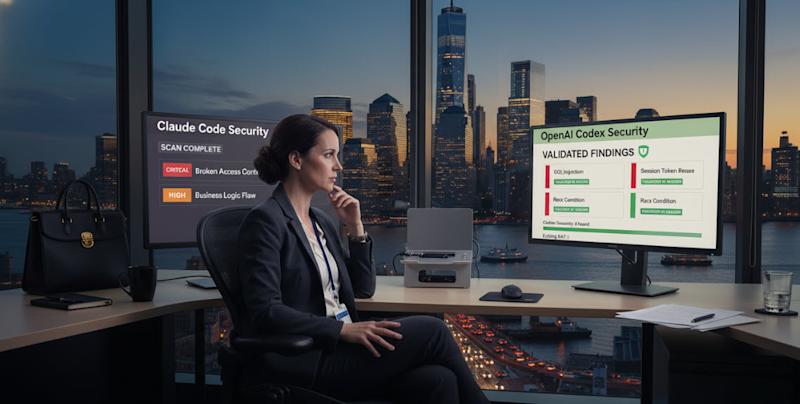

Anthropic on Monday released Code Review, a multi-agent code review system built into Claude Code that dispatches teams of AI agents to scrutinize every pull request for bugs that human reviewers routinely miss. The feature, now available in research preview for Team and Enterprise customers, arrives on what may be the most consequential day in the company’s history: Anthropic simultaneously filed lawsuits against the Trump administration over a Pentagon blacklisting, while Microsoft announced a new partnership embedding Claude into its Microsoft 365 Copilot platform.
The convergence of a major product launch, a federal legal battle, and a landmark distribution deal with the world’s largest software company captures the extraordinary tension defining Anthropic’s current moment. The San Francisco-based AI lab is simultaneously trying to grow a developer tools business approaching $2.5 billion in annualized revenue, defend itself against an unprecedented government designation as a national security threat, and expand its commercial footprint through the very cloud platforms now navigating the fallout.
Code Review is Anthropic’s most aggressive bet yet that engineering organizations will pay significantly more — $15 to $25 per review — for AI-assisted code quality assurance that prioritizes thoroughness over speed. It also signals a broader strategic pivot: the company isn’t just building models, it’s building opinionated developer workflows around them.
How a team of AI agents reviews your pull requests
Code Review works differently from the lightweight code review tools most developers are accustomed to. When a developer opens a pull request, the system dispatches multiple AI agents that operate in parallel. These agents independently search for bugs, then cross-verify each other’s findings to filter out false positives, and finally rank the remaining issues by severity. The output appears as a single overview comment on the PR along with inline annotations for specific bugs.
Anthropic designed the system to scale dynamically with the complexity of the change. Large or intricate pull requests receive more agents and deeper analysis; trivial changes get a lighter pass. The company says the average review takes approximately 20 minutes — far slower than the near-instant feedback of tools like GitHub Copilot’s built-in review, but deliberately so.
“We built Code Review based on customer and internal feedback,” an Anthropic spokesperson told VentureBeat. “In our testing, we’ve found it provides high-value feedback and has helped catch bugs that we may have missed otherwise. Developers and engineering teams use a range of tools, and we build for that reality. The goal is to give teams a capable option at every stage of the development process.”
The system emerged from Anthropic’s own engineering practices, where the company says code output per engineer has grown 200% over the past year. That surge in AI-assisted code generation created a review bottleneck that the company says it now hears about from customers on a weekly basis. Before Code Review, only 16% of Anthropic’s internal PRs received substantive review comments. That figure has jumped to 54%.
Crucially, Code Review does not approve pull requests. That decision remains with human reviewers. Instead, the system functions as a force multiplier, surfacing issues so that human reviewers can focus on architectural decisions and higher-order concerns rather than line-by-line bug hunting.
Why Anthropic thinks $20 per review is a bargain
The pricing will draw immediate scrutiny. At $15 to $25 per review, billed on token usage and scaling with PR size, Code Review is substantially more expensive than alternatives. GitHub Copilot offers code review natively as part of its existing subscription, and startups like CodeRabbit operate at significantly lower price points. Anthropic’s more basic code review GitHub Action — which remains open source — is itself a lighter-weight and cheaper option.
Anthropic frames the cost not as a productivity expense but as an insurance product. “For teams shipping to production, the cost of a shipped bug dwarfs $20/review,” the company’s spokesperson told VentureBeat. “A single production incident — a rollback, a hotfix, an on-call page — can cost more in engineer hours than a month of Code Review. Code Review is an insurance product for code quality, not a productivity tool for churning through PRs faster.”
That framing is deliberate and revealing. Rather than competing on speed or price — the dimensions where lightweight tools have an advantage — Anthropic is positioning Code Review as a depth-first tool aimed at engineering leaders who manage production risk. The implicit argument is that the real cost comparison isn’t Code Review versus CodeRabbit, but Code Review versus the fully loaded cost of a production outage, including engineer time, customer impact, and reputational damage.
Whether that argument holds up will depend on the data. Anthropic has not yet published external benchmarks comparing Code Review’s bug-detection rates against competitors, and the spokesperson did not provide specific figures on bugs caught per dollar or developer hours saved when asked directly. For engineering leaders evaluating the tool, that gap in publicly available comparative data may slow adoption, even if the theoretical ROI case is compelling.
What the internal numbers reveal — and what they don’t
Anthropic’s internal usage data provides an early window into the system’s performance characteristics. On large pull requests exceeding 1,000 lines changed, 84% receive findings, averaging 7.5 issues per review. On small PRs under 50 lines, that drops to 31% with an average of 0.5 issues. The company reports that less than 1% of findings are marked incorrect by engineers.
That sub-1% figure is the kind of stat that demands careful unpacking. When asked how “marked incorrect” is defined, the Anthropic spokesperson explained that it means “an engineer actively resolving the comment without fixing it. We’ll continue to monitor feedback and engagement while Code Review is in research preview.”
The methodology matters. This is an opt-in disagreement metric — an engineer has to take the affirmative step of dismissing a finding. In practice, developers under time pressure may simply ignore irrelevant findings rather than actively marking them as wrong, which would cause false positives to go uncounted. Anthropic acknowledged the limitation implicitly by noting the system is in research preview and that it will continue monitoring engagement data. The company has not yet conducted or published a controlled evaluation comparing agent findings against a ground-truth baseline established by expert human reviewers.
The anecdotal evidence is nonetheless striking. Anthropic described a case where a one-line change to a production service — the kind of diff that typically receives a cursory approval — was flagged as critical by Code Review because it would have broken authentication for the service. In another example involving TrueNAS’s open-source middleware, Code Review surfaced a pre-existing bug in adjacent code during a ZFS encryption refactor: a type mismatch that was silently wiping the encryption key cache on every sync. These are precisely the categories of bugs — latent issues in touched-but-unchanged code, and subtle behavioral changes hiding in small diffs — that human reviewers are statistically most likely to miss.
A Pentagon lawsuit casts a long shadow over enterprise AI
The Code Review launch does not exist in a vacuum. On the same day, Anthropic filed two lawsuits — one in the U.S. District Court for the Northern District of California and another in the D.C. Circuit Court of Appeals — challenging the Trump administration’s decision to label the company a supply chain risk to national security, a designation historically reserved for foreign adversaries.
The legal confrontation stems from a breakdown in contract negotiations between Anthropic and the Pentagon. As CNN reported, the Defense Department wanted unrestricted access to Claude for “all lawful purposes,” while Anthropic insisted on two redlines: that its AI would not be used for fully autonomous weapons or mass domestic surveillance. When talks collapsed by a Pentagon-set deadline on February 27, President Trump directed all federal agencies to cease using Anthropic’s technology, and Defense Secretary Pete Hegseth formally designated the company a supply chain risk.
According to CNBC, the complaint alleges that these actions are “unprecedented and unlawful” and are “harming Anthropic irreparably,” with the company stating that contracts are already being cancelled and “hundreds of millions of dollars” in near-term revenue are in jeopardy.
“Seeking judicial review does not change our longstanding commitment to harnessing AI to protect our national security,” the Anthropic spokesperson told VentureBeat, “but this is a necessary step to protect our business, our customers, and our partners. We will continue to pursue every path toward resolution, including dialogue with the government.”
For enterprise buyers evaluating Code Review and other Claude-based tools, the lawsuit introduces a novel category of vendor risk. The supply chain risk designation doesn’t just affect Anthropic’s government contracts — as CNBC reported, it requires defense contractors to certify they don’t use Claude in their Pentagon-related work. That creates a chilling effect that could extend well beyond the defense sector, even as the company’s commercial momentum accelerates.
Microsoft, Google, and Amazon draw a line around Claude’s commercial availability
The market’s response to the Pentagon crisis has been notably bifurcated. While the government moved to isolate Anthropic, the company’s three largest cloud distribution partners moved in the opposite direction.
Microsoft on Monday announced it is integrating Claude into Microsoft 365 Copilot through a new product called Copilot Cowork, developed in close collaboration with Anthropic. As Yahoo Finance reported, the service enables enterprise users to perform tasks like building presentations, pulling data into Excel spreadsheets, and coordinating meetings — the kind of agentic productivity capabilities that sent shares of SaaS companies like Salesforce, ServiceNow, and Intuit tumbling when Anthropic first debuted its Cowork product on January 30.
The timing is not coincidental. As TechCrunch reported last week, Microsoft, Google, and Amazon Web Services all confirmed that Claude remains available to their customers for non-defense workloads. Microsoft’s legal team specifically concluded that “Anthropic products, including Claude, can remain available to our customers — other than the Department of War — through platforms such as M365, GitHub, and Microsoft’s AI Foundry.”
That three of the world’s most powerful technology companies publicly reaffirmed their commitment to distributing Anthropic’s models — on the same day the company sued the federal government — tells enterprise customers something important about the market’s assessment of both Claude’s technical value and the legal durability of the supply chain risk designation.
Data security and what enterprise buyers need to know next
For organizations considering Code Review, the data handling question looms especially large. The system necessarily ingests proprietary source code to perform its analysis. Anthropic’s spokesperson addressed this directly: “Anthropic does not train models on our customers’ data. This is part of why customers in highly regulated industries, from Novo Nordisk to Intuit, trust us to deploy AI safely and effectively.”
The spokesperson did not detail specific retention policies or compliance certifications when asked, though the company’s reference to pharmaceutical and financial services clients suggests it has undergone the kind of security review those industries require.
Administrators get several controls for managing costs and scope, including monthly organization-wide spending caps, repository-level enablement, and an analytics dashboard tracking PRs reviewed, acceptance rates, and total costs. Once enabled, reviews run automatically on new pull requests with no per-developer configuration required.
The revenue figure Anthropic confirmed — a $2.5 billion run rate as of February 12 for Claude Code — underscores just how quickly developer tooling has become a material revenue line for the company. The spokesperson pointed to Anthropic’s recent Series G fundraise for additional context but did not break out what share of total company revenue Claude Code now represents.
Code Review is available now in research preview for Claude Code Team and Enterprise plans. Whether it can justify its premium in a market already crowded with cheaper alternatives will depend on whether Anthropic can convert anecdotal bug catches and internal usage stats into the kind of rigorous, externally validated evidence that engineering leaders with production budgets require — all while navigating a legal and political environment unlike anything the AI industry has previously faced.
Credit: Source link