













Sakorn Sukkasemsakorn
Aemetis, Inc. (NASDAQ:AMTX) recently announced new energy efficiency projects at the Keyes ethanol plant, new agreements in India, and expectations of capacity increases. Taking into account the current period of expansion and the beneficial expectations of other market analysts, AMTX appears a stock to follow carefully. I do see risks from the total amount of debt, lower energy prices, or dependence on third parties, however I do believe that Aemetis could trade at a higher price mark.
Aemetis
Aemetis is a company in the energy sector based in Cupertino, California, founded in 2006. The company’s activities are mainly related to renewable energy for fuels and natural gas.
Aemetis focuses on the acquisition, development, and commercialization of innovative products in the reduction of the carbon footprint and the investigation of technologies that replace the traditional ways of obtaining energy, especially petroleum-based products.
The company’s operations are divided into three segments: California Ethanol, California Dairy Renewable Natural Gas, and India Biodiesel. In addition, another segment includes the rest of the minor activities carried out by the company. Aemetis works through a process of building microenvironments, using waste management technologies to reduce the level of carbon, renewable fuels that reduce greenhouse gas emissions, and the improvement of air quality.
The first of the segments, California Ethanol, deals with close to 65 million gallons per year from its ethanol production facilities in Kayes. In the same plant, different products are also produced that are used to feed the animals of more than 80 local farms and hatcheries. These products are also used in the food industry as oil or carbon dioxide distillers.
On the other hand, the California Dairy Renewable Natural segment, namely Aemetis Biogas or ABGL, is the segment dedicated to the construction and operation of biomethane anaerobic digesters in dairies close to the Kayes plant. The company transfers these gasses to the plant through its own distribution networks, where these gasses are transformed into renewable natural gas that is subsequently distributed to its customers.
Finally, the India Biodiesel segment is made up of a single production plant in Kakinada, with a capacity of 50 million gallons per year, producing high-quality distillate biodiesel and refined glycerin for customers in Asia and Europe. This plant is one of the largest in India in terms of production capacity. Recently, the company signed agreements with the government of India to be a supplier of biodiesel to public marketing companies such as Hindustan Petroleum, Bharat Petroleum, and Indian Oil Corporation. I believe that these agreements could serve as revenue catalysts in the future.
Analysts Believe That Aemetis Could Deliver Positive Net Income By 2025
I believe that it is worth having a look at the beneficial expectations noted by other analysts. Market estimates include sales growth in 2024 and 2025, operating margin growth, and net margin growth. 2025 net sales would stand at $784 million, with 2025 EBITDA of $176 million, 2025 EBIT of $157 million, and net income close to $61.3 million.
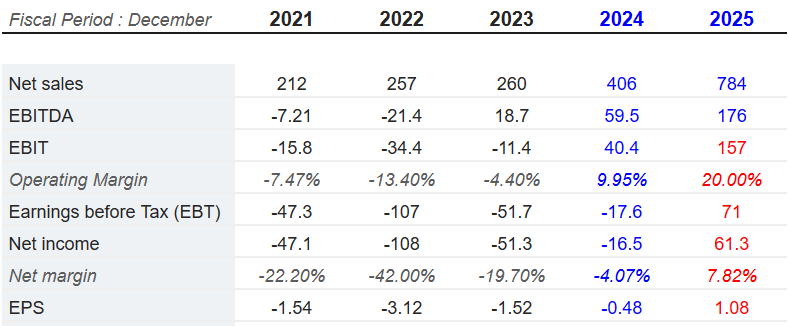
Source: Marketscreener.com
Considering the previous negative net income results, if Aemetis successfully reports positive 2025 net income, I would expect significant demand for the stock.
Aemetis Financed New Inventories With Some Debt
In the last quarterly report, the company reported more assets and more liabilities than that in 2022. The increase in assets was driven by increases in inventories, financed by increases in the total amount of debt, and some increases in accounts payable. I don’t like the fact that the total amount of debt increased, however if inventories are increasing, in my view, it is likely that management expects to sell more in the future.
As of March 31, 2023, the company reported cash and cash equivalents worth $4 million, accounts receivable of $261 million, inventories of $12 million, prepaid expenses of $1 million, other current assets of $2 million, total current assets of $21 million, property, plant, and equipment of $180 million, operating lease right-of-use assets of $2 million, other assets of $5 million, and total assets of $210 million. The asset/liability ratio is below 1x, which most investors would most likely not appreciate.
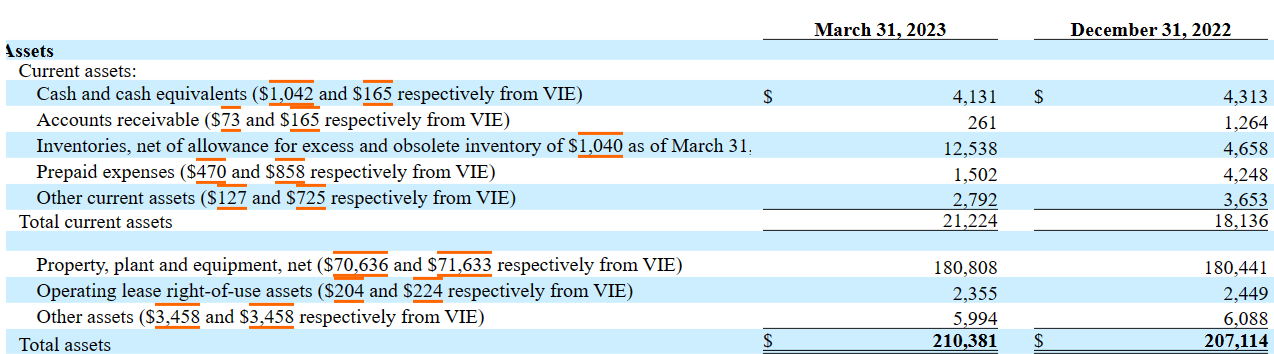
Source: 10-Q
The list of liabilities includes accounts payable worth $28 million, current portion of long term debt of about $17 million, short term borrowings close to $45 million, and total current liabilities worth $103 million. Current liabilities/current assets ratio is larger than 1x, which is not ideal.
Additionally, long term liabilities include senior secured notes and revolving notes worth $158 million, eb-5 notes of about $29 million, other long term debt close to $11 million, series A preferred units worth $122 million, and total long term liabilities worth $329 million.
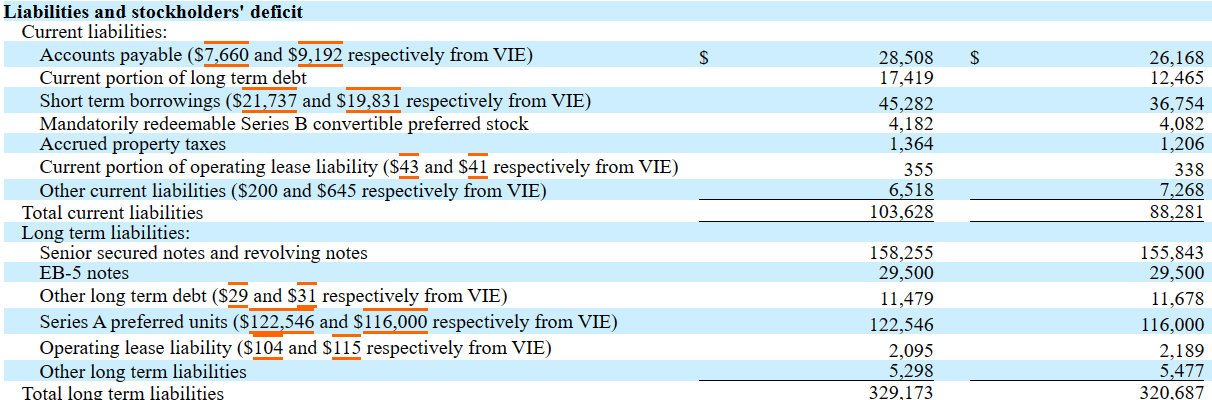
Source: 10-Q
Recent Increases In Total Capacity, Efficiency, And Initiatives In India Would Imply A Valuation Of More Than $9.255 Per Share
Considering the comments reported in the last quarterly report, I am quite optimistic about the energy efficiency projects at the Keyes ethanol plant. In my view, further maintenance and upgrades will most likely bring FCF margin growth in the coming years. The fact that other analysts are expecting positive net income in 2025 does not seem a coincidence taking into account the recent words from management.
We are pleased with the milestones accomplished during the first quarter of 2023 regarding our energy efficiency projects at the Keyes ethanol plant as well as bringing six dairy digesters, a 40 mile biogas pipeline and the Renewable Natural Gas production facility with utility interconnect into service in late January. We took the opportunity to complete significant maintenance and upgrades to the Keyes ethanol plant. Source: 10-Q
I would also expect further increases in production rates thanks to the biogas-to-RNG production facility and utility gas pipeline interconnection. I believe that the company is in a process of expansion of the product offer and a change in the construction of gas pipelines and distribution lines for its plant in California as well as recent contracts with the Indian government. I believe that we could expect further increases in capacity, which will most likely lead to net Biogas sales growth. In this regard, I believe that investors may want to read the following lines from management.
Aemetis Biogas exceeded the RNG production plan by approximately 20% during Q2 2023. Production rates at our dairy digesters are notably higher than our original projections. Our biogas pipeline, biogas-to-RNG production facility and utility gas pipeline interconnection are running smoothly, converting dairy biogas into valuable RNG delivered into the PG&E natural gas pipeline system. Source: Aemetis, Inc. | Aemetis RNG Production Exceeds Plan by 20% during Q2 2023
Aemetis, Inc. has approved the Aemetis Biogas Services subsidiary’s renewable natural gas production facility for the generation of D3 Renewable Identification Numbers under the federal Renewable Fuel Standard. Six dairy biogas digesters are fully operational and a seventh dairy digester is scheduled to be operational in early June 2023. Source: Aemetis, Inc. | Aemetis RNG Production Exceeds Plan by 20% during Q2 2023
I am quite optimistic about the incoming changes in the ABGL segment. I believe that management will successfully increase its FCF margins, further increase its own facilities for animal feeding, and expand the distribution line of the network to increase yields and returns.
Additionally, I would expect beneficial news from the recent changes in regulations determined by the local Indian government in relation to tariffs. Besides, I would expect successful attraction of new investors and acquisitions of companies in the technology field to optimize the operational performance of the facility in Kakinada.
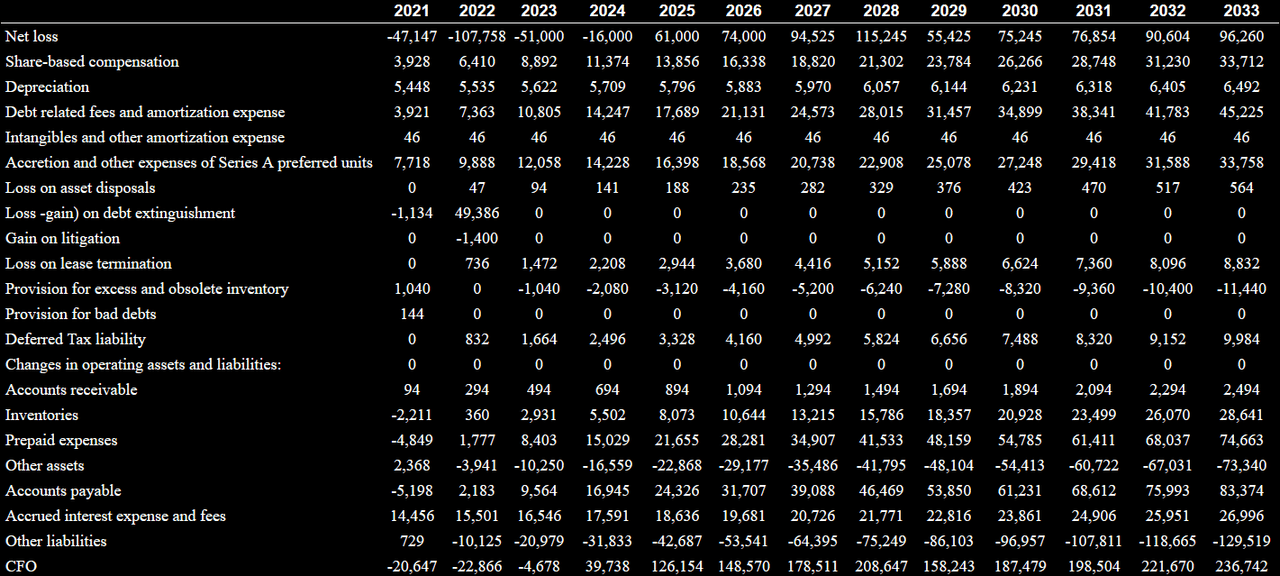
Considering the previous assumptions, my financial model includes net income growth, depreciation growth, and increases in changes in prepaid expenses. Besides, with increases in changes of inventories as well as increases in changes in accounts payable, I also obtained CFO growth.
My expectations include 2033 net income of $96 million, share-based compensation of about $33 million, depreciation close to $6 million, and accretion and other expenses of series A preferred units worth $33 million.
Also, with provision for excess and obsolete inventory worth -$12 million, changes in accounts receivable of $2 million, changes in inventories close to $28 million, and changes in prepaid expenses worth $74 million, I included changes in accounts payable worth $83 million, which implied 2033 CFO of about $236 million. Finally, if we also assume capital expenditures worth -$177 million, 2033 FCF would stand at $60 million.
Source: My DCF Model
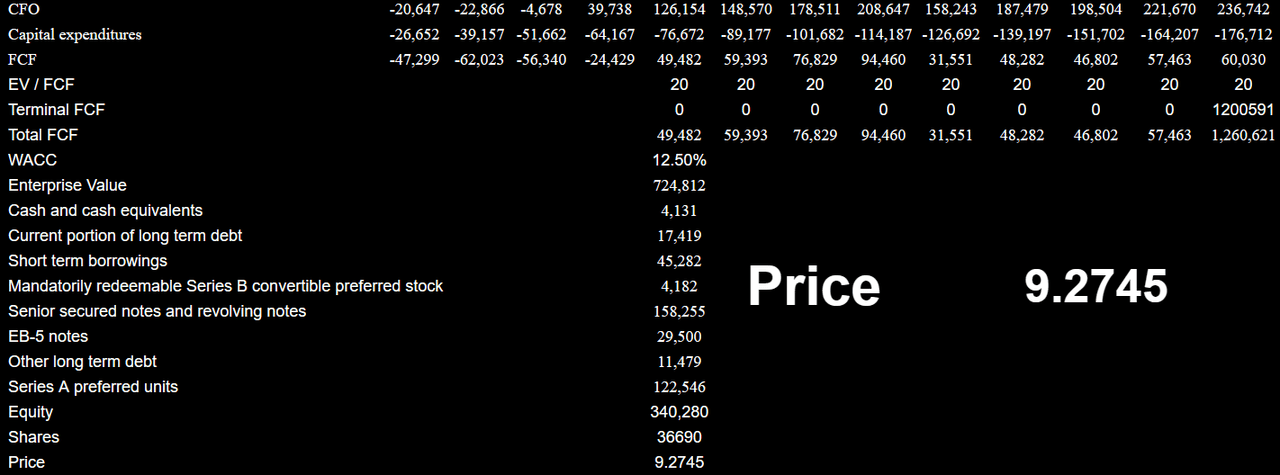
If we assume EV/FCF of about 20x, 2033 total FCF would be close to $1.26055 billion. Besides, with a discount of 12.55%, the enterprise value would be close to $724.55 million. Adding cash and cash equivalents worth $4 million, current portion of long term debt of about $17 million, short term borrowings close to $45 million, mandatorily redeemable series B convertible preferred stock of about $4 million, senior secured notes of $158 million, eb-5 notes of $29 million, and series A preferred units of $122 million, the implied equity would be $340.55 million. Finally, the implied price would be close to $9.255 per share.
Source: My DCF Model
Competitors
In the United States, there are currently around 200 ethanol production facilities that compete with the Aemetis. Competition for the company is occasional in the Northern California market. In some cases, to meet the demand in the region, the product is also imported, mainly from Brazil. In the generation of natural gas, due to the nature of the production model and the recent transformation of the infrastructure, there are no clear forecasts of competition.
When it comes to the India Biodiesel segment, the main competitors are the local government-owned production companies, Reliance Petroleum and Essar Oil, which have significantly larger market shares and fuel infrastructure as well as much larger networks and distribution than Aemetis.
Risks
Among the main risks for Aemetis, we can highlight the company’s historical incurrence in losses, the total amount of debt, and the great dependence on third-party financing, which limit and condition to a great extent the allocation and investment strategies that the company can carry out.
As of March 31, 2023, EB-5 Phase II funding in the amount of $4.0 million had been released from escrow to us. Our principal uses of cash have been to refinance indebtedness, fund operations, and for capital expenditures. We anticipate these uses will continue to be our principal uses of cash in the future. Global financial and credit markets have been volatile in recent years, and future adverse conditions of these markets could negatively affect our ability to secure funds or raise capital at a reasonable cost, or at all. Source: 10-Q
In addition, we can add the volatility of the prices of both fuel and ethanol, which prevents clear forecasts in operational and financial senses. Above all, this factor is magnified if we take into account the great dependence on a few clients that the company has, such as the case of 100% ethanol production for a single customer.
Finally, due to the nature of the industry, the company is highly conditioned and subject to changes in regulations regarding climate change and forms of production and consumption of energy, which vary from country to country, and could directly affect the operations of Aemetis both in the United States and India.
Conclusion
Aemetis delivered new energy efficiency projects at the Keyes ethanol plant. In addition, new agreements with corporations in India and further capacity increase in the ABGL segment were recently announced. I believe that the company is in a process of expansion, which may be soon reflected in the stock price. Considering the expectations of other analysts, who foresee positive net income by 2025, and the results of my DCF model, I believe that Aemetis’ stock could trade higher. There are risks from the total amount of debt, dependence on third-parties, and changes in the prices of energy, however I think the stock is undervalued.
Credit: Source link