














Justin Sullivan/Getty Images News
Blue jean retailer, Levi Strauss & Co. (NYSE:LEVI), didn’t fit properly with investors following recent results. Perhaps it will be a better fit for the bargain hunters.
Why Did LEVI Shares Drop?
Q2 results showed a 9% decrease in constant-currency net revenues and an overall net loss of +$1.6M, their first in the post-COVID era. While the net loss was a surprise, revenues at the topline were in-line with expectations. What really triggered the alarm bell was weakness in both their wholesale business and in their U.S. market. A cut to their full-year guidance added further to investor woes.
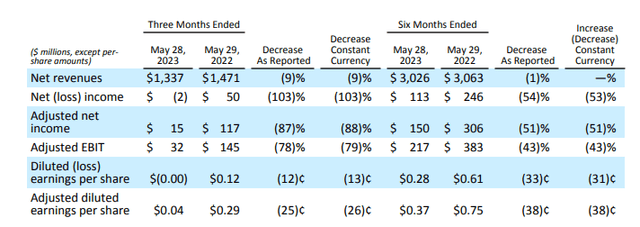
LEVI Q2 Earnings Release – Snapshot Of Results
The southbound trek in shares came swiftly. Immediately following the release, the stock dropped about 6% in extended trading. And at the close of trading on Friday, it settled nearly 8% lower. Following the losses, shares are now down about 15% YTD and 20% over the past year.

Seeking Alpha – Basic Trading Data Of LEVI
Weakness In LEVI Wholesale
Like others, such as NIKE (NKE), LEVI has strategically shifted to a more direct-to-consumer (“DTC”) mindset in recent periods. Margin preservation/expansion is one reason for the shift. Greater control over their brand is another.
And LEVI has produced accordingly in their DTC efforts. DTC now represents a record 44% of their total sales following Q2 growth in the unit of 14% on a constant-currency basis. The continuing strength, however, is not without cost. SG&A, for example, was up 6% in Q2 due primarily to an increase in their company operated store count.
But more importantly, the focus on DTC appears to be creating a distraction to their wholesale business, which still accounts for the majority share of their total revenues. YOY, wholesale was down 22%, driven by weakness in the U.S. market. The macroeconomic landscape was mostly to blame. Though, interestingly, DTC grew 6% in the region.
The disparity is a tale involving those on opposite ends of the income spectrum. On one end are higher income consumers, who remain drawn to LEVI’s premium brands, which happen to be sold more widely via the DTC channel. On the other end are the lower- and moderate-income consumers who tend to purchase LEVI products through department stores.
Here, CEO, Chip Bergh, noted that consumers are stretched and much more price sensitive. Accordingly, other priorities, such as travel and other service-oriented spending, are taking precedence with these consumers. And so much so that even their value brands were noted to be down double-digits during the period.
The pullback in a key demographic does warrant extra attention, especially as LEVI continues to move forward with their expansion in DTC. The challenge for the company will be to make the shift without continuing to alienate their core customer base. Previously, for example, LEVI raised prices on their wholesale selection. While that in it of itself is not notable, the fact that they had increased prices ahead of their competition is noteworthy, because the company now finds themselves backtracking.
Bergh said LEVI is “taking surgical price reductions,” on select wholesale offerings. The consequence of these surgical actions is their lowered profit outlook for the year. It should be mentioned, too, that their outlook assumes no further deterioration in the macroeconomic environment.
This should leave investors on guard, namely because their largest target customer base is those between 18 to 30 years old. This demographic also happens to be those right in the throes of an impending restart in student loan payments. Surprisingly, the topic wasn’t addressed at all on the earnings call, nor did any analyst raise the issue. Perhaps it’s not viewed as a concern on the street. But I’d be hard pressed to write it off as a nonfactor.
Is LEVI Stock A Buy, Sell, Or Hold?
Wholesale and the U.S. markets aside, results were good. Or at least, not bad enough to justify the steep decline in the share price following their release. Though overall revenues were down 9%, this was primarily attributable to timing relating to their ERP implementation. Excluding this, revenues were down a much lesser 2%.
In addition, weakness at home was offset in part by growing momentum in their Asian and Latin American markets. China, specifically, appears to be doing better than most had expected, with sales in the region back to pre-pandemic levels.
While second half gross margins are expected to be lower YOY due to their targeted pricing actions, they are still expected to end the year up nearly 300 basis points relative to 2019. Furthermore, the company is expecting margin tailwinds into Q4, which should carry into the 2024 calendar year. Overall adjusted EBIT margins are also expected to increase by nearly 100 points in H2.
On the inventory front, dollar balances were up nearly 20% in Q2, but this still represented a sequential improvement over the prior quarter. And looking ahead, the company expects to end the year below prior year levels, ahead of expectations. Further normalization in their inventory levels in future periods should result in positive working capital adjustments, which should benefit operating/free cash flows.
Though LEVI needs to right-size their U.S-based wholesale business, the future is ultimately geared to their DTC and international units. And in these two segments, LEVI is thriving. While getting back on track in wholesale will entail some short-term pain, patient investors who stick with the stock may ultimately be rewarded in the back half of the year.
At an 11.5x forward multiple and a price/sales ratio of about 0.85x, shares aren’t an expensive ask. Arguably, much, if not all, of the potential downside appears priced in at these prices. Consensus estimates peg shares with about 25% upside, which would indicate a forward multiple of 14.5x. I wouldn’t view this as a reach, especially for a retailer with the number one position in the global jeans market.
For opportunistic investors, LEVI may just be the right denim for their long-term portfolios.
Credit: Source link