
• bitcoinBitcoin(BTC)$79,416.00-0.69%
  • ethereumEthereum(ETH)$2,503.82-0.08%
  • tetherTether(USDT)$1.000.00%
  • binancecoinBNB(BNB)$742.68-1.12%
  • rippleXRP(XRP)$1.40-0.25%
  • usd-coinUSDC(USDC)$1.000.01%
  • solanaSolana(SOL)$104.38-1.23%
  • tronTRON(TRX)$0.3351160.00%
  • Figure HelocFigure Heloc(FIGR_HELOC)$1.060.00%
  • zcashZcash(ZEC)$1,148.84-3.23%
  • HyperliquidHyperliquid(HYPE)$85.33-1.94%
  • dogecoinDogecoin(DOGE)$0.0913411.29%
  • RainRain(RAIN)$0.016302-2.35%
  • USDSUSDS(USDS)$1.000.01%
  • moneroMonero(XMR)$518.26-3.06%
  • chainlinkChainlink(LINK)$12.79-1.45%
  • whitebitWhiteBIT Coin(WBT)$76.944.42%
  • leo-tokenLEO Token(LEO)$9.22-0.28%
  • cardanoCardano(ADA)$0.2225820.92%
  • stellarStellar(XLM)$0.1931673.59%
  • bitcoin-cashBitcoin Cash(BCH)$261.591.94%
  • daiDai(DAI)$1.000.01%
  • uniswapUniswap(UNI)$7.090.88%
  • Ethena USDeEthena USDe(USDE)$1.000.00%
  • litecoinLitecoin(LTC)$56.173.07%
  • USD1USD1(USD1)$1.000.00%
  • CantonCanton(CC)$0.107118-3.17%
  • the-open-networkGram (prev. Toncoin)(GRAM)$1.39-2.23%
  • hedera-hashgraphHedera(HBAR)$0.0829052.22%
  • avalanche-2Avalanche(AVAX)$8.093.50%
  • suiSui(SUI)$0.834.31%
  • Global DollarGlobal Dollar(USDG)$1.000.00%
  • shiba-inuShiba Inu(SHIB)$0.0000060.54%
  • nearNEAR Protocol(NEAR)$2.34-1.18%
  • paypal-usdPayPal USD(PYUSD)$1.000.00%
  • BlackRock USD Institutional Digital Liquidity FundBlackRock USD Institutional Digital Liquidity Fund(BUIDL)$1.000.00%
  • crypto-com-chainCronos(CRO)$0.0574520.09%
  • tether-goldTether Gold(XAUT)$4,424.690.48%
  • MemeCoreMemeCore(M)$1.175.03%
  • Circle USYCCircle USYC(USYC)$1.140.00%
  • BittensorBittensor(TAO)$262.19-2.72%
  • okbOKB(OKB)$117.453.34%
  • Ripple USDRipple USD(RLUSD)$1.00-0.01%
  • Ondo US Dollar YieldOndo US Dollar Yield(USDY)$1.150.13%
  • AsterAster(ASTER)$0.78-1.93%
  • mantleMantle(MNT)$0.631.01%
  • aaveAave(AAVE)$132.67-0.83%
  • pax-goldPAX Gold(PAXG)$4,428.710.52%
  • OndoOndo(ONDO)$0.3871951.35%
  • polkadotPolkadot(DOT)$1.068.14%
TradePoint.io
  • Main
  • AI & Technology
  • Stock Charts
  • Market & News
  • Business
  • Finance Tips
  • Trade Tube
  • Blog
  • Shop
No Result
View All Result
TradePoint.io
No Result
View All Result

Quasar “Clocks” Show Universe Was 5x Slower Soon After the Big Bang

July 5, 2023
in Market & News
Reading Time: 6 mins read
A A
Quasar “Clocks” Show Universe Was 5x Slower Soon After the Big Bang
ShareShareShareShareShare

YOU MAY ALSO LIKE

Canada’s retaliatory US tariffs set to take effect as trade dispute grows – The Guardian

G-III Apparel Group, Ltd. 2027 Q2 – Results – Earnings Call Presentation (NASDAQ:GIII) 2026-09-07

In a pioneering study, scientists have used quasars as cosmic clocks to observe the early universe running in extreme slow motion, further validating Einstein’s theory of general relativity. By examining data from nearly 200 quasars, hyperactive supermassive black holes in the centers of early galaxies, the team found that time appeared to flow five times slower when the universe was just over a billion years old.

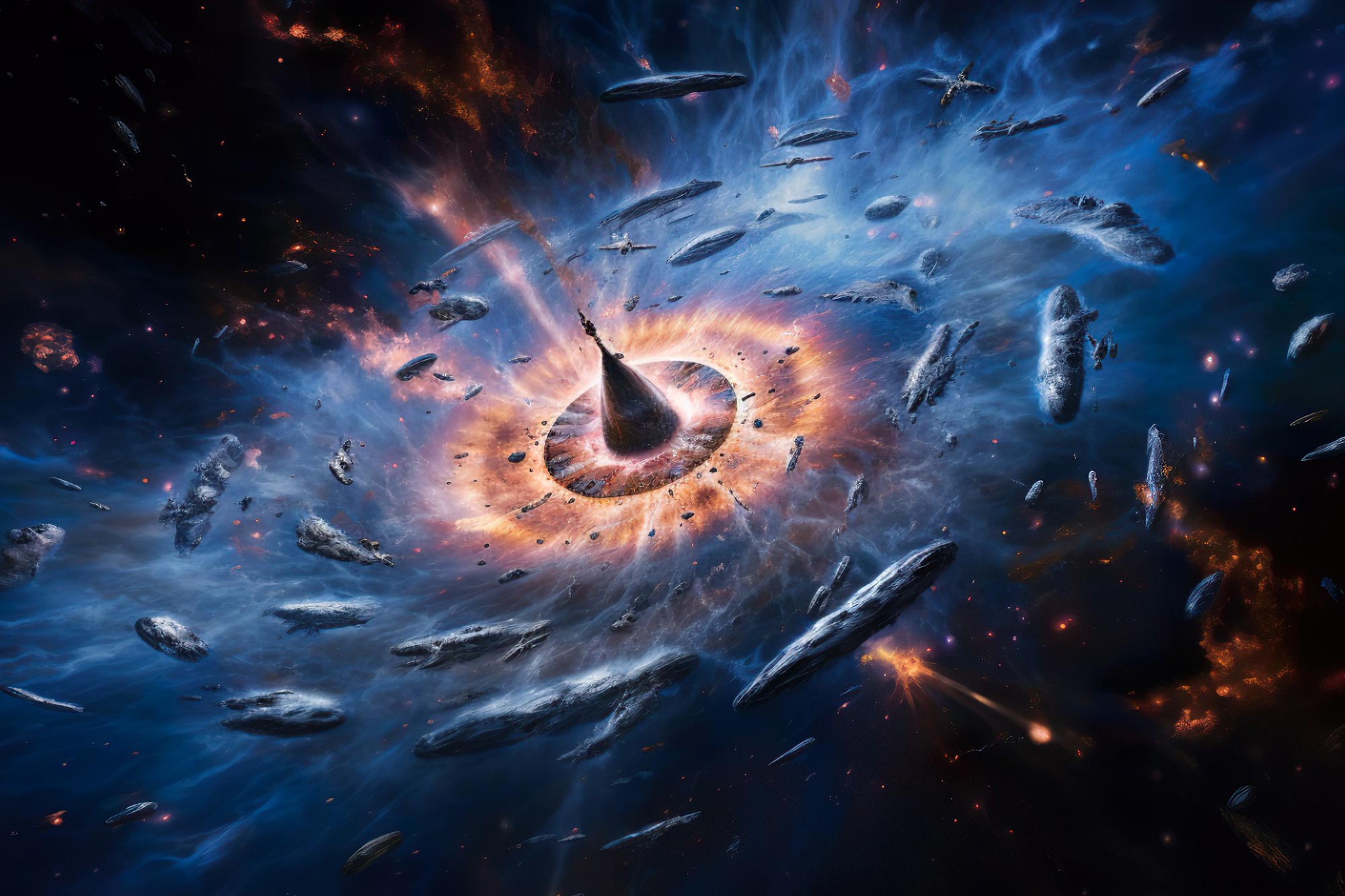
Observational data from nearly 200 quasars show Einstein correct – again – about time dilation of the cosmos.

Scientists have for the first time observed the early universe running in extreme slow motion, unlocking one of the mysteries of Einstein’s expanding universe.

Einstein’s general theory of relativity means that we should observe the distant – and hence ancient – universe running much slower than the present day. However, peering back that far in time has proven elusive. Scientists have now cracked that mystery by using quasars as ‘clocks’.

“Looking back to a time when the universe was just over a billion years old, we see time appearing to flow five times slower,” said lead author of the study, Professor Geraint Lewis from the School of Physics and Sydney Institute for Astronomy at the University of Sydney.

“If you were there, in this infant universe, one second would seem like one second – but from our position, more than 12 billion years into the future, that early time appears to drag.”

The research was published on July 3 in Nature Astronomy.

Geraint Lewis

Professor Geraint Lewis in the Sydney Institute for Astronomy in the School of Physics at the University of Sydney. Credit: The University of Sydney

Professor Lewis and his collaborator, Dr. Brendon Brewer from the University of Auckland, used observed data from nearly 200 quasars – hyperactive supermassive black holes at the centers of early galaxies – to analyze this time dilation.

“Thanks to Einstein, we know that time and space are intertwined and, since the dawn of time in the singularity of the Big Bang, the universe has been expanding,” Professor Lewis said.

“This expansion of space means that our observations of the early universe should appear to be much slower than time flows today.

“In this paper, we have established that back to about a billion years after the Big Bang.”

Previously, astronomers have confirmed this slow-motion universe back to about half the age of the universe using supernovae – massive exploding stars – as ‘standard clocks’. But while supernovae are exceedingly bright, they are difficult to observe at the immense distances needed to peer into the early universe.

By observing quasars, this time horizon has been rolled back to just a tenth the age of the universe, confirming that the universe appears to speed up as it ages.

Professor Lewis said: “Where supernovae act like a single flash of light, making them easier to study, quasars are more complex, like an ongoing firework display. 

“What we have done is unravel this firework display, showing that quasars, too, can be used as standard markers of time for the early universe.”

Professor Lewis worked with astro-statistician Dr. Brewer to examine details of 190 quasars observed over two decades. Combining the observations taken at different colors (or wavelengths) – green light, red light, and into the infrared – they were able to standardize the ‘ticking’ of each quasar. Through the application of Bayesian analysis, they found the expansion of the universe imprinted on each quasar’s ticking.

“With these exquisite data, we were able to chart the tick of the quasar clocks, revealing the influence of expanding space,” Professor Lewis said.

These results further confirm Einstein’s picture of an expanding universe but contrast earlier studies that had failed to identify the time dilation of distant quasars.

“These earlier studies led people to question whether quasars are truly cosmological objects, or even if the idea of expanding space is correct,” Professor Lewis said.  

“With these new data and analysis, however, we’ve been able to find the elusive tick of the quasars and they behave just as Einstein’s relativity predicts,” he said.

Reference: “Detection of the cosmological time dilation of high-redshift quasars” by Geraint F. Lewis and Brendon J. Brewer, 3 July 2023, Nature Astronomy.
DOI: 10.1038/s41550-023-02029-2


Credit: Source link

ShareTweetSendSharePin

Related Posts

Canada’s retaliatory US tariffs set to take effect as trade dispute grows – The Guardian
Market & News

Canada’s retaliatory US tariffs set to take effect as trade dispute grows – The Guardian

September 7, 2026
G-III Apparel Group, Ltd. 2027 Q2 – Results – Earnings Call Presentation (NASDAQ:GIII) 2026-09-07
Market & News

G-III Apparel Group, Ltd. 2027 Q2 – Results – Earnings Call Presentation (NASDAQ:GIII) 2026-09-07

September 7, 2026
AfD just won 44% in a German state. Now Germany's firewall faces its biggest test. – Axios
Market & News

AfD just won 44% in a German state. Now Germany's firewall faces its biggest test. – Axios

September 7, 2026
Falcons name Tagovailoa as starter vs. Steelers – NBC Sports
Market & News

Falcons name Tagovailoa as starter vs. Steelers – NBC Sports

September 7, 2026
Next Post
Analysts’ Actions: Electric Carmaker Gets Hit With a Downgrade at Pacific Crest

Analysts' Actions: Electric Carmaker Gets Hit With a Downgrade at Pacific Crest

Leave a Reply Cancel reply

Your email address will not be published. Required fields are marked *

Search

No Result
View All Result
Nvidia Deepens Chip Ties With .5 Billion MediaTek Bet | Bloomberg Tech 8/31/2026

Nvidia Deepens Chip Ties With $3.5 Billion MediaTek Bet | Bloomberg Tech 8/31/2026

September 3, 2026
Texas’ power grid meets record demand with investments in solar energy

Texas’ power grid meets record demand with investments in solar energy

September 6, 2026
LIVE: Trump makes announcement on nuclear innovation | NBC News

LIVE: Trump makes announcement on nuclear innovation | NBC News

September 5, 2026

About

Learn more

Our Services

Legal

Privacy Policy

Terms of Use

Bloggers

Learn more

Article Links

Contact

Advertise

Ask us anything

©2020- TradePoint.io - All rights reserved!

Tradepoint.io, being just a publishing and technology platform, is not a registered broker-dealer or investment adviser. So we do not provide investment advice. Rather, brokerage services are provided to clients of Tradepoint.io by independent SEC-registered broker-dealers and members of FINRA/SIPC. Every form of investing carries some risk and past performance is not a guarantee of future results. “Tradepoint.io“, “Instant Investing” and “My Trading Tools” are registered trademarks of Apperbuild, LLC.

This website is operated by Apperbuild, LLC. We have no link to any brokerage firm and we do not provide investment advice. Every information and resource we provide is solely for the education of our readers. © 2020 Apperbuild, LLC. All rights reserved.

No Result
View All Result
  • Main
  • AI & Technology
  • Stock Charts
  • Market & News
  • Business
  • Finance Tips
  • Trade Tube
  • Blog
  • Shop

© 2023 - TradePoint.io - All Rights Reserved!