




















Younes Kraske /iStock via Getty Images
Main Thesis/Background
The purpose of this article is to evaluate the high-yield (corporate) credit market in the U.S. and determine whether or not there is true value there at the moment. This is a sector that has seen its income grow along with interest rates, and has held up reasonably well despite a looming recession. In fact, counter-intuitively, the riskier corners of the debt market have been easily outpacing their peers in terms of total return year-to-date in 2023:
YTD Returns (Various Sectors) (Wall Street Journal)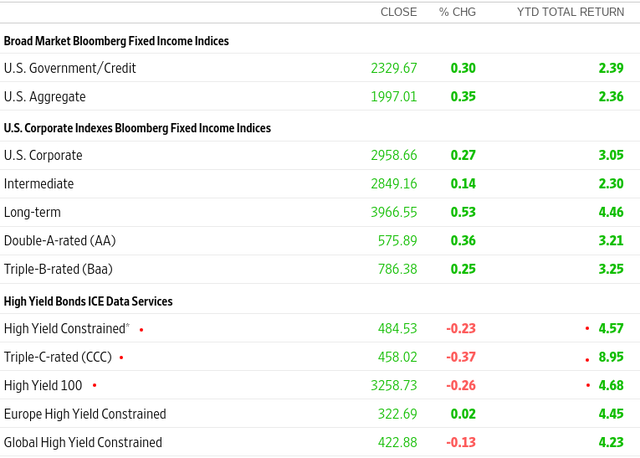
What this might suggest is that junk debt is the place to be. Yields are high on a historical basis, returns are alpha-generating, and momentum could lead to more gains in the second half of the year. This is a very valid scenario.
However, there are macro-concerns that may not be fully priced into prices right now. This is where some of the “cracks” are residing, in my opinion. One, while yields are higher, so is inflation, so yields have to be higher to compensate for this, or it doesn’t make sense to buy them. So we have to consider are yields high enough to justify the risk. In that vein there is some doubt. Two, defaults have been rising, but the market has not been rattled by it (so far). This tells me there is a bit of a disconnect between reality and investor sentiment – something that always leaves me concerned. Three, debt profiles have been shrinking consistently over the past few years. With the Fed pushing a “higher for longer” mantra, that means more debt is going to come due. While leveraged companies will tend to refinance their debt in this scenario, that is going to be a more expensive proposition than most probably planned for if rates do stay higher for longer. That is a major crack forming.
Spreads Narrowing As Conditions Worsen
Let’s begin by talking about risk-adjusted spreads. This is central to my first point above which was are yields high enough. What I mean by this is we all know that bonds are offering higher levels of income right now. As prices got slammed in 2022, yields rose – this was true in IG and non-IG debt. It opened up more attractive entry points for buyers, as long as they were not shell-shocked from the pain last year.
The argument I am making here is just looking at the surface yield will not tell us the whole story. How attractive this yield is depends on other factors. What the risk-free rate is, what IG debt is paying, and what the macro-outlook is for the economy. It is that latter point that is really in focus for me. If the economy is expected to see a downturn, we need riskier debt to pay us more to take on that economic risk. Yet, spread options show us that junk bonds are narrowing compared to other sectors. This comes at a time when banks and other lenders are tightening their borrowing standards – often a precursor to a recession or at least slower economic growth. This disconnect is unusual:
Bank Lending / Corporate Spread Data (Charles Schwab)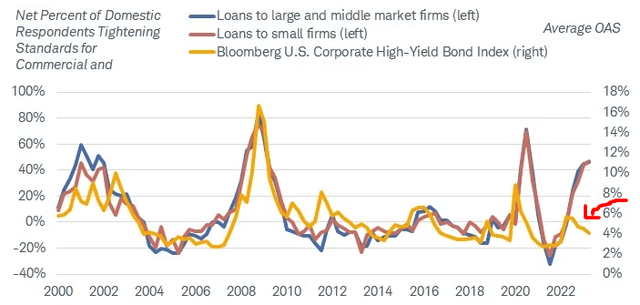
As you can see, options-adjusted spreads for high-yield bonds will often rise along with tighter lending standards in the financial sector. That has been a pretty consistent trend over the past twenty years. But 2023 has shown a divergence in that time-tested trend.
What is the takeaway from this? Well, we don’t know yet, and I am not going to pretend I know for certain what the ultimate outcome will be. I can guess, but the end result is based on a host of factors.
Defaults Rising, Market Ignoring It?
Another important factor that is generally overlooked right now is the number of corporate defaults. This has been on the rise, but is not reflected in bond prices as spreads/yields have narrowed/fallen, not widened/risen which would be the logical development. According to a recent report from Moody’s, the U.S. trailing 12-month speculative-grade default rate rose to 3.1% in May, up from 1.4% a year ago. Perhaps more importantly, their analysts are expecting this trend to continue into 2024:
Moody’s Forecasts (June 2023) (Moody’s)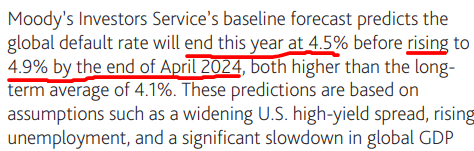
This is where I have probably the most concern. When we hear that junk debt corporates have “attractive yields” relative to history, what exactly does that mean? Sure, the yield may be higher, but is that really more attractive if the risk of default is also higher?
The takeaway for me is to be cautious here. I agree that credit markets look attractive in relative terms compared to history – all other things being equal. But things are never really equal. If we are about to enter a recession and/or see an uptick in corporate defaults, then the yield should be higher to compensate for this risk. What I mean is that the risk-adjusted returns are appropriate and investors are not really getting a “deal”. Keep this top of mind before buying in.
“Higher For Longer” Will Hurt This Sector
My next point looks at the Fed’s guidance. Personally, I see this as a bit of a wild card, and I am not going to suggest that I know precisely what the Fed is going to do. But I have been on record this entire year in saying that I didn’t understand the opinion that the Fed was going to start cutting rates in 2023. I honestly don’t know how that became a consensus opinion, and it seems that the market is only finally waking up to that reality in the past few months.
Nevertheless, the Fed has surprised markets a bit with that forecast, especially beyond 2023. While the funds rate is still expected to be lower in 2024 than it is this year, current forecasts show a push higher in where rates are going to be for the next 18 months compared to prior guidance:
Fed Projections (’23-24) (S&P Global)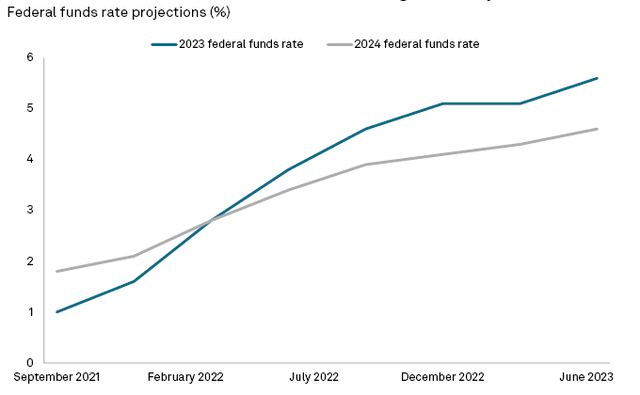
This really shows that the market needs to begin adjusting to the idea that rates will be higher for longer. Even if they come off the peak rates of 5-5%, we are not going to see 1-2% rates again for a long time. This means quite a bit of a transformation in credit markets compared to the past decade.
Of course, this isn’t all “bad”. We need a more normalized interest rate environment for a healthy economy. At least in my opinion. But we should recognize that higher interest rates don’t benefit (or hurt) everyone equally. In terms of risk, this is one spot where junk issuers are going to be disproportionately impacted.
One of the fundamental reasons why is that corporate junk issuers had loaded up on shorter-term debt over the past few years compared to what they had done in the past. In fact, the current maturity profile is, on average, less than half what it was in the 1990s:
Average Time To Maturity (Junk Corporate Debt) (Yahoo Finance)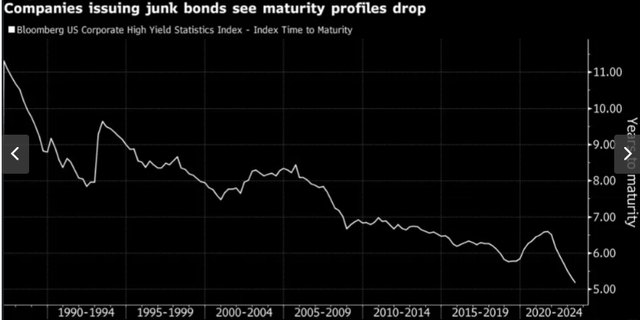
This begs the question – where is the risk here?
The risk lies in what will happen when this debt matures and companies have to either pay off the debt or refinance. If rates are higher for longer, then when this debt matures (and it will in a shorter timeframe than in past cycles), then these issuers will have to accept higher borrowing costs as a result. Unless they are in a position to pay off their liabilities – and I suspect they won’t be – then they will have to bear the burden of the new market reality. This means higher borrowing costs, which leads to an increase in the risk of defaults or, at the very least, an increase in the amount of distressed debt.
This is not meant to be a doom and gloom scenario. But readers should note that even if high-yield issuers seem to be in a good financial position at the moment, that could change in a few years. This matters in varying levels to investors and is dependent on each individual’s time horizon.
The Story Is Not All Bad
I wrote this review to help my followers properly assess the risks in the junk bond and credit markets going forward. It is not meant to be alarmist, but to balance out so many of the positive headlines we see every day. Many investors tend to focus on yield, and we see a plethora of “this yield is high – buy it now” articles on a daily basis. But a high-yield is not always a good sign. There are often signals that suggest yields are high for valid reasons – they are risky. If that is the case, readers need to understand what those risks are and critique whether or not they can handle them.
For this reason I touched on some fundamental risks for the next year or year and a half. But, again, this is still an investable market. One reason is that yields are indeed high, so investors are being compensated for these risks to some degree. Two, there is also a chance the U.S. avoids a recession this year. If so, that pushes out the default risk on a lot of distressed debt that is starting to pile up. Three, high-yield credit has been a strong performer in 2023. While I see some of this as unjustified, the performance does speak for itself. This momentum could easily continue in the second half of the year, especially if inflation continues to moderate. Four, most high-yield issues are secured, which means they are backed by some form of collateral. While most junk debt is not secured, the amount that is has been rising over time:
Percent of High Yield Debt That Is Secured (Bloomberg)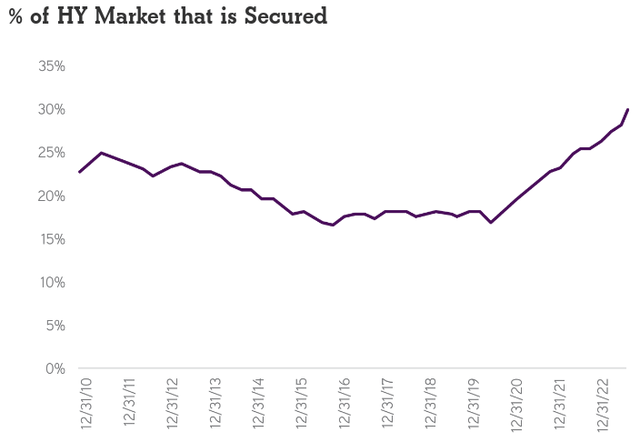
The relevance here is that secured debts have higher recovery percentages than unsecured ones. This helps to contradict some of the fear that defaults are going to rise in an unsustainable way. If this debt does default, but investors get most (or all) of their investment back through the collateral, it will help shore up confidence in the sector and limit the fallout.
Bottom Line
The overall conclusion here is there are reasons to be optimistic as well as cautious – but I think caution should win the day. I see risks building, so weigh the pros and cons carefully before making any portfolio adjustments. The high-yield corner is typically fraught with above-average risk, that is nothing new, but the problem is that I see risk accelerating in the months ahead. To put this into an actionable plan, readers should be proactive, discerning, and exercise moderation when building positions in this sector.
Credit: Source link