

sandsun
The past three articles on Star Bulk Carriers (NASDAQ:SBLK) on Seeking Alpha suggest that the stock is a buy. Also, in my previous article on SBLK, I mentioned the higher TCE rates for Capesize vessels in March and April (compared with January and February), and explained that as Capesize vessels account for 55% of SBLK’s fleet, and China’s economic growth in 1Q 2023 was better than expected, SBLK can be a buy. However, considering the current market outlook which has changed compared with two months ago, I conclude to downgrade my previous rating on SBLK to hold. This downgrade means that I don’t expect SBLK’s stock price to change materially by the end of the year. Also, I estimate SBLK’s 2Q 2023 dividend to be $0.35 per share, and I estimate SBLK’s 1-year forward dividend yield to be between 6.8% to 8.5%, which can be attractive for some investors. However, take into account that with current interest rates and inflation rates, the mentioned forward dividend yield may not be as attractive as it was 2 years ago. Overall, the stock is a hold.
Investment Thesis
From the week ending 19 April 2023 to the week ending 10 May 2023, 4 to 6 months dry time charter estimates for Capesize vessels increased from $18500 per day to $21000 per day, up 13.5%. In the second quarter of 2023, the growth in the construction sector in China was weaker than anticipated. It is worth noting that the construction sector accounts for about half of Chinese steel demand. As China’s demand for iron ore was the main reason behind higher Capesize rates in the first few months of 2023, with the country’s failure in meeting expectations about its steel demand in the second quarter, Capesize rates started decreasing. From the week ending 10 May to the week ending 14 June, 4 to 6 months dry time charter estimates for Capesize vessels decreased by 30%. According to BMI, in the second half of 2023, we can expect a mild recovery in China (weaker than previously expected). Also, due to heavy rainfall in the southern regions and high temperatures, construction activity in China from June to August normally slows. Moreover, as a result of high interest rates, the tight financial condition can continue hindering the economic growth of Western countries. Thus, I don’t expect the freight rates for dry bulk vessels, especially Capesize vessels to increase significantly in the following months. According to Figure 1, the Baltic Dry Index, which has more than halved in the past year, may remain below 1400, the current 1-year average, in the second half of the year.
Figure 1 – Baltic Dry Index
tradingeconomics.com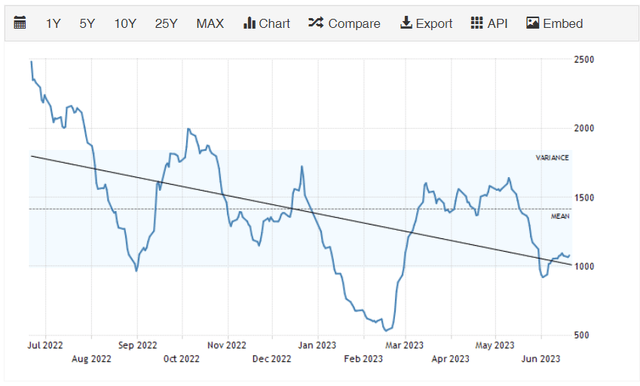
In the first quarter of 2023, SBLK reported voyage revenue and net income of $224 million (down 38% YoY and 25% QoQ) and $46 million (down 73% YoY and 47% QoQ), respectively. The company’s TCE rate dropped from $27405 per day in 1Q 2022, to $19590 per day in 4Q 2022, and decreased further to $14199 per day in 1Q 2023. It is worth noting that in the first quarter of 2022, on average, the Baltic Dry Index was about 2000, in 4Q 2022, the Baltic Dry Index was on average about 1500, and in 1Q 2023, the Baltic Dry Index was on average about 1100. As of 21 June 2023, the average Baltic Dry Index in the second quarter of 2023 is about 1300. Thus, SBLK’s financial results in 2Q 2022 can be better than in 1Q 2023. However, according to the current market outlook, SBLK’s financial results in 3Q 2023 and 4Q 2023 may be weaker than in 2Q 2023.
For the first quarter of 2023, SBLK’s Capesize/Newcastlemax vessels TCE rate was $16807 per day, its Post Panamax/Kamsarmax/Panamax vessels TCE rate was $13904 per day, and its Ultramax/Supramax vessels TCE rate was $12393 per day. Figure 2 shows that according to the company’s fleet coverage for 2Q 2023, its Capesize/Newcastlemax vessels TCE rate was $20693 per day (for 55% fixed days), its Post Panamax/Kamsarmax/Panamax vessels TCE rate was $16105 per day (for 63% fixed days), and its Ultramax/Supramax vessels TCE rate was $16195 per day (for 63% fixed days). Overall, as of 17 May 2023, SBLK had a fleet wide coverage for 2Q 2023 of 61% at a TCE of $17477 per day. As the Baltic Dry Index in the second half of May and June is lower than in April and the first half of May, I estimate SBLK’s 2Q 2023 TCE rate to be about 15600, which is 10% higher than the company’s 1Q 2023 TCE per day. However, for the third and fourth quarters, SBLK’s TCE rate might be lower than in the second quarter.
SBLK paid a dividend of $0.35 per share for the first quarter of 2023, and I estimate the company’s dividend for the second quarter of 2023 to be $0.35 per share (see Figure 3). Based on the market condition in the second half of the year which is deeply connected to the economic growth of China, India, and Western countries, the war in Ukraine, and also SBLK’s operational results and plans, I estimate the company’s 3Q and 4Q 2023 dividend to be between $0.30 to $0.40 per share. At its current price (about $18 per share), I calculate a 1-year forward dividend yield of between 6.8% (in the not-improving market condition scenario) to 8.5% (in the improving market condition scenario). Of course, with an impairing market condition that may occur due to economic recovery challenges in China and potential financial instability in Western countries, TCE rates can decrease to lower levels, and SBLK’s quarterly dividends can decrease.
Figure 2 – SBLK’s 2Q 2023 fleet coverage
1Q 2023 presentation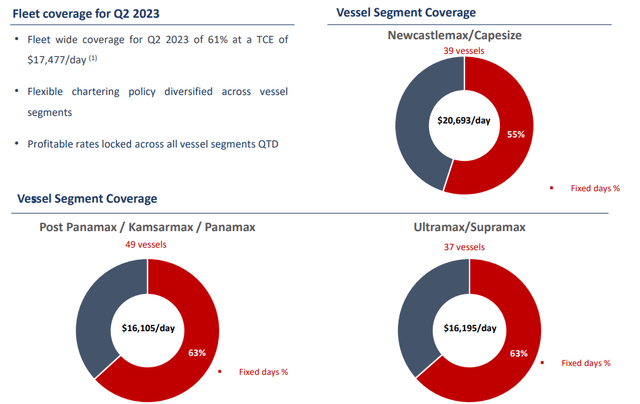
Figure 3 – SBLK’s 2Q 2023 dividend estimation
Author (based on SBLK’s financial results)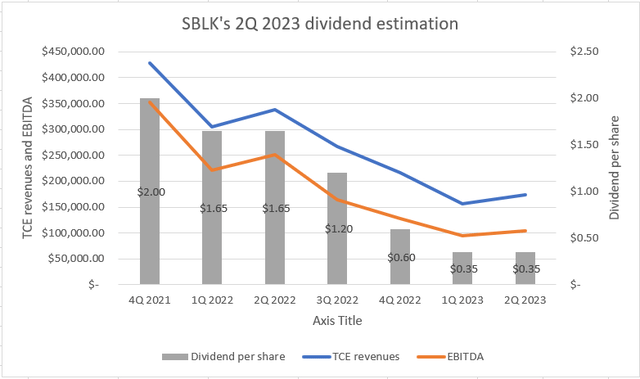
End note
If you want to bet on stronger dry bulk shipping market conditions in 2024 and 2025, SBLK’s dividend yield might persuade you to buy the stock. However, based on the current market conditions, and the current TCE rates, SBLK’s stock price may not increase significantly in the next six months. The stock is a hold.
Credit: Source link