















andresr
For the past 15 quarters, Omega Healthcare Investors (NYSE:OHI) paid a dividend of $0.67 per common share. However, it is important to know that in the first quarter of 2023, the company’s funds available for distribution (FAD) payout ratio was 107%, compared with 99% in 1Q 2022. The company’s Board of Directors might be able to continue declaring the quarterly dividend of $0.67 per common share. However, you should consider that it might take about more than a year before OHI’s FAD payout ratio comes back to below 100%. Also, you should take into account that OHI calculates its FAD by considering the provision for impairments on real estate properties, and also, uncollectible accounts receivable. In the first quarter of 2023, OHI’s provision for impairment on real estate properties and uncollectible accounts receivable were significantly higher than in the same period last year. Due to high interest rates, and economic headwinds which may continue for about a year, OHI’s provision for impairment on real estate properties and uncollectible accounts receivable may increase further, increasing OHI’s credit and liquidity risks.
Despite the mentioned situation that the company is facing, according to OHI’s 1Q 2023 financial results, Taylor Pickett, OHI’s CEO expects the company’s financial performance to improve in the coming quarters, as restructurings are concluded, restructured operators begin paying rent again, and proceeds from assets sales are redeployed. At first glance the word “restructuring” might seem good for the company; however, it is not. The restructuring that the CEO mentioned, means payment deferral and reduction of annual base rent and interest from LaVie, Maplewood, Healthcare Homes, Amego, and other operators. It simply means that OHI has agreed not to receive its money at the time that was expected, as the mentioned operators were not able to pay their rent on time.
As I want to be fair, I should mention that Healthcare Homes was supposed to resume full contractual payments in May 2023, and Amego was supposed to resume making rent and interest payments during the second quarter of 2023. However, as still there are no signs of economic tailwinds, and also there might be some financial instabilities due to high interest rates, there might be more restructuring, meaning that OHI may get in a situation to let more operators defer their rents.
At its current price of around $31 per share, OHI has a forward dividend yield of 8.6%, which is higher than the sector median of 5.03%, and despite all the challenges, the company likely won’t declare a dividend cut. Thus, if you are interested in OHI’s quarterly dividends, and a dividend yield of between 8-9% fits with your investment strategy, OHI is on the table. However, if you also look for higher stock prices, for three main reasons, OHI’s stock price may not have enough potential to rise for now. Firstly, due to the weak economic outlook, and the fact that interest rates can remain high for the next few quarters, more operators might defer their payments, hurting OHI’s cash position. Secondly, higher allowance for credit losses in 1Q 2023 means that the company estimated that compared with previous quarters, a larger portion of its loans might be defaulted on, and due to high interest rates and the tightness of the capital market, the company’s allowance for credit losses in 2Q 2023 might be higher than in 1Q 2023. Thirdly, at the stock’s current price, OHI’s dividends are attractive. However, for the stock price to go up, the company’s Board of Directors should be able to increase the quarterly dividend, which is not likely as OHI’s FAD payout ratio has surpassed 100%. The stock is a hold.
FAD payout ratio
In its 1Q 2023 financial results, OHI reported total revenues of $218 million, compared with $249 million in 1Q 2022, driven by lower rental income, and lower real estate loan interest income, partially offset by higher non-real estate loan interest income. Also, as a result of significantly higher impairment on real estate properties, the company’s total expenses increased from $168 million in 1Q 2022 to $200 million in 1Q 2023. It is important to know that despite hiked interest rates that have caused the interest expenses of REITs to jump, OHI’s interest expense of $55 million in 1Q 2023, was only 1% higher than in 1Q 2022. Also, it is important to know that the company’s net gain on assets sold dropped from $113 million in 1Q 2022 to $16 million in 1Q 2023. As a result, OHI’s net income available to common shareholders dropped from $190 million in 1Q 2022 to $36 million in 1Q 2023. Deducting the gain from real estate depositions, the company’s net income decreased from $82 million in 1Q 2022 to $23 million in 1Q 2023. Furthermore, by eliminating non-cash items included in net income (mainly depreciation and amortization, and provision for impairments on real estate properties), OHI’s funds from operations (FFO) decreased from $171 million in 1Q 2022 to $146 million in 1Q 2023.
As a result of lower FFO, OHI’s funds available for distribution decreased from $162 million ($0.65 per common share) in 1Q 2022 to $147 million ($0.60 per common share) in 1Q 2023. Due to the repurchases of common stock in prior quarters, the company’s diluted weighted average common shares outstanding decreased from 247.5 million in 1Q 2022 to 243.2 million in 1Q 2023, helping the Board of Directors to maintain the quarterly dividend of $0.67 per share. Although, it is important to know that in 1Q 2023, OHI paid a $157 million dividend, which was $10 million higher than the company’s funds available for distribution (in 1Q 2022, OHI’s dividend paid was $1 million higher than its funds available for distribution). As OHI’s FAD payout ratio increased from 99% in 1Q 2022 to 107% in 1Q 2023, making the company’s cash position in 1Q 2023 weaker than in 1Q 2022.
“As we indicated last quarter, we expect our financial performance to improve in the coming quarters, as restructurings are concluded, restructured operators begin paying rent again, and proceeds from asset sales are redeployed. Barring additional unforeseen restructurings, this should result in both our dividend payout ratio and our leverage rapidly improving as the year progresses,” the CEO commented in the company’s 1Q 2023 financial results.
“While both corporate and industry metrics are improving, the industry is still on the road to recovery and remains quite fragile. As such, it is vital that both federal and state efforts continue to support an industry that proved so integral to protecting the aging and vulnerable during the pandemic,” he continued.
Higher allowance for credit losses can be expected
Figure 1 shows OHI’s principal amounts outstanding of real estate loans receivable as of 31 March 2023. As of March 31, 2023, OHI’s real estate loans receivable consisted of eight fixed rate mortgage notes on 53 long-term care facilities and 10 other real estate loans. We can see that the company’s gross mortgage notes receivable increased from $732 million on 31 December 2022 to $736 million on 31 March 2023. Also, we can see that OHI’s allowance for credit losses on mortgage notes receivable decreased from $83 million on 31 December 2022 to $74 million on 31 March 2023, which is a good sign for the company. We can see the same thing happened for OHI’s leasehold mortgages and other real estate loans.
Figure 2 shows OHI’s non-real estate loans receivables. As of March 31, 2023, OHI had 34 loans with 19 different borrowers. We can see that the company’s gross non-real estate loan receivables decreased from $309 million on 31 December 2022 to $305 million on 31 March 2023. Also, we can see that its allowance on credit losses on non-real estate loans receivable increased significantly from $84 million on 31 December 2022 to $115 million on 31 March 2023, which is not a good sign.
The company’s allowance for credit losses increased due to the economic headwinds resulting mainly from high inflation rates followed by high interest rates. I believe higher allowance for credit losses in 1Q 2023 compared with 1Q 2022 means that OHI came to the conclusion its borrowers were not able to pay their debts on time. As interest rates increased in the second quarter of 2023, and the economic condition is still unfavorable, I expect OHI’s allowance for credit losses to increase further, driven by a higher allowance for credit losses on non-real estate loans.
Figure 1 – The principal amounts outstanding of real estate loans receivable
1Q 2023 results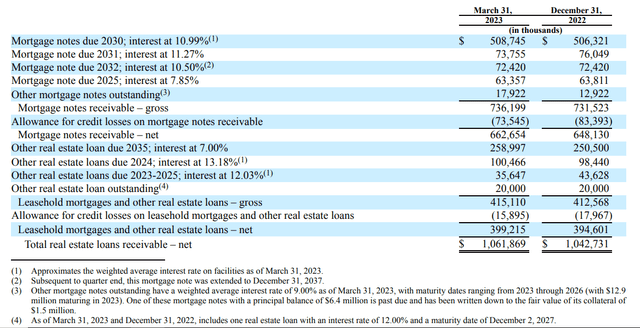
Figure 2 – OHI’s non-real estate loans receivable
1Q 2023 results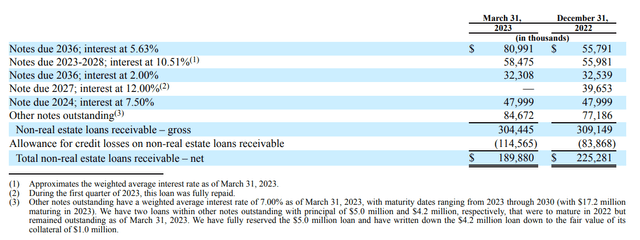
Why I might be wrong
OHI has an attractive dividend yield, and despite all the challenges, it seems that the Board of Directors can maintain the current quarterly dividend, even if it means a FAD payout ratio of higher than 100%. As OHI’s dividend yield of 8.6% is significantly higher than the sector median dividend yield of 4.86%, more investors may decide to buy the stock, increasing its stock price. Furthermore, as some of the company’s operators were supposed to resume paying their rent in the second quarter of 2023, and in reality, there might be no further rent deferral, OHI’s financial results may start improving sooner than I expect.
End note
OHI’s dividend yield of 8.6% is attractive and based on the company’s financial position and the company’s policy, I don’t expect its quarterly dividend of $0.67 to decrease in the upcoming quarters. However, there might be no room for higher dividends and the stock’s price may not go up. The stock is a hold.
Credit: Source link