
Mario Tama
American consumer goods giant Procter & Gamble (NYSE:PG) continues to deliver steady results. Prospects are stable but likely baked into the stock.
Q3 2023: continued organic sales growth , momentum led by Healthcare, and Fabric & Homecare segments
For Q3 2023 (quarter ended March 2023), P&G’s sales rose 4% YoY on a reported basis and 7% YoY on an organic basis to USD 20.1 billion, accelerating from the previous quarter when organic sales grew 5% YoY and matching Q1 2023 when organic sales rose 7% YoY.
Organic sales growth was driven by a 10% contribution from pricing and a 1% contribution from favorable product/mix, offset by a 3% drop in volume. Healthcare (which includes brands like Vicks and Pepto), and Fabric & Home Care (which includes brands like Gain, Microban 24, Mr Clean, Ariel, and Tide) led growth, continuing on a momentum seen over the past two quarters.
Procter & Gamble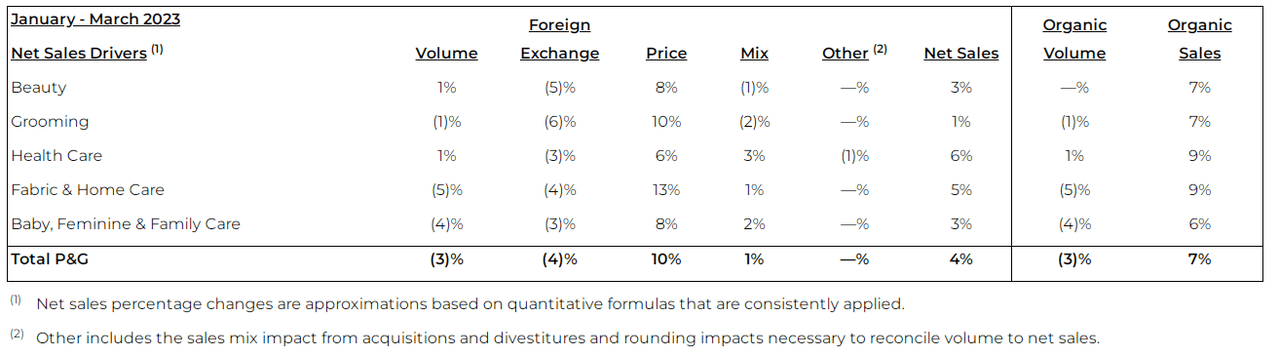
Tailwinds from covid-driven demand for cleaning products is likely to dissipate (possibly putting a lid on organic sales growth in P&G’s Feminine & Family Care segment which was one of the fastest-growing segments in terms of organic sales growth this year). Offsetting this is tailwinds from China’s economic reopening after a prolonged covid lockdown last year. As consumer confidence and mobility improves in the country, P&G’s second-biggest market globally after the U.S. overall sales should get a lift. Management expects Greater China to return to mid single digit growth longer term.
Additionally, inflation is moderating and expected to continue slowing near term. This could ease margin pressures as well as market share erosion from consumers downtrading to cheaper, private label brands.
Management raised guidance with full year FY 2023 organic sales expected to grow 6% YoY compared with 4%-5% previously. EPS guidance remained unchanged at in-line to up to 4% from FY 2022 EPS of USD 5.81.
Looking further ahead, a few noteworthy positive factors could support P&G’s financial performance.
Beauty segment expansion holds potential
Following P&G’s portfolio transformation, the company is a market leading player across most categories it operates in.
-
In baby care, the company is a global market leader with a 20% market share, and is the number one or two player in most of the key markets they operate in, largely driven by P&G’s USD 7 billion baby diaper brand Pampers. P&G’s market share in disposable diapers has held steady over the past several years suggesting a strong market position.
-
P&G is a global leader in feminine care with over 20% market share primarily from Tampax and Ariel brands.
-
P&G is a global leader in the hair care market with a 20% market share led by brands Pantene and Head & Shoulders.
-
P&G is a global leader in razors with market share of 60% primarily from Gillette and Venus brands.
-
P&G is a global leader in male electric shavers (25% market share) and female epilators market (over 65% market share).
-
P&G holds a number two position globally in oral care with a 20% global market share driven by Oral B and Crest brands.
-
In fabric care. P&G is a global market leader with 35% market share driven by brands Ariel, Tide & Downy. P&G is also a global home care market leader with a market share of 25% driven by brands Cascade, Dawn, Febreeze, Swiffer.
In Beauty, P&G is noticeably not as strong, with beauty brand Olay commanding a 6% market share in skincare, and SK-II, which is popular in Asia, commanding a market share of 4% in the region. Management however is sharpening their focus on the segment, and their strategic efforts could yield dividends.
Premiumization Is a growth opportunity in the global beauty market (McKinsey expects premium beauty to grow at 8% annually over the next few years versus 5% for mass beauty), and P&G appears to be making calculated efforts to capitalize on this opportunity.
P&G’s Japanese prestige beauty brand SK-II’s new marketing push targets Gen-Zs, a key demographic in the prestige beauty market. In addition, P&G has been acquisitive, scooping up promising brands to add to its prestige beauty brand portfolio; last year P&G acquired prestige beauty brand Tula, in 2021 acquired prestige indie brand Farmacy Beauty, and premium haircare brand Ouai Haircare.
P&G has also been targeting other untapped opportunities within the beauty market; the company’s acquisition of Mielle Organics will expand the company’s reach to black women, a market segment with growing spending power presenting a meaningful opportunity considering 11% of beauty consumers are black but black brands account for just 2.5% of revenues in the beauty industry according to McKinsey.
Leveraging on P&G’s global distribution networks and hefty marketing budget, these newly acquired small brands could be scaled up massively and contribute meaningfully to financial performance in the medium term.
Due to higher financing costs and valuations, P&G says they will not depend heavily on acquisitions, but are willing to consider acquisitions in the beauty space. With a debt to equity of 80.5, P&G has more balance sheet flexibility for further acquisitions compared to rivals Kimberly-Clark (debt to equity of 1,009) (KMB), Unilever (debt to equity of 135) (UL), and Reckitt Benckiser (debt to equity of 94) (OTCPK:RBGPF).
Productivity gains in marketing, supply chain could be margin and cash flow accretive
P&G’s ad efficiency efforts (like investments to bring more digital capabilities in-house) is expected to save USD 400 million – 500 million a year). The cost savings and resulting higher ad ROI could be plowed back into marketing re-investments supporting medium term financial performance.
P&G is also looking to save USD 1.5 billion in costs through automation and digital investments to improve supply chain efficiency as part of their “Supply China 3.0” initiative.
Risks
Competitive risks
The beauty industry is fragmented, and P&G’s playbook of acquiring promising small brands and scaling them up is one being relied on by other beauty giants such as L’Oreal (OTCPK:LRLCF).
Competitive pressures may limit P&G’s market share gains and financial performance.
Conclusion
Analysts are mostly bullish on the stock.
WSJ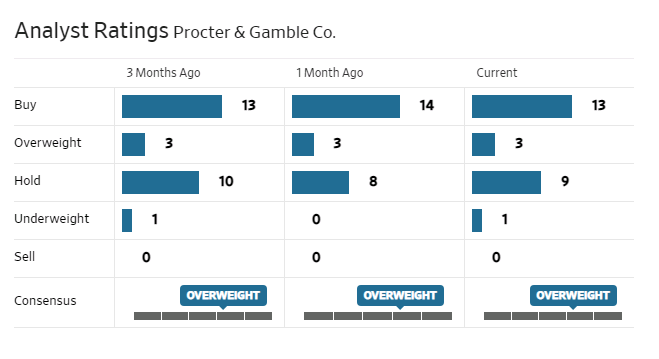
With a forward P/E of 25, P&G is roughly in line with historical levels which may seem fair for a global market leader, but is on the pricey side considering P&G operates in relatively slow-growth, matured industries while high-growth and highly profitable stocks like Alphabet and META are trading at cheaper forward P/Es of 23., likely because threats of a looming recession made defensive stocks like P&G popular over the past year while tech stocks fell out of favor. P&G’s prospects, while decent, are likely baked into its share price and the stock could be viewed as a hold.
Seeking Alpha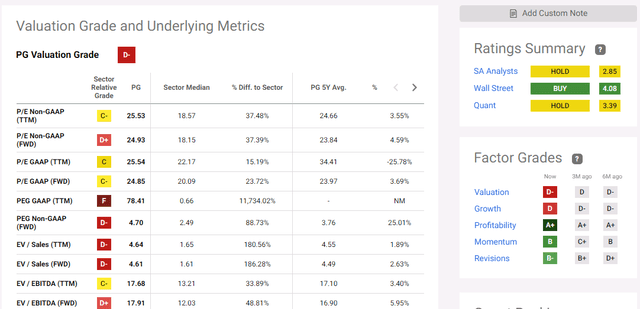
Credit: Source link