
ArtistGNDphotography/E+ via Getty Images
By Dimitry Dayen, CFA, Analyst for Renewables/Industrial Products & Services, ClearBridge Investments
The Outlook for Industry Growth Is Improving
Rising interest rates, supply chain issues, questions over tariffs on imported panels and trade policy have cast a cloud over the utility solar market in recent quarters. However, the outlook for industry growth is improving significantly as notable tailwinds emerge. Increasing clarity over customs clearance and IRA capture rules, a tariff moratorium through June 2024 and deflation in the supply chain are all reasons utility-scale solar should bask in the sun in the coming quarters.
Utility-scale solar, as opposed to rooftop residential solar, typically generates solar power through large farms of ground-mounted photovoltaic solar panels and sells it directly onto the electricity grid. Industry growth currently relies heavily on imports of solar panels for the projects, primarily from Southeast Asia, although U.S. panel manufacturing capacity is growing. Companies capturing value in the U.S. utility solar industry include those providing associated components of the projects, such as Shoals Technologies, which makes electric balance of systems (EBOS) components such as cable and connector assemblies, and fuses and Nextracker, which makes trackers and software for ground-mounted solar projects that lets the panels align with the sun throughout the day.
There is evidence that the U.S. is poised to increase utility-scale solar installations to ~20 GW in 2023 (which would mean ~70% growth from 2022) and potentially as much as 30 GW by 2024, despite some current skepticism toward the market. Points of concern include the Uyghur Forced Labor Prevention Act (UFLPA), which came into force in 2022 amid heightened concerns of forced labor of Uyghur people in China’s supply chain, and which some fear will lead to ongoing delays in securing panels as Customs and Border Protection (CBP) detains shipments. Further, U.S. Treasury guidance has domestic content requirements increasing post 2024, which suggests that additional investments are needed to strengthen the domestic supply chain, which might delay some growth.
Border Logjam Breaking
However, the UFLPA-caused solar panel border logjam appears to be breaking. The main issue is that CBP has been detaining solar panel shipments that could not document UFLPA compliance. As late as November 2022, U.S. ports had blocked over 1,000 shipments of solar components. Our research suggests that after months of back-and-forth with CBP, there is now evidence of an understanding emerging on the documentation needed to prove that solar panel imports are compliant with the UFLPA. The release of Jinko Solar panels from detention in December 2022 supports this view, and the number of shipments detained has declined since late 2022, suggesting standards have been established for imports to get through (Exhibit 1). The parameters driving enforcement of UFLPA can still change, but evidence points to easing of constraints, so far.
Exhibit 1: UFLPA Enforcement Statistics: Electronics Imports
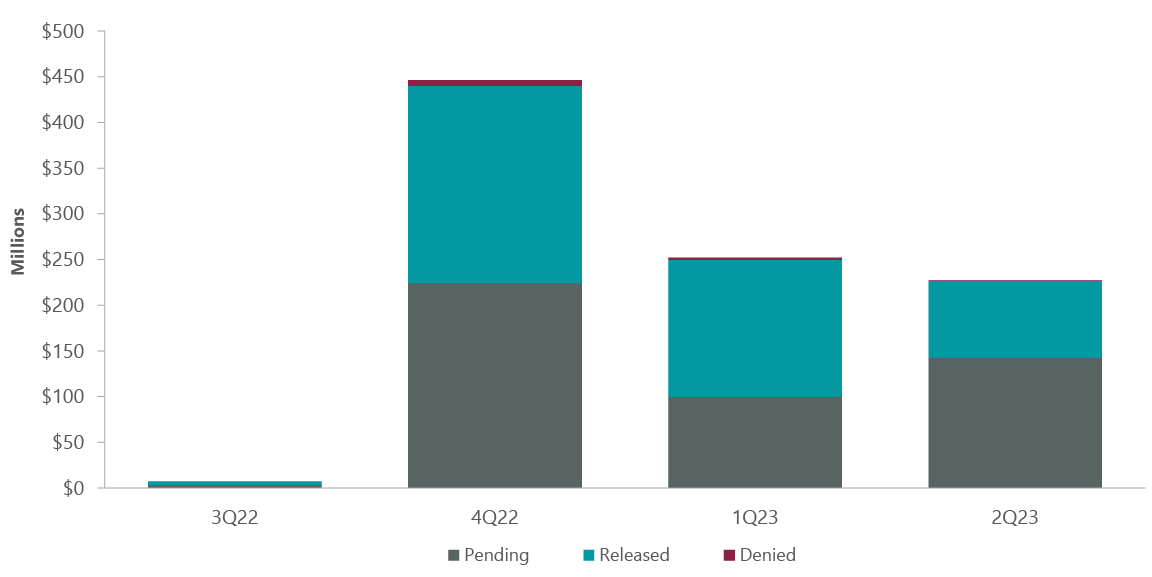
As of April 3, 2023. Source: ClearBridge Investments, U.S. Customs and Border Protection. Solar panels are reported to account for the majority of detained electronics shipments.
Additionally, the U.S. Treasury has recently released much-anticipated guidance on booking the additional 10% domestic content investment tax credit in the Inflation Reduction Act. The release of the guidelines provides visibility and confidence needed to move projects forward. At the same time, the guidelines appear to incentivize early development of utility-scale solar by establishing a lower domestic content threshold (40%) through 2024. Domestic content requirement scales to 55% beyond 2026.
Tariff Moratorium Still a Tailwind for Importers
Data also suggests imports of solar panels are increasing following the implementation of a two-year moratorium on new tariffs. In June 2022, President Biden issued an executive order stopping implementation of any new solar tariffs for two years. Imports from countries affected by tariffs jumped in the months following the executive order and ended 2022 at multiyear highs (Exhibit 2). Monthly imports had fallen to below 2 GW before the moratorium, but have risen to over 4 GW in 2023, with the majority of the increase driven by countries affected by tariffs in Southeast Asia. This pace of imports suggests that developers may be stockpiling panels in anticipation of accelerated growth in utility-scale solar installations in the second half of 2023 and beyond.
Exhibit 2: U.S. Solar Module Imports
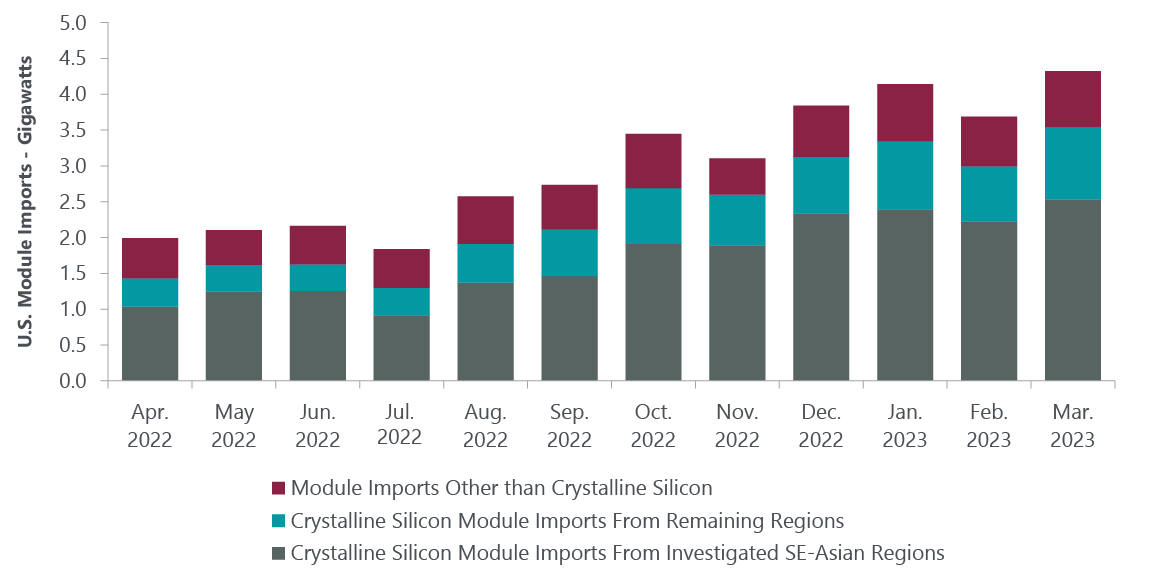
As of March 1, 2023. Source: Piper Sandler. Crystalline silicon is the dominant semiconducting material used in photovoltaic technology for the production of solar cells.
A Congressional Review Act (CRA) to roll back the moratorium has injected uncertainty into solar utilities stocks in 2023. After Congress passed the CRA, President Biden vetoed the bill, as was widely expected. This effectively puts to rest the concerns about these tariffs through mid-2024.
We should not expect significant disruption to imports in July 2024 either, as the preliminary decision on the tariffs from the Department of Commerce appears to focus on tariffs in the 30% range, much lower than the 200% feared by some. The decision also exempts certain large producers and allows for imports of panels and wafers from tariff-affected countries even if they did use Chinese polycrystalline. Furthermore, new capacity, announced on the back of this decision, should be online in the next couple of years. This is in addition to domestic capacity currently being built. As such, by the time the executive order expires, and considering what appears to be inventory stocking of panels, there should be sufficient compliant capacity to drive meaningful industry growth.
New capacity announcements in the U.S. have focused mostly on panel assembly. However, as manufacturers vertically integrate in the U.S., we are likely to get capacity expansions for solar cells (which, combined, make the panels) and, over time, for wafers (the building blocks of the solar cells). Domestic content requirements presented by the U.S. Treasury provide incentives for this activity to take place.
Yes, Deflation Exists Somewhere
At the same time, deflation in solar panel and shipping prices is improving cost structures for developers, some of which are public utilities, although the group comprises a wide range of companies, large and small, public, and private. Recently, inflation in the polysilicon market (polysilicon is the raw material used to make wafers), as well as in the cost of steel and transportation, has driven up the price of solar panels from ~$0.30/watt to just over $0.40/watt at the peak. However, recent deflation in these costs is pushing panel prices below $0.40/watt again. This is impactful considering the overall cost of a utility-scale project in the U.S. is around $1.10/watt. With developers looking for an IRR of 6%–8%, deflation of even $0.05/watt is important.
In early 2023, the price of solar-grade polysilicon — which jumped from below $10/kg in 2020 to nearly $40/kg in 2022 —collapsed sharply, below $20/kg (Exhibit 3). It could head even lower. Long-awaited polysilicon capacity in China is coming onto the market and is expected to continue in 2023. This year, as much as 500 GW of annual polysilicon capacity could be available versus a typical overall global market of less than 400 GW. Not all of this translates into the U.S. panel pricing directly, as capacity in Inner Mongolia is likely to be scrutinized under UFLPA. However, our channel checks indicate that U.S. imports are seeing 4–5 cents/watt price declines already.
Exhibit 3: Deflation in Solar-Grade Polysilicon
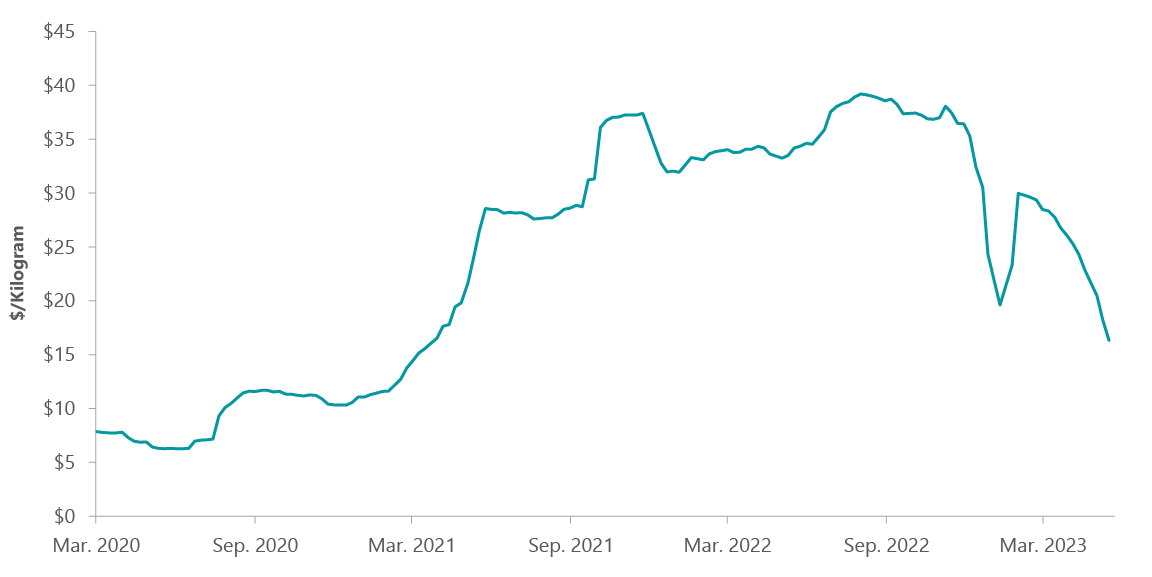
As of May 24, 2023. Source: ClearBridge Investments, Bloomberg Finance.
There are concerns in the industry on securing sufficient interconnection capacity with the electricity grid to accommodate new solar capacity. More work certainly needs to be done in this area to accommodate long-term utility-scale growth in the U.S. At the same time, Federal Energy Regulatory Commission data is showing 72 GW of solar “high-probability additions” through 2025, and International Energy Agency data is showing a similar pipeline. This suggests that at least over the next couple years, grids should accommodate the growth in solar discussed here. This reinforces our view that skies are clearing up for the U.S. utility-scale solar market.
Credit: Source link