
LangChain launched LangSmith Tool Gateway in public beta on November 19, 2026, giving enterprises a managed way to control which tools AI agents can call, whose credentials they use and how each action is recorded.
Tool Gateway routes agent requests to MCP tool servers through a shared control layer on the LangSmith Agent Platform. It centralizes authentication, access rules and call records that would otherwise be built separately into each agent. LangChain is addressing a production environment in which agents serve users with different permissions, tokens need refreshing, and security teams must record access for audits.
LangChain described a large US retailer using more than 50 MCP servers to expose over 1,000 tools for store-operations and inventory agents. A store assistant needs to act under each associate’s credentials across inventory, schedules and email, while an inventory agent reconciles stock at 3 a.m. with service credentials. With hard-coded credentials or access to a complete server, there are no deterministic checks preventing use of the wrong identity or an unapproved tool; security also lacks an end-to-end view for auditing.
Tool Kits and Caller Identity
Administrators can register a remote MCP server once or enable a LangSmith-hosted built-in server, then assemble selected tools from different servers into a kit exposed through one MCP URL. The kit determines which tools the agent can see. For large catalogs, search mode allows the agent to query the kit and load task-relevant tools when needed rather than loading the entire set.
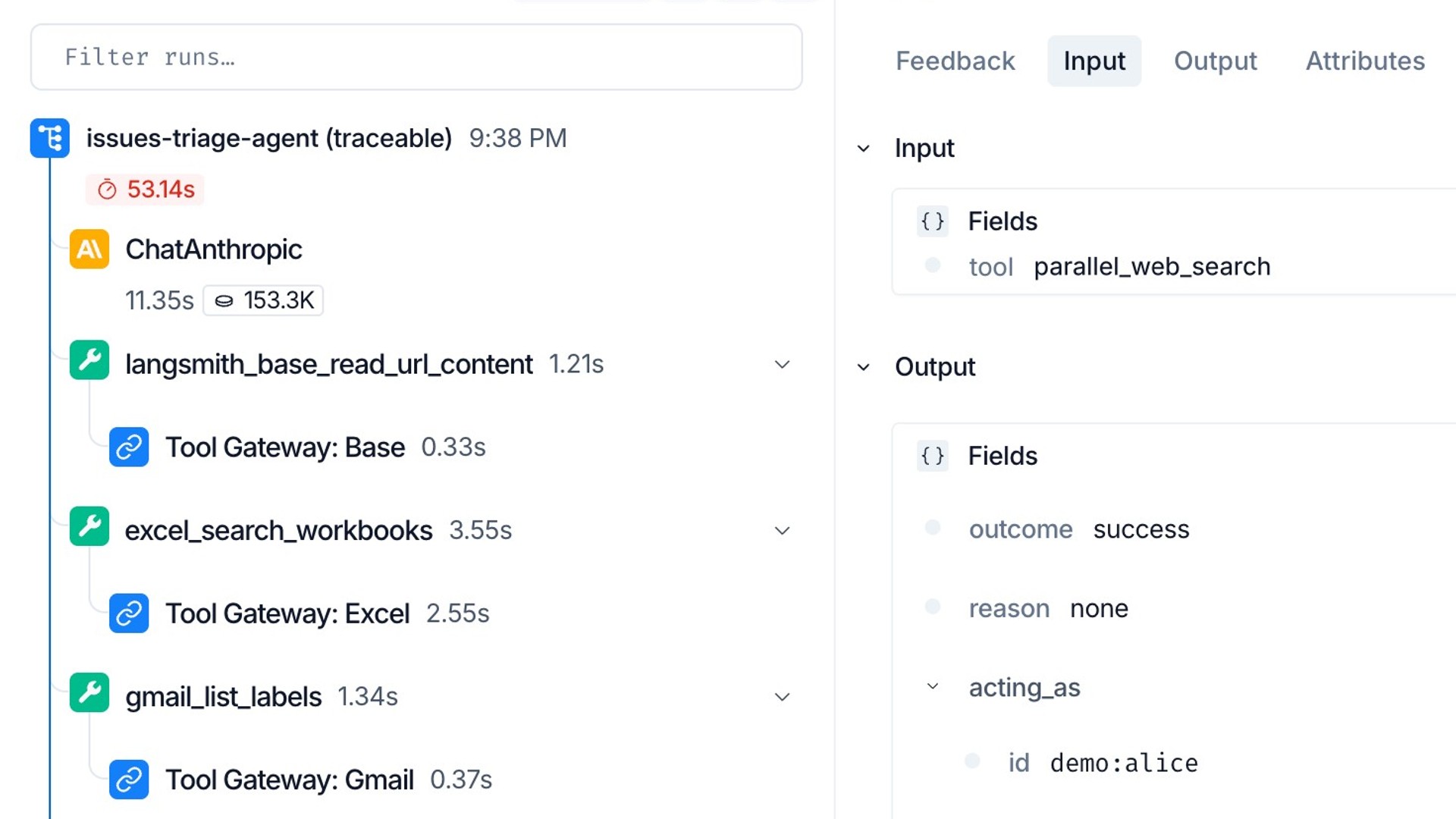
Caller identity follows two models. Acting-as-user mode applies the end user’s credentials, with Okta or Entra ID identifying that person. An unconnected user receives a sign-in link, and the call continues after authentication. Acting-as-agent mode supports unattended work through the agent’s own credentials or a profile containing shared credentials connected once by a workspace administrator. The distinction allows a scheduled background process to operate under service permissions while an employee-facing assistant retains the employee’s permissions.
Policies, Tracing and Integrations
The Tool Gateway documentation sets out a fixed order for each request. The gateway identifies the user, agent or profile, applies deny policies, attaches a stored credential or requests a connection, checks approval policies, and forwards the call; a trace is recorded when tracing is enabled. Deny rules can target users, service keys or combinations at organization or workspace level, including rules for everyone with listed exceptions.
Approval policies add a human checkpoint in the MCP client before a sensitive call executes. LangChain’s example is a warehouse-writing tool: an administrator can require a person to confirm each attempted write. This places review at the moment of action rather than relying only on a later audit.
With tracing enabled, a call’s record can include the tool, server, user, outcome and duration within the surrounding agent conversation. The data sent to or returned by the tool is not stored in that record. Enterprise plans also provide an organization-wide audit log showing which tool ran and under whose identity, giving security and compliance teams a consolidated view of agent activity.
LangSmith-managed sign-in integrations include Google, Microsoft, Salesforce, GitHub, Linear and LinkedIn. API-key or public built-ins cover Parallel search, Exa, Tavily, Apollo, Ashby, Pylon and web-page reading. Tool kits work with MCP clients including LangChain, Deep Agents, Managed Deep Agents, Claude Code and Cursor.
Beta Plans and Regional Support
The beta is available on LangSmith Plus and Enterprise plans. On LangSmith Cloud, support covers the GCP US, GCP EU, GCP APAC and AWS US regions; Azure US is excluded. Enterprise customers additionally receive the organization-wide audit log.
The release also gives LangChain adjacent governance points for agent execution. LLM Gateway controls model calls with features such as spending limits and fallbacks, while Tool Gateway governs interactions with external tools. For enterprises, that pairing brings model usage and tool actions into one LangSmith control plane, with the beta’s plan and regional support setting the initial limits on deployment.
Credit: Source link