



























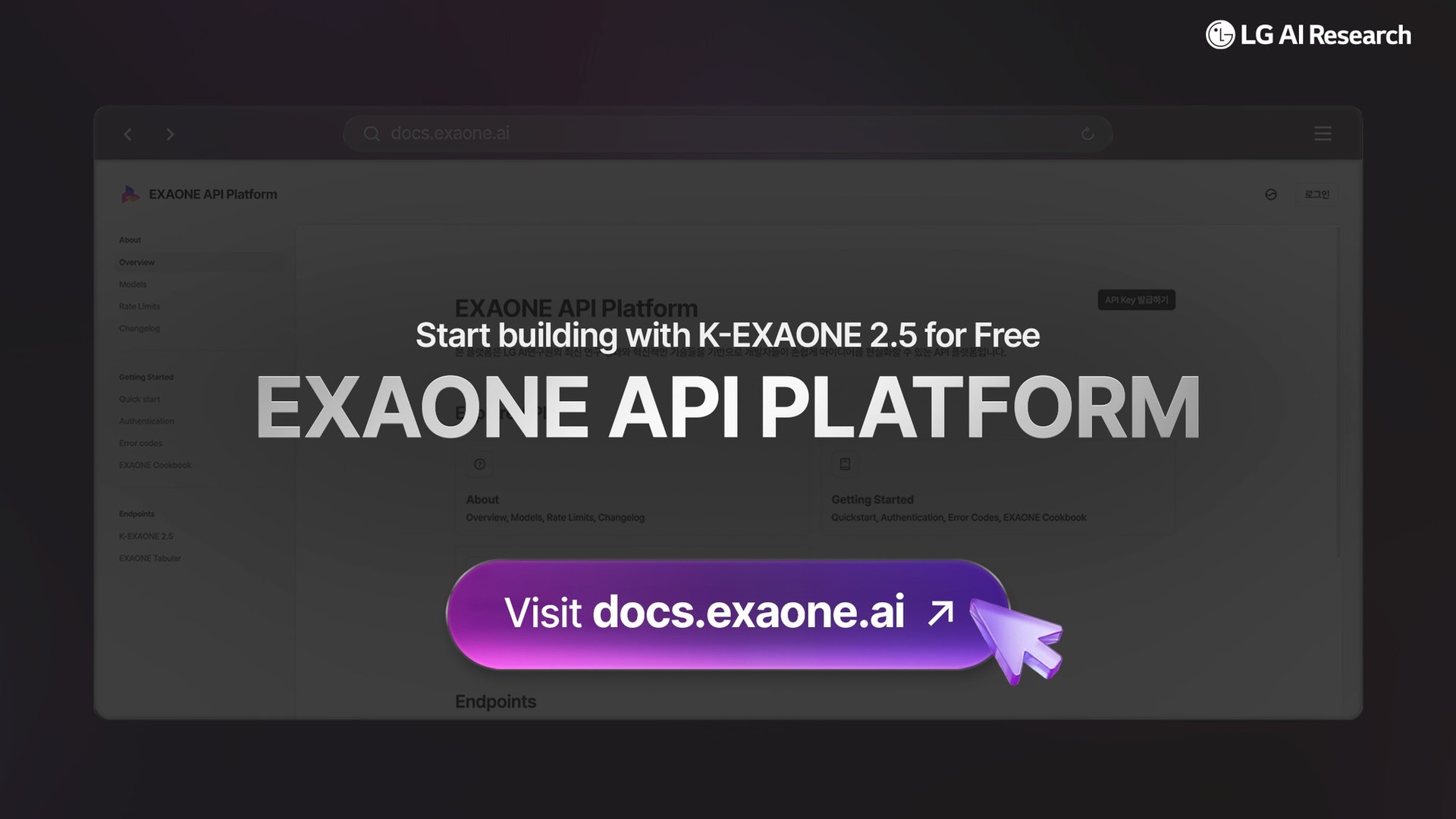

LG AI Research announced free API access to K-EXAONE 2.5 on November 9, 2026, opening hosted use of the 750-billion-parameter model through the EXAONE API Platform.
Developers, startups, companies and research institutions can obtain an API key to use the model for service development and research. LG describes K-EXAONE 2.5 as a technology-validation model produced by applying additional training to the version released in August 2026. The earlier K-EXAONE 2.0 model card documents an open-weight Apache 2.0 release using a Mixture-of-Experts architecture, with 37 billion active parameters and a 262,144-token context length.
Vendor-Reported Agentic Results
LG said it measured K-EXAONE 2.5 internally on open datasets and found it competitive with frontier-class global open-weight models. The model documentation provides this comparison with its predecessor and two external systems:
| Benchmark | K-EXAONE 2.5 | K-EXAONE 2.0 | DeepSeek-V4.1-Flash | GLM-5.3 |
|---|---|---|---|---|
| SWE-Bench Pro, agentic coding | 59.21 | 47.1 | 58.41 | 64.03 |
| BrowseComp, agentic search | 78.0 | 50.87 | 75.8 | 79.0 |
| AutomationBench open-set, agentic tool use | 74.6 | 16.9 | 74.9 | 71.6 |
| Claw-Eval, agentic tool use | 77.29 | 62.11 | 75.78 | 77.64 |
The benchmarks address software development and modification, finding needed information on the web, automating work with SaaS tools, and agent problem-solving in work environments. On LG’s reported figures, K-EXAONE 2.5 improves on its predecessor across all four. It scores above DeepSeek-V4.1-Flash on SWE-Bench Pro, BrowseComp and Claw-Eval but below it on AutomationBench; against GLM-5.3, it scores above that model only on AutomationBench.
LG names code generation, debugging, refactoring and test-code writing as applications, making software development a central use case alongside agentic search and workplace automation.
API Design and Agent Integration
K-EXAONE 2.5 is text-only and supports Korean and English. Its documentation lists 31 billion active parameters, a January 2026 knowledge cutoff, and features including chat, tool calling, structured outputs, code generation and streaming.
The endpoint reference specifies an OpenAI-compatible POST /v1/chat/completions interface using the model identifier k-exaone_v2.5. Input tokens plus the max_tokens generation allowance, which includes reasoning, cannot exceed 524,288 tokens; larger requests return a 400 error. Responses use standard OpenAI-format JSON, or server-sent-event chunks when streaming is enabled.
Reasoning controls are exposed directly. reasoning_effort defaults to max, while preserve_thinking can carry earlier assistant reasoning into multi-turn requests. LG’s agent guide says higher reasoning intensity can increase response time and token usage, and treats current-response effort separately from passing earlier reasoning and tool-call history.
The guide includes configurations for the Hermes general agent and OpenCode coding agent. In the documented workflow, the external harness executes tool calls returned by the model and passes their results back, while handling text, reasoning and tool-call deltas across subsequent turns. Developers therefore receive reasoning and tool-call decisions through the API, but the surrounding agent remains responsible for executing actions and managing the loop.
Free access lowers the cost of testing LG’s agentic-coding results inside existing OpenAI-compatible tooling. The central question is how those internally measured gains carry into production software and business workflows, where reasoning depth, tool execution and context management will shape the model’s practical value.
Credit: Source link