• bitcoinBitcoin(BTC)$80,517.002.90%
  • ethereumEthereum(ETH)$2,422.754.63%
  • tetherTether(USDT)$1.000.07%
  • binancecoinBNB(BNB)$714.361.90%
  • rippleXRP(XRP)$1.323.52%
  • usd-coinUSDC(USDC)$1.000.04%
  • solanaSolana(SOL)$96.623.75%
  • tronTRON(TRX)$0.318529-1.09%
  • Figure HelocFigure Heloc(FIGR_HELOC)$1.051.51%
  • zcashZcash(ZEC)$1,318.452.63%
  • HyperliquidHyperliquid(HYPE)$83.48-2.40%
  • dogecoinDogecoin(DOGE)$0.0768422.35%
  • moneroMonero(XMR)$635.42-0.82%
  • USDSUSDS(USDS)$1.000.03%
  • whitebitWhiteBIT Coin(WBT)$77.853.36%
  • chainlinkChainlink(LINK)$11.603.92%
  • leo-tokenLEO Token(LEO)$9.350.46%
  • cardanoCardano(ADA)$0.1989173.91%
  • stellarStellar(XLM)$0.1676872.19%
  • bitcoin-cashBitcoin Cash(BCH)$287.824.06%
  • nearNEAR Protocol(NEAR)$4.03-0.35%
  • uniswapUniswap(UNI)$7.601.85%
  • daiDai(DAI)$1.000.00%
  • Ethena USDeEthena USDe(USDE)$1.000.07%
  • litecoinLitecoin(LTC)$56.142.90%
  • RainRain(RAIN)$0.006018-3.02%
  • CantonCanton(CC)$0.1025373.41%
  • avalanche-2Avalanche(AVAX)$8.781.42%
  • suiSui(SUI)$0.931.82%
  • USD1USD1(USD1)$1.000.02%
  • the-open-networkGram (prev. Toncoin)(GRAM)$1.17-1.05%
  • tether-goldTether Gold(XAUT)$4,103.262.17%
  • hedera-hashgraphHedera(HBAR)$0.0731593.55%
  • quant-networkQuant(QNT)$205.966.22%
  • Global DollarGlobal Dollar(USDG)$1.000.02%
  • shiba-inuShiba Inu(SHIB)$0.0000051.28%
  • BittensorBittensor(TAO)$236.562.68%
  • paypal-usdPayPal USD(PYUSD)$1.000.04%
  • crypto-com-chainCronos(CRO)$0.0523122.30%
  • Ripple USDRipple USD(RLUSD)$1.000.03%
  • EthenaEthena(ENA)$0.180910-0.14%
  • Ondo US Dollar YieldOndo US Dollar Yield(USDY)$1.15-0.15%
  • okbOKB(OKB)$111.412.37%
  • Circle USYCCircle USYC(USYC)$1.140.01%
  • pepePepe(PEPE)$0.000005-2.29%
  • aaveAave(AAVE)$133.121.26%
  • OndoOndo(ONDO)$0.4092881.67%
  • Pump.funPump.fun(PUMP)$0.004328-2.28%
  • MemeCoreMemeCore(M)$0.83-2.24%
  • BlackRock USD Institutional Digital Liquidity FundBlackRock USD Institutional Digital Liquidity Fund(BUIDL)$1.000.00%
TradePoint.io
  • Main
  • AI & Technology
  • Stock Charts
  • Market & News
  • Business
  • Finance Tips
  • Trade Tube
  • Blog
  • Shop
No Result
View All Result
TradePoint.io
No Result
View All Result

Why Are Bond Yields Climbing?

November 5, 2026
in Market & News
Reading Time: 8 mins read
A A
Why Are Bond Yields Climbing?
ShareShareShareShareShare

Jira Pliankharom/iStock via Getty Images

Global debt rose for a fifth consecutive quarter in Q1 2026, increasing by more than $4.4 trillion to a record high of over $350 trillion, with the increase concentrated largely in the United States and China. – IIF – Institute of International Finance


Money was very cheap

Not that long ago, the price of money was close to zero. I vividly remember the day in June 2022 when my wife and I completed the purchase of our new home in Roskilde, Denmark. When contacting the mortgage bank, I was stunned to learn that it would actually send me a cheque every month. Interest rates were negative at the time. Even Danish mortgage rates were, and that has never happened to me before. As you can see in Exhibit 1, for a short period of time, the governments of Japan and Germany even enjoyed negative rates on 10-year government bonds.

Exhibit 1: 10-year government bond yields in various countries
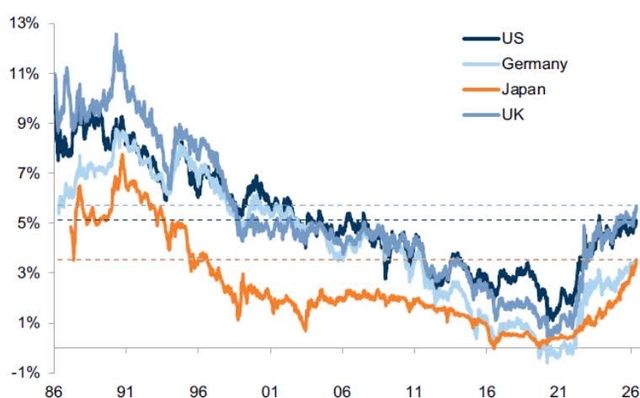
Line chart: Comparison of interest rates or yields across US, Germany, Japan, and UK from 1986 to 2026.

Source: Goldman Sachs Global Investment Research

Now fast forward to 2026, and take another look at the chart above. As you can see, much has since changed. 10-year govies yield 2.83% in Japan as these lines are written, 3.35% in Germany, 4.98% in USA and 5.28% in the UK. And households seeking a fixed mortgage or corporate borrowers looking for long-term working capital pay a great deal more than that.

If you wish to fix the loan for, say, 30 years, the cost is even higher, and I have noted that the Japanese government has to pay even more (3.90%) than the German (3.67%). Money is no longer cheap – not even in Japan. And, if anyone thinks that’s high, I remember conditions in the late 1970s and early 1980s, when I paid 18% interest on my first mortgage.

What is happening?

The U.S. military action in the Middle East is seen by many as the primary reason bond yields are suddenly so much higher. The war has admittedly led to significant energy supply problems because of the closure of the Strait of Hormuz, and this has indeed led to inflationary pressures, which have affected bond yields.

Having said that, the war in the Middle East is far from the whole story, and neither should you follow Trump and blame Ukraine for the high diesel prices. The real reason is multi-faceted. I can think of at least seven reasons why bond yields are on the rise – in no particular order:

  • The war in the Middle East.
  • Ukraine’s sustained attacks on Russian refining capacity.
  • A sovereign debt feast.
  • A higher term premium.
  • Higher corporate borrowing needs, as the hyperscalers continue their massive capex spending programmes.
  • The diminished hedge value of bonds (60/40 portfolios don’t work at present).
  • A shortage of savings when compared to robust investments (when demand exceeds supply, the price goes up).

In my book, reason #3 above – the inclination amongst sovereigns to take on more and more debt – stands out as the primary reason why bond investors are getting cold feet.

As you know, the largest financial markets are in North America, Asia (Japan) and Europe. Now, look at Exhibit 2, and see where government debt-to-GDP is highest. 30 years ago, debt-to-GDP in Japan was 90%. It is now 200%. In the U.S., it was 65%. It is now 135%. Get my point?

Exhibit 2: Government debt-to-GDP by country
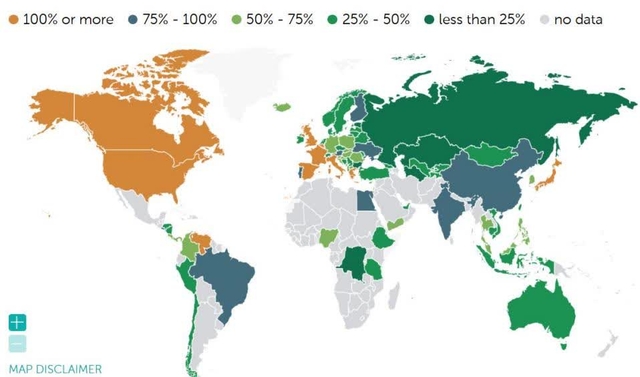
Data map: World map showing percentage ranges by country.

Source: IMF

Further exploring the link between debt and bond yields

There is definitely a link between government debt and bond yields; however, it is not 1:1. The best example of that is Japan, the most indebted country in the world. What

makes Japan unusual is its virtual independence of foreign investors – virtually all Japanese government bonds are placed domestically. That is not the case in North America, nor in Europe.

If you compare Japan to Germany, you can see how that affects bond yields. As mentioned earlier, government debt-to-GDP in Japan is 200%, whereas in Germany it is 65%; however, despite the massive difference, bond yields are broadly the same (give or take). Therefore there, must be other reasons why bond yields differ from (DM) country to (DM) country. Less reliance on foreign investors cannot be the only reason. In no particular order, I can think of several reasons:

  • diverging economic growth patterns;
  • different inflation expectations;
  • dissimilar savings ratios;
  • varying investor confidence in the central banks in question;
  • contrasting policy programmes in those central bank; and
  • different credibility of the currencies in question.

How are higher rates likely to affect GDP growth?

GDP growth is quite obviously negatively affected by rising interest rates, and three GDP components are affected more than anything else:

1. Residential property:

Demand for residential housing cools when interest rates rise, mostly because mortgages become more expensive.

2. Discretionary consumer spending:

Discretionary consumer spending is affected by higher interest rates, mainly because credit-financed demand for durable goods, e.g. motor vehicles, falls.

3. Business investments:

Corporate investments slow when interest rates rise, as companies devote a larger share of revenues to servicing existing debt. This problem is amplified if/when existing debt must be refinanced at a higher rate.

Of those three, #1 has historically been the most important in percentage terms; however, #2 and #3 are both considerably bigger than #1 in terms of share of GDP, i.e. none of the three should be ignored. Furthermore, there is in fact a factor #4 as well. When bond yields rise, it becomes more expensive to service and/or to refinance existing debt. That component is particularly painful for Japan at present due to the country’s high debt levels.

Exhibit 3: Cum. % effect on GDP growth from a 100 bps rise in interest rates
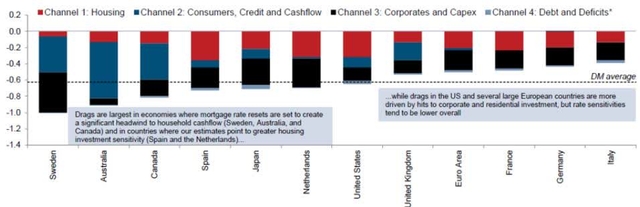
Bar chart: Stacked bar chart of financial channels across countries compared to DM average.

Source: Goldman Sachs Global Investment Research

The cumulative effect on the average OECD country is about -0.6% – i.e. a rise of 100 basis points in interest rates should slow OECD GDP growth by approx. 0.6%; however, as you can see in Exhibit 3, the variation from country to country is meaningful.

Final few words

Bond yields have risen more in the U.S. than elsewhere, and much of the reason for that can probably be explained by Exhibit 4 below. Government debt has indeed risen almost everywhere; however, in the U.S., unlike in most other countries, policy makers have, in recent years, allowed debt to grow (much) faster than GDP.

Exhibit 4: Government debt vs. GDP on USA
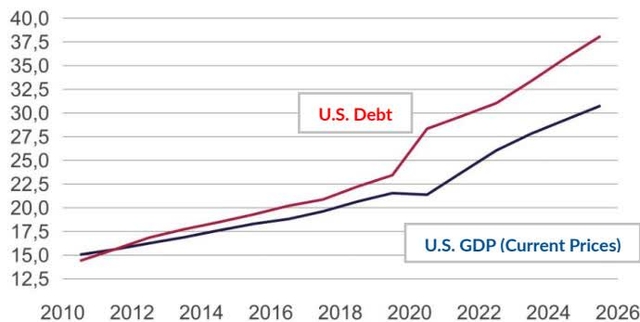
Line chart: Comparison of U.S. Debt and U.S. GDP (Current Prices) from 2010 to 2025.

Sources: Macrobond, Berlingske

Now, after 10+ years of allowing that to happen, investors have started to bark, and the impact has been noticeable. The biggest question of them all is probably how that will affect the appetite for continued growth in capex spending amongst the U.S. hyperscalers as they, almost singlehandedly, drive the U.S. economy and the U.S. stock market at present. If only I knew the answer to that question…

Niels


© Absolute Return Partners LLP 2026. Registered in England No. OC303480. Authorised and Regulated by the Financial Conduct Authority. Registered Office: 3rd Floor, 45 Albemarle Street, Mayfair, London W1S 4JL, UK

Important Notice

YOU MAY ALSO LIKE

Stock Yards Bancorp, Inc. (SYBT) Presents at 2026 Hovde Group Financial Services Conference – Slideshow

Wembanyama has career night with 52 points, 24 rebounds, 8 blocks in Spurs' win – ESPN

This material has been prepared by Absolute Return Partners LLP (ARP). ARP is authorised and regulated by the Financial Conduct Authority in the United Kingdom. It is provided for information purposes, is intended for your use only and does not constitute an invitation or offer to subscribe for or purchase any of the products or services mentioned. The information provided is not intended to provide a sufficient basis on which to make an investment decision. Information and opinions presented in this material have been obtained or derived from sources believed by ARP to be reliable, but ARP makes no representation as to their accuracy or completeness. ARP accepts no liability for any loss arising from the use of this material. The results referred to in this document are not a guide to the future performance of ARP. The value of investments can go down as well as up and the implementation of the approach described does not guarantee positive performance. Any reference to potential asset allocation and potential returns do not represent and should not be interpreted as projections.

Absolute Return Partners LLP is a London based thematic investment manager committed to megatrend investing. We aim to benefit from long term thematic trends including Climate Change, the Era of Disruption, Last Stages of the Debt Supercycle among others. You can find more information about the megatrend we invest in accordance with on our website.

We are authorised and regulated by the Financial Conduct Authority in the UK.

Visit www. arpinvestments. com to learn more about us.


Original Post

Editor’s Note: The summary bullets for this article were chosen by Seeking Alpha editors.

Credit: Source link

ShareTweetSendSharePin

Related Posts

Stock Yards Bancorp, Inc. (SYBT) Presents at 2026 Hovde Group Financial Services Conference – Slideshow
Market & News

Stock Yards Bancorp, Inc. (SYBT) Presents at 2026 Hovde Group Financial Services Conference – Slideshow

November 5, 2026
Wembanyama has career night with 52 points, 24 rebounds, 8 blocks in Spurs' win – ESPN
Market & News

Wembanyama has career night with 52 points, 24 rebounds, 8 blocks in Spurs' win – ESPN

November 5, 2026
Pennsylvania reports 6th measles-associated death – The Washington Post
Market & News

Pennsylvania reports 6th measles-associated death – The Washington Post

November 5, 2026
Joby Aviation, Inc. (JOBY) Q3 2026 Earnings Call Transcript
Market & News

Joby Aviation, Inc. (JOBY) Q3 2026 Earnings Call Transcript

November 5, 2026

Leave a Reply Cancel reply

Your email address will not be published. Required fields are marked *

Search

No Result
View All Result
Columbia Sportswear Company 2026 Q3 – Results – Earnings Call Presentation (NASDAQ:COLM) 2026-10-29

Columbia Sportswear Company 2026 Q3 – Results – Earnings Call Presentation (NASDAQ:COLM) 2026-10-29

October 29, 2026
Ferrovial: This Toll Road Operator Is Still Expensive

Ferrovial: This Toll Road Operator Is Still Expensive

October 29, 2026
Powerlattice Raises M in Equity Offering, SEC Filing Shows – Unite.AI

Powerlattice Raises $86M in Equity Offering, SEC Filing Shows – Unite.AI

October 30, 2026

About

Learn more

Our Services

Legal

Privacy Policy

Terms of Use

Bloggers

Learn more

Article Links

Contact

Advertise

Ask us anything

©2020- TradePoint.io - All rights reserved!

Tradepoint.io, being just a publishing and technology platform, is not a registered broker-dealer or investment adviser. So we do not provide investment advice. Rather, brokerage services are provided to clients of Tradepoint.io by independent SEC-registered broker-dealers and members of FINRA/SIPC. Every form of investing carries some risk and past performance is not a guarantee of future results. “Tradepoint.io“, “Instant Investing” and “My Trading Tools” are registered trademarks of Apperbuild, LLC.

This website is operated by Apperbuild, LLC. We have no link to any brokerage firm and we do not provide investment advice. Every information and resource we provide is solely for the education of our readers. © 2020 Apperbuild, LLC. All rights reserved.

No Result
View All Result
  • Main
  • AI & Technology
  • Stock Charts
  • Market & News
  • Business
  • Finance Tips
  • Trade Tube
  • Blog
  • Shop

© 2023 - TradePoint.io - All Rights Reserved!